
Whose idea was it to put letters in math?
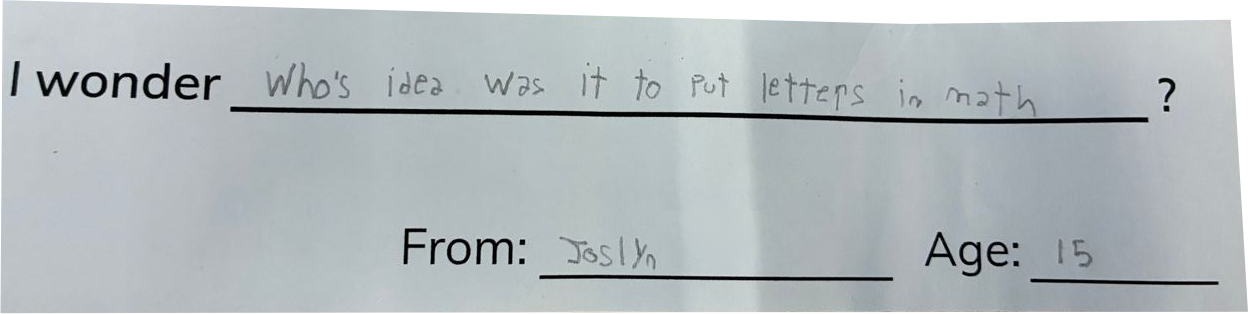
“I wonder whose idea it was to put letters in math??” — Joslyn, age 15
Excellent question! Like most old ideas, we’re unfortunately not going to be able to say with certainty who first had this one, but we can look at some earliest known examples of mathematical writing that featured letters in various ways. One of the big references on this topic is Florian Cajori’s two-volume work, A History of Mathematical Notation. Cajori kicked off his second volume (published in 1929) with a section called “Letters Representing Magnitudes,” so we’ll start there.
Letters standing in for numbers
Cajori starts by looking at the way some ancient Greek mathematicians and philosophers used letters to represent quantities. Here is his (translated) example from Physics, a work by Aristotle (384-322 BCE):
“If A is what moves, B what is being moved, and Γ the distance over which it was moved, and Δ the time during which it was moved, then the same force A, in the same time could move half of B twice as far as Γ, or also in half the time Δ exactly as far as Γ.”
In the course of your studies, you may have at some point seen capital letters like A, B, and C used to represent points and then two-letter “words” like AB to represent the line segment between the points A and B. This style was prominent in the Elements by Euclid (c. 300 BCE).
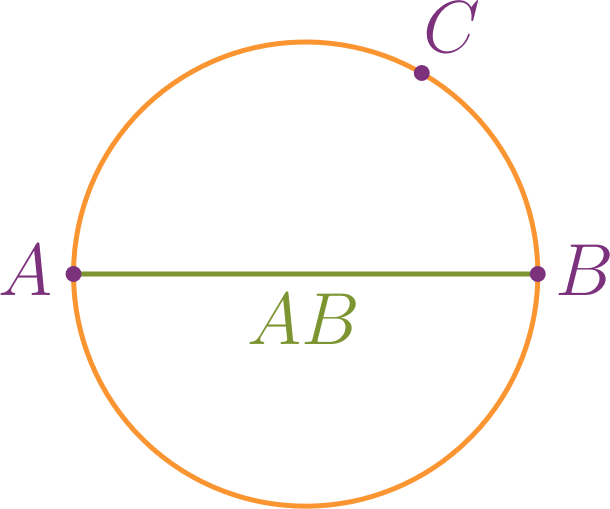
Euclid would sometimes also represent a segment as a single letter, using either his single-letter or double-letter to represent a length. Of course, Euclid used Greek letters, but his works were often later translated to instead use the Latin alphabet, as you’re probably more accustomed to.
Aristotle, though he had some misconceptions about force, velocity, and acceleration, was attempting to describe a relationship between force, mass, distance, and time. Euclid was providing a way index numbers he had referred to and later compare them or do arithmetic with them. (“Remember the length we were calling AB? Well, it’s the same length as CD joined with EF.”) Both were using letters to help fix in mind some sort of general quantity that we can then reason about without having to pin down its exact value.
Solving for x
When we think about “letters in math,” however, what most of us probably think of are unknown quantities we need to use algebra to solve for in terms of one another. They’re still stand-ins for quantities, but how we use them feels pretty different.
When we solve for x in an expression like 3x = x+4 or x²-5x+6 = 0, we start by thinking of x as a general placeholder for a number and then use algebraic reasoning to pin down what possible values it could have that lead to these equations being true. From the start, we treat x as though we expect it to secretly have had some specific value (or values) all along.
While the processes of algebraic reasoning were outlined in Al-Khwarizmi’s influential text Al-Jabr, even numbers were written out as words, so we can recognize it conceptually as a work on “solving for x” even though it doesn’t present its variables as letters. This might seem a little surprising, since it was written around 820 CE, long after ancient Greek mathematicians like Diophantus had produced work that made extensive use of shorthand and symbols.
As Al-Khwarizmi’s work made its way to Europe, letters were again used to represent quantities, but often without symbols for operations and in a narrative form. In many works, instead of writing something like “A+B,” authors would instead introduce a new letter like C to be the sum of A and B, which could make reading mathematical arguments harder. If the point of good notation is to make complicated ideas easier to read, then this particular use of letters was definitely a step backward!
An early pioneer in representing unknowns as letters was Benedetto of Florence, who would use up to 5 variables to solve linear equations, as he did in the 1463 manuscript below:
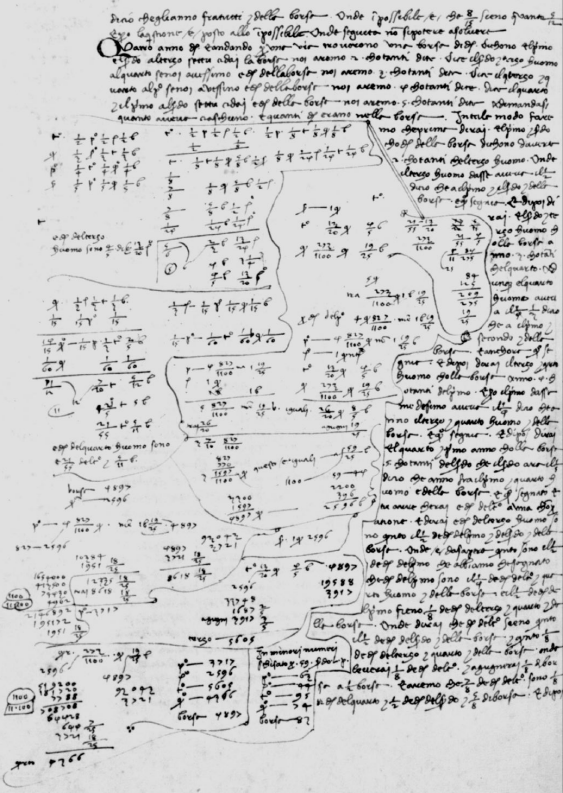
A page from Benedetto’s Trattato d’aritmetica praticha (via Jens Høyrup)
Benedetto supplemented his symbolic calculations with verbal calculations, perhaps indicating he thought the latter might be more accessible when he was writing. It’s not clear whether he invented this symbolic style of algebra or learned it elsewhere, but he seemed to understand that he was early to the party.
Most sources recognize François Viète and René Descartes as the two main figures in the development of symbolic algebra. It now feels quaint that Viète prescribed using vowels for unknowns and consonants for constants in 1591, but this seems to have been an early (if not first) attempt at systematizing the roles to which letters are assigned.

Excerpt from Viète’s In artem analyticem isagoge (via archive.org)
Descartes departed from this in 1637 by prescribing letters from the beginning of the alphabet as constants and letters from the end as variables.
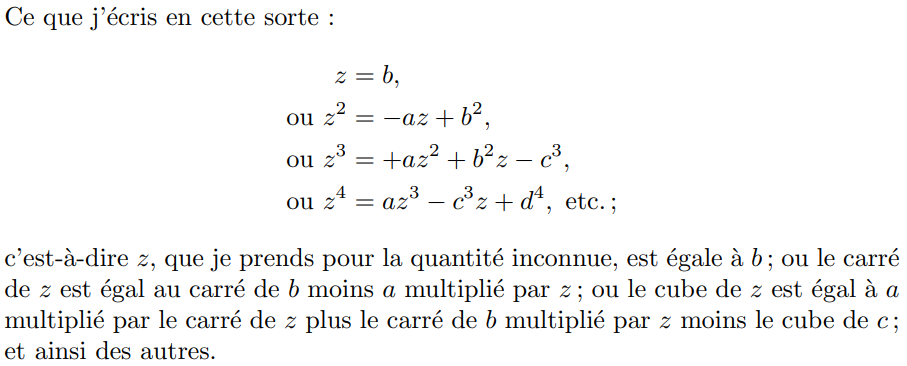
Excerpt from Descartes’ La géométrie (via Project Gutenberg)
As you can see, Descartes was also writing polynomial equations as we recognize them today. His work was so influential that our tradition of using x, y, and z for the first three variables we solve for comes to us from Descartes!