
Math in… Orange Peels
When you eat an orange or other citrus fruit, how do you peel it? Do you first cut it into wedges, removing the peel from each wedge, or do you peel the entire orange? If you peel the whole orange, do you tear the peel off in little chunks or do you try to remove it as a single piece?
Image: stevepb (via Pixabay)
If you’ve tried to remove a peel as a single piece, what shape did you end up with? My approach is to dig my thumb into any old spot on the orange and then pull on the peel, ripping it into whatever shape it wants to form.
If you try to peel as neatly as possible, however, you might try to tear so that the peel is unraveled in a single piece with uniform width. What shape would that peel have it you laid it flat on a table?
Image: Ivan S (via Pexels)
In an article for the Mathematical Intelligencer titled Orange Peels and Fresnel Integrals, Laurent Bartholdi and André Henriques answered exactly this question, finding it creates a sort of two-armed spiral. In their framing of the problem, they take the orange to have radius 1 and remove the peel in a single strip of width 1/N. Below is their example for N = 3.
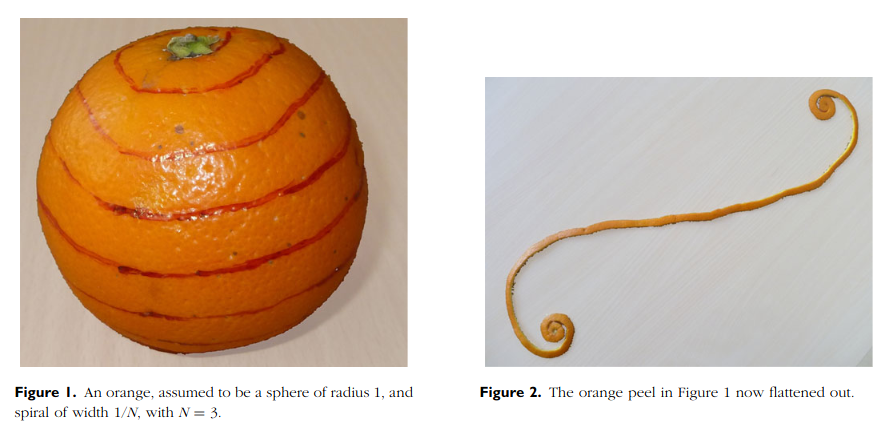
Image from the article by Bartholdi and Henriques.
Since half the circumference of this sphere of radius 1 is π, we’ll end up seeing the the spiral pass around Nπ times, so about 9.42 times in the image above corresponding to N = 3.
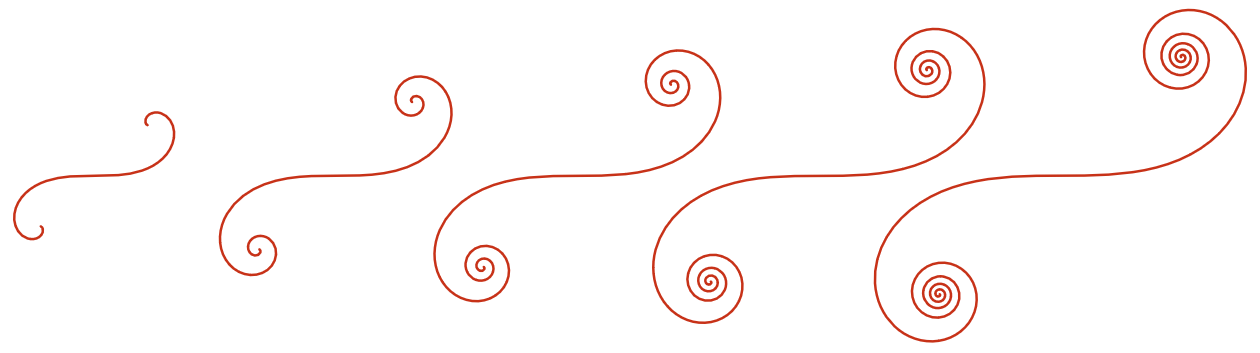
As N gets larger, the peel strip gets thinner. However, since the area of the peel stays the same, a thinner peel must be longer. Here is the curve running down the middle of the peel strip that we would see for N = 1, 2, 3, 4, 5:
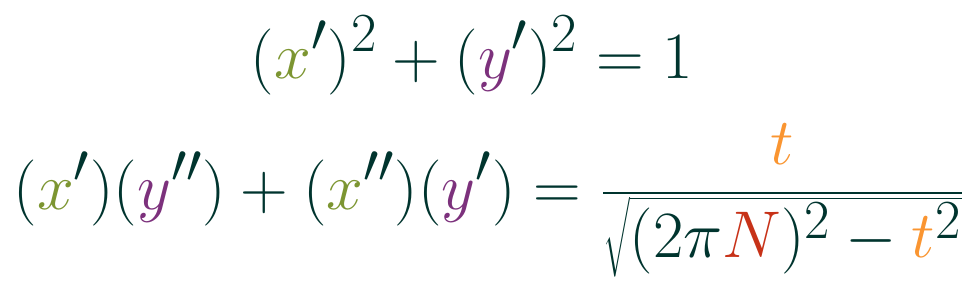
But what are these curves? Bartholdi and Henriques were able to derive differential equations that a curve (x(t),y(t)) would satisfy if parametrized in the plane with constant unit velocity and maintaining the local curvatures it would have on the surface of the sphere:
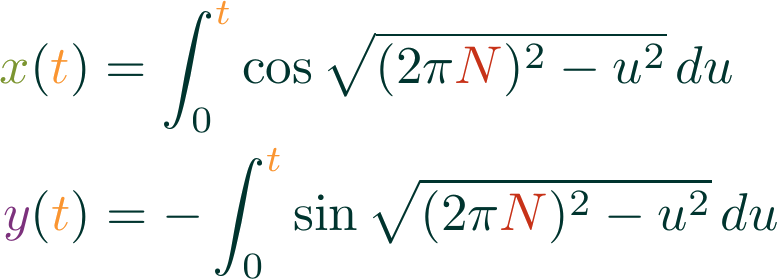
They then solved this system to find the coordinates are given by functions that can be expressed as integrals:
As N gets large and the strip gets thin, the spirals become better and better approximations for an Euler spiral, a curve whose curvature changes proportionately to its length. Here’s an approximation to the Euler spiral for N = 50, zooming in on the upper right arm:
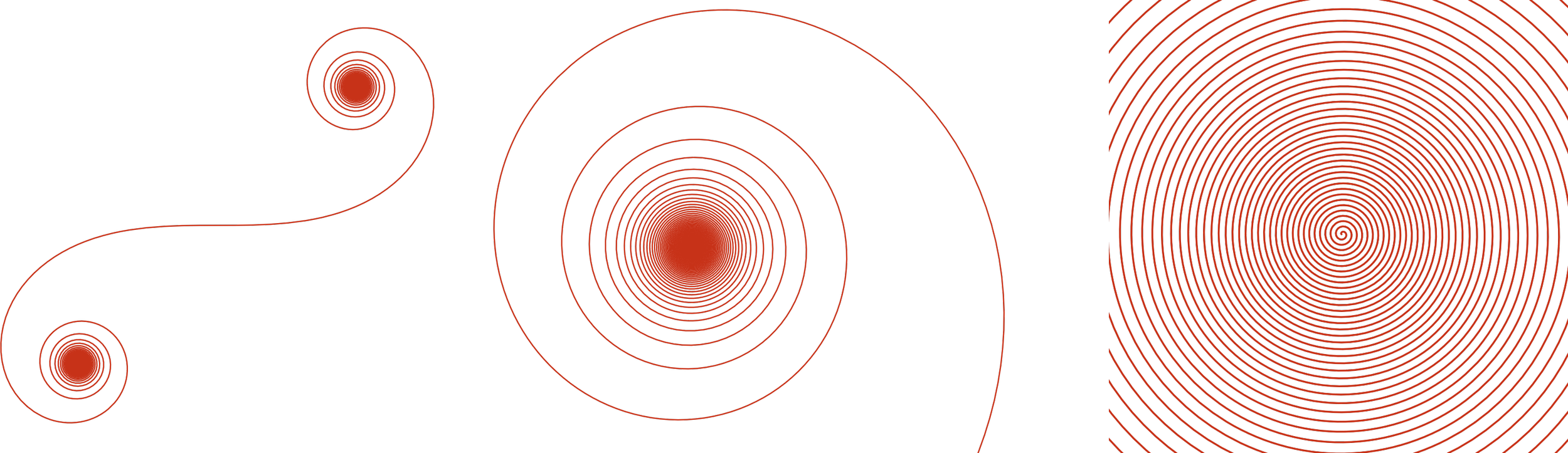
As you can see, since there is a narrow but positive width of 1/50 to the peel strip, our spiral curve is long but eventually terminates after getting quite dense. The theoretical Euler spiral keeps spiraling closer to that point it appears to be circling!
If you want to see the full derivation of this orange peel curve, read Orange Peels and Fresnel Integrals for the details.
In what other ways might peeling an orange be mathematical?