
Parent Ninja Move: Make Story Time Double as Math Time
Meet Guest Author Erin Wahler-Cleveland! Erin is an experienced educator and founder of Roots and Wings Math. Holding a Master’s degree in Teaching Mathematics and bringing over 19 years of teaching and leadership experience, Erin works with parents and schools to design engaging strategies that empower every child to build a strong math foundation.

We’re delighted to feature Erin in this month’s Talking Math! She joins us as a special guest author for both this month and August to share how any story time can double as a fun math discovery.
Like many parents, I’ve absorbed the message about the importance of early literacy—starting with the simple, powerful advice to read to your kids. But when it comes to math, what does it mean to “do math” with our young children?
As an often-overwhelmed parent of two little ones, I’m all for anything that accomplishes two goals at once—especially when it actually deepens the experience rather than diluting it.
Enter the parent ninja move: using story time to also spark early math interactions. EFM publishes books that make this connection explicit, but I will boldly claim that you can create math moments in any book your child loves. What follows is a specific example from our home.
From Bedtime Story to Math Discovery
My daughters, ages 2 and 5, go through lots of fads - sound familiar? They want to eat the same snack every day until suddenly, it falls out of favor and we are on to the next new favorite (and I try to figure out how to not waste the last third of the Costco-sized box for whatever it was). The same thing happens with bedtime books.
Recently, Janelle (5 years old) went through a period of fandom for a very cute book called Ten Little Ladybugs by Melanie Girth. It had languished on the shelf for years, and all of a sudden she picked it up and wanted to read it every night for close to two weeks.
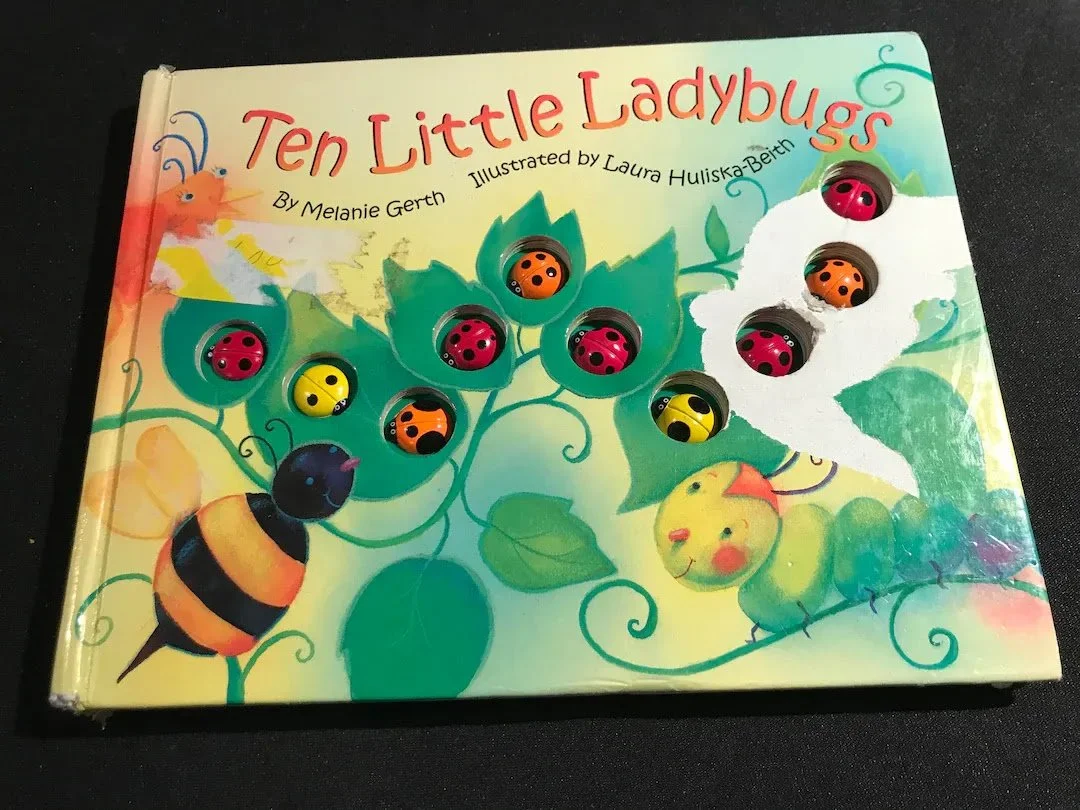
Not having seen this book for a while, I was excited about its potential for an easy early math entry point with my younger daughter, Jonylah (Jo-NYE-lah, 2 years old at the time).
Janelle’s counting and early numeracy skills are well beyond counting up to and back from 10, but Jonylah is at the perfect stage for interacting with the number sequence going backwards.
But Janelle had picked this book, and her book picks are sacred, so off we went reading Ten Little Ladybugs bedtime after bedtime.
Maybe ten days into this streak, she stopped on a page and asked:
“How many spots are on the ladybugs?”
What a delightful mathematical question, and a beautiful opportunity to capitalize on Janelle’s natural curiosity! I strongly believe these moments are best—when a child asks the question themselves, there’s an internal motivation to figure out the answer. My job is to help with any skills she needs to learn on the journey to answering her question.
Janelle went with an approach of counting one-by-one. It’s not very often we’ve stumbled upon a natural opportunity to count so high, and it was fascinating to watch. About halfway through I managed to get a video started. Take 30 seconds to watch.
Did you catch when she said “twenty-nine, twenty-ten” and then stopped to correct herself? And when she lost track of her count in the thirties, and ended up getting off by one on the second-to-last ladybug? She counted 41; my count looking back at the page is 42. Despite this mistake, let’s look at some of the early numeracy skills going on here.
The Learning Behind the Ladybugs
This is a great demonstration of one-to-one correspondence (the principle that we say one count for each individual object), and how it’s tougher to keep track of a count when the thing you’re counting is randomly arranged.
Janelle also shows us that she has a grasp of the principle of cardinality—when she finishes her count, she reiterates that there are 41. This developmental milestone typically happens in the 3-5 age range. Children who haven’t yet reached this understanding will restart their count if you ask them how many objects there are, even if they’ve just finished counting.
This is one of those skills that feels beyond obvious in adulthood—I doubt any of us remember what it’s like to not yet have mastered this principle! Yet cardinality marks a significant step in mathematical learning and is a prerequisite for understanding the operations of addition and subtraction.
In my Roots and Wings Math newsletters, I share family and school math moments like this frequently. If you're a parent of a young child, I'd love to have you subscribe to my parent newsletter. If you're an educator, sign up for my my educator newsletter here. Happy math-ing!