
Math in… Spider Webs
It’s spider season in Seattle! In late summer, I started encountering more and more spider webs on my walks around the neighborhood. There are even a few spiders that like to build webs right by my door.
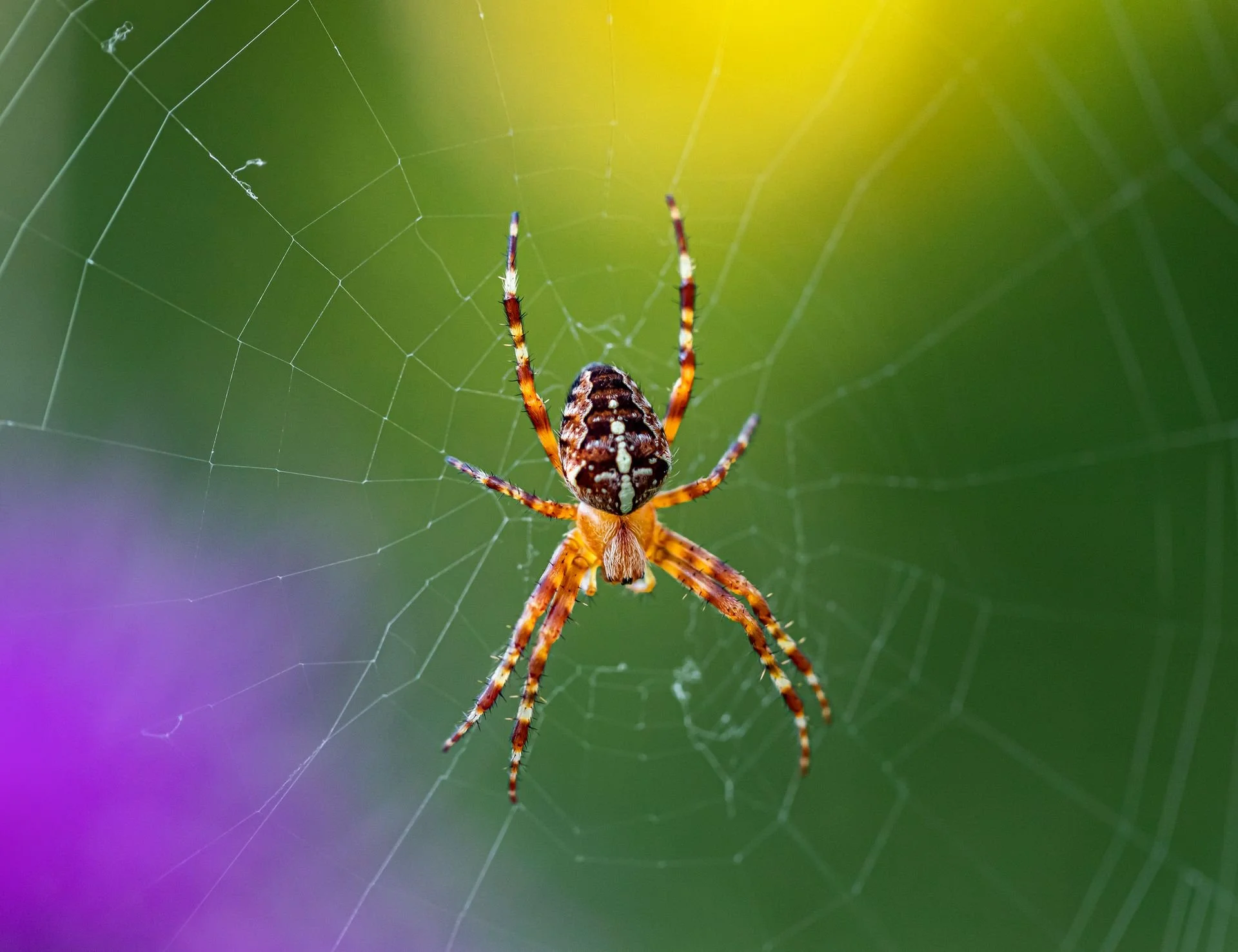
A cross orb weaver on its web. (Image: Erik Karits, via Pexels.)
I try not to walk through them, since I don’t like to destroy anyone’s hard work. When I do accidentally tear down a spider web, however, I often find it rebuilt that very same day. They’ve got this down to a science! But how do they do it?
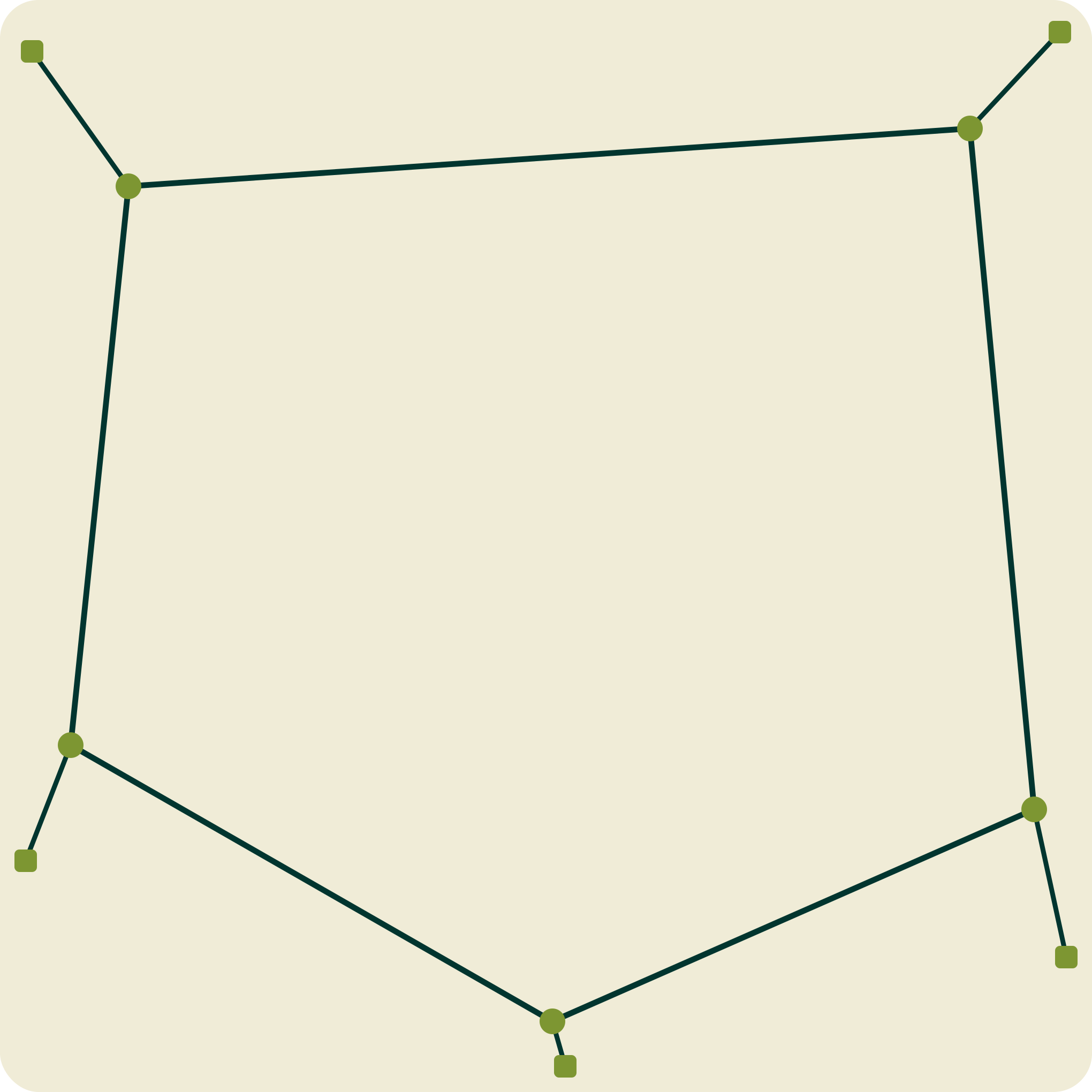
When a spider starts its web, it does so a little haphazardly. It starts by releasing a light bit of silk that catches the wind and travels, the other end still connected to the spider. Once the silk hits something nearby and sticks, the spider crawls along it and reinforces it into a stronger strand. The spider uses these to build out a rough frame anchored to things like tree branches, houses, and fences.
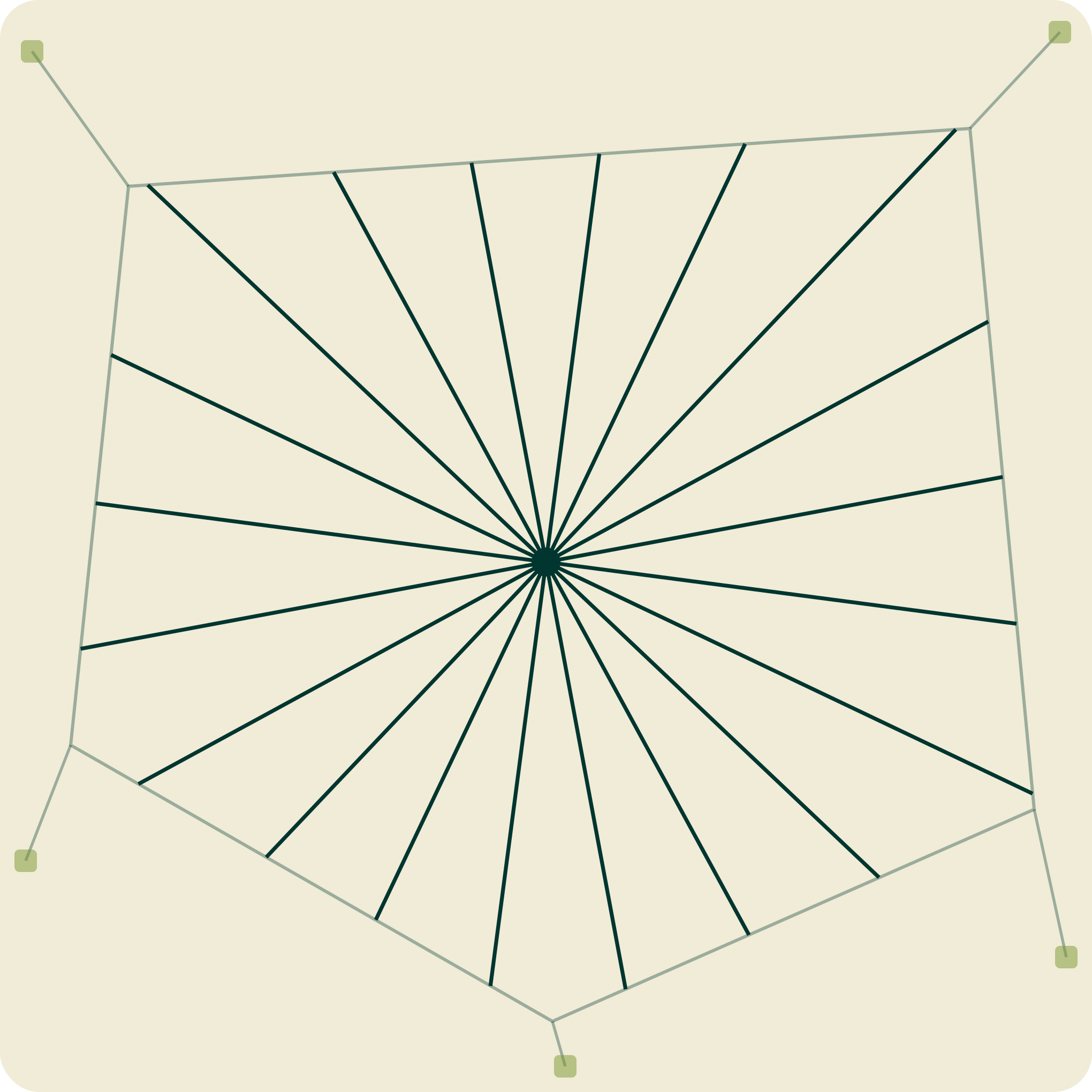
The spider then begins building radial spokes in this frame, all meeting at a point that will be the web’s center.
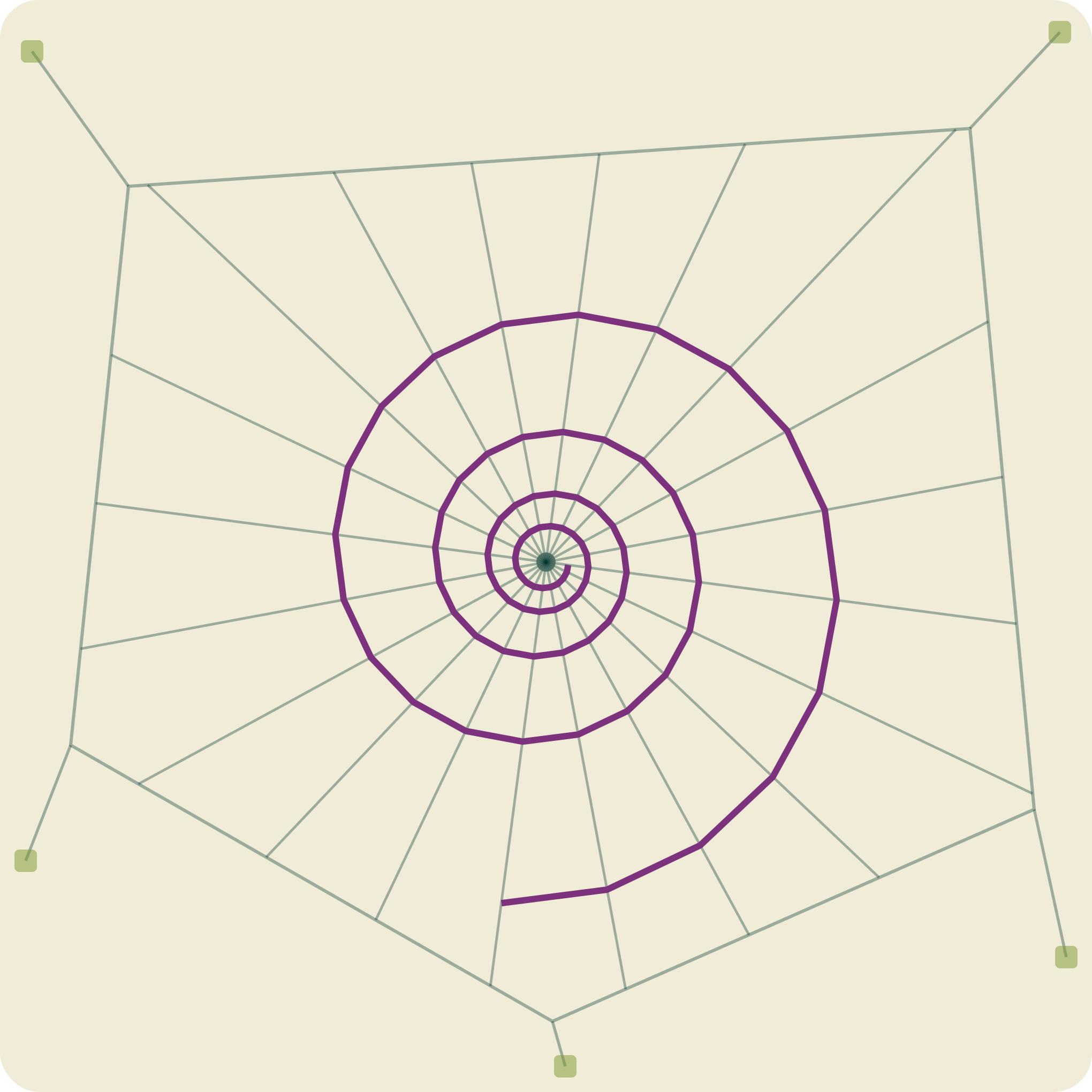
It then makes an auxiliary spiral, spiraling outward from the center, with the spiral arm gap widening as the spider gets farther from the center. The silk used for this is strong but not sticky, since it’s just for support.
The spider switches to producing sticky silk and begins creating a tighter capture spiral from the outside in. This time the spacing between spiral arms is more uniform, because this spiral is acts as the insect net and can’t be so gappy. If the frame’s shape is irregular, the spider may reverse direction from clockwise to counterclockwise or vice versa to fill out more of the frame.
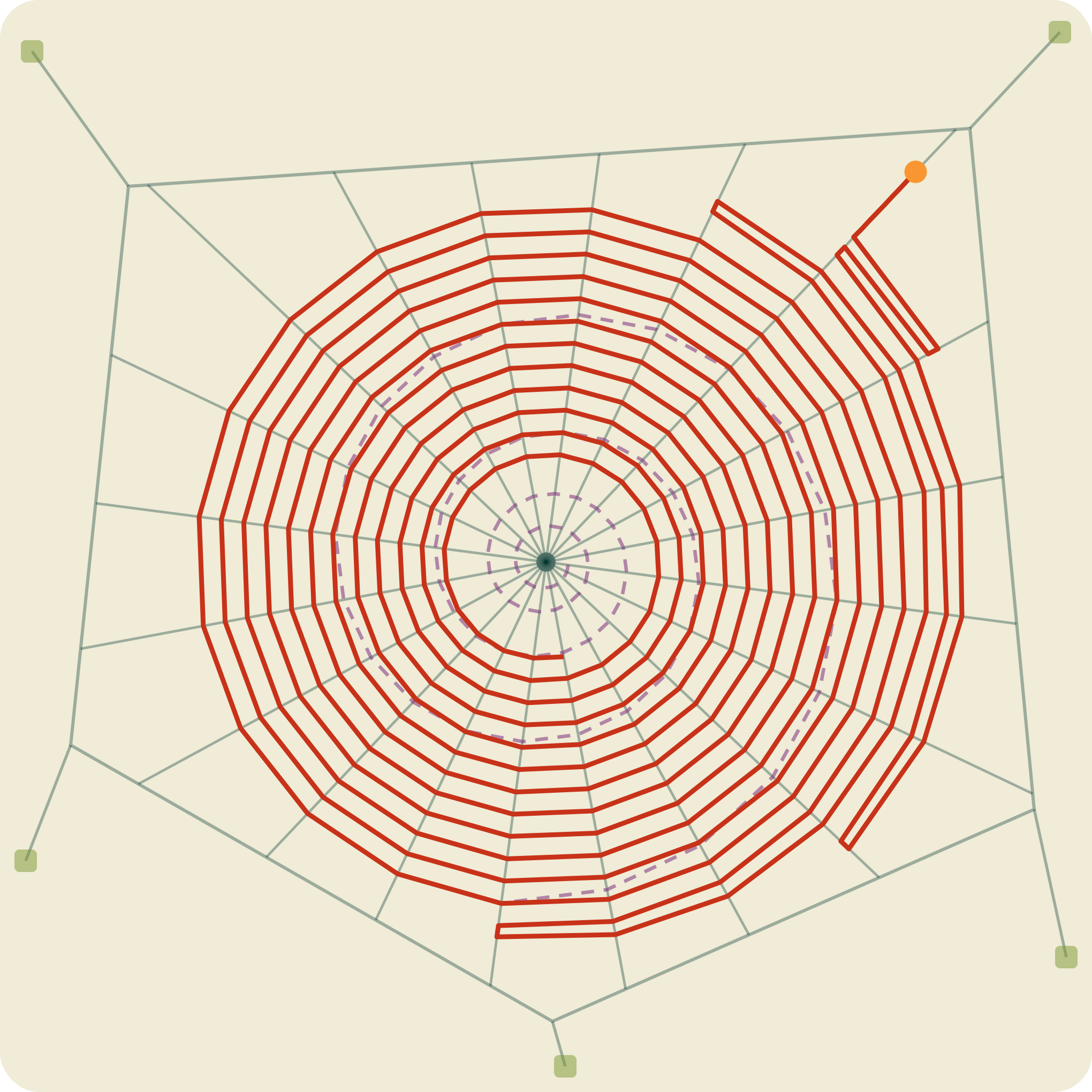
When building the capture spiral, the spider will remove the auxiliary spiral as it goes along, either letting it fall to the ground or eating it for its protein content. Many orb weavers, like the ones in my yard, will actually eat their webs and rebuild them each day. (I hadn’t known that before researching, but it makes me feel a little less bad the times I accidentally walk through their webs!)
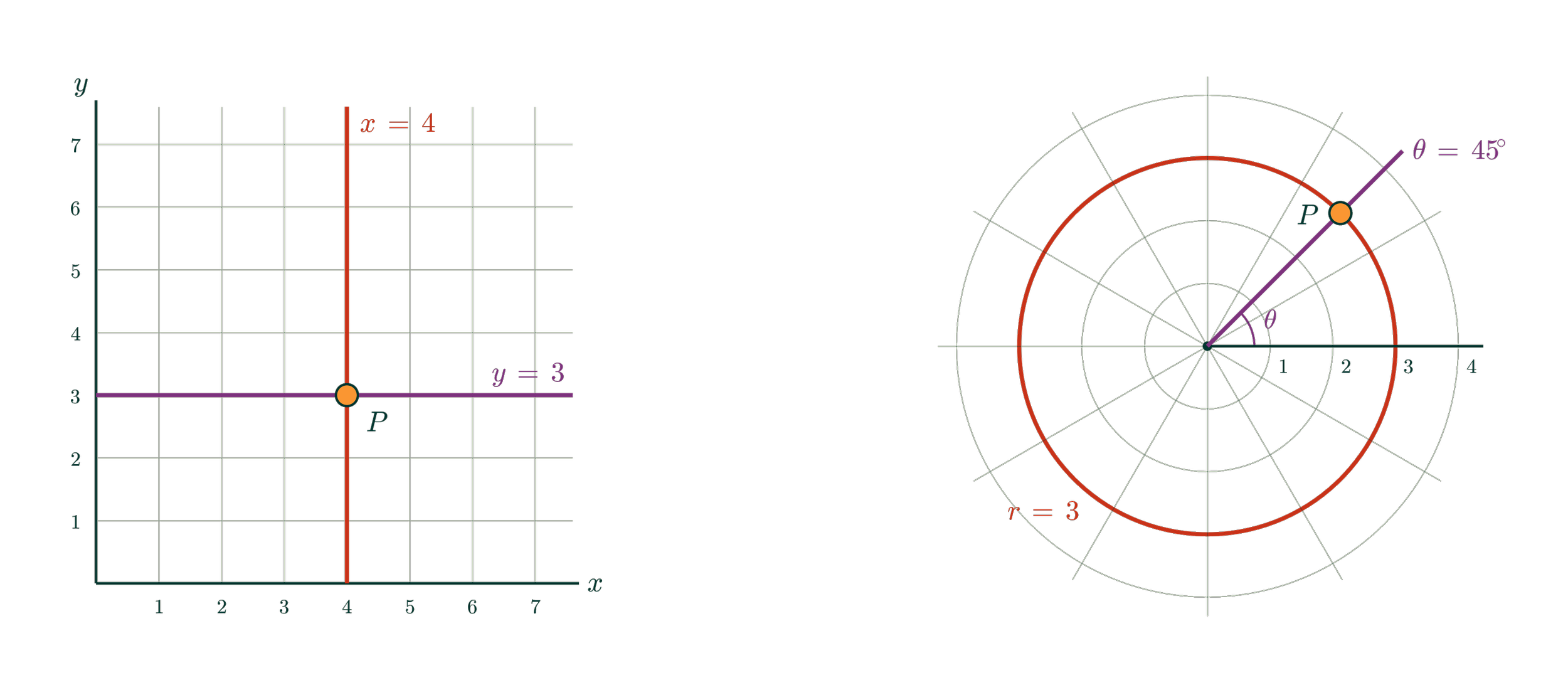
Since spider webs have centers, radial spokes, and roughly circular features, we can think about them in polar coordinates. In polar coordinates, we define points via their radius (distance from the origin) and angle their radial lines make with the positive \(x\)-axis.
While the coordinate curves providing the gridding of the Cartesian plane are vertical and horizontal lines, the coordinate curves in a polar coordinate system are circles centered at the origin and rays extending from the origin:
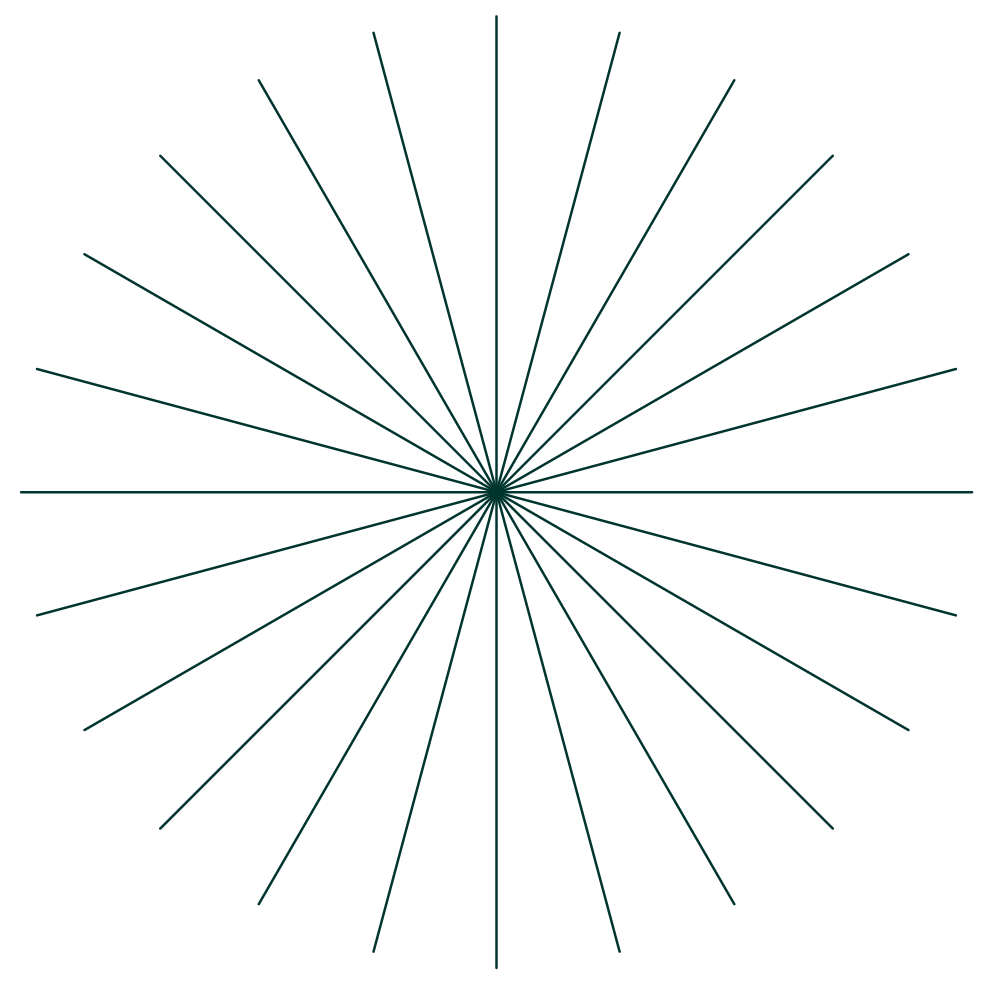
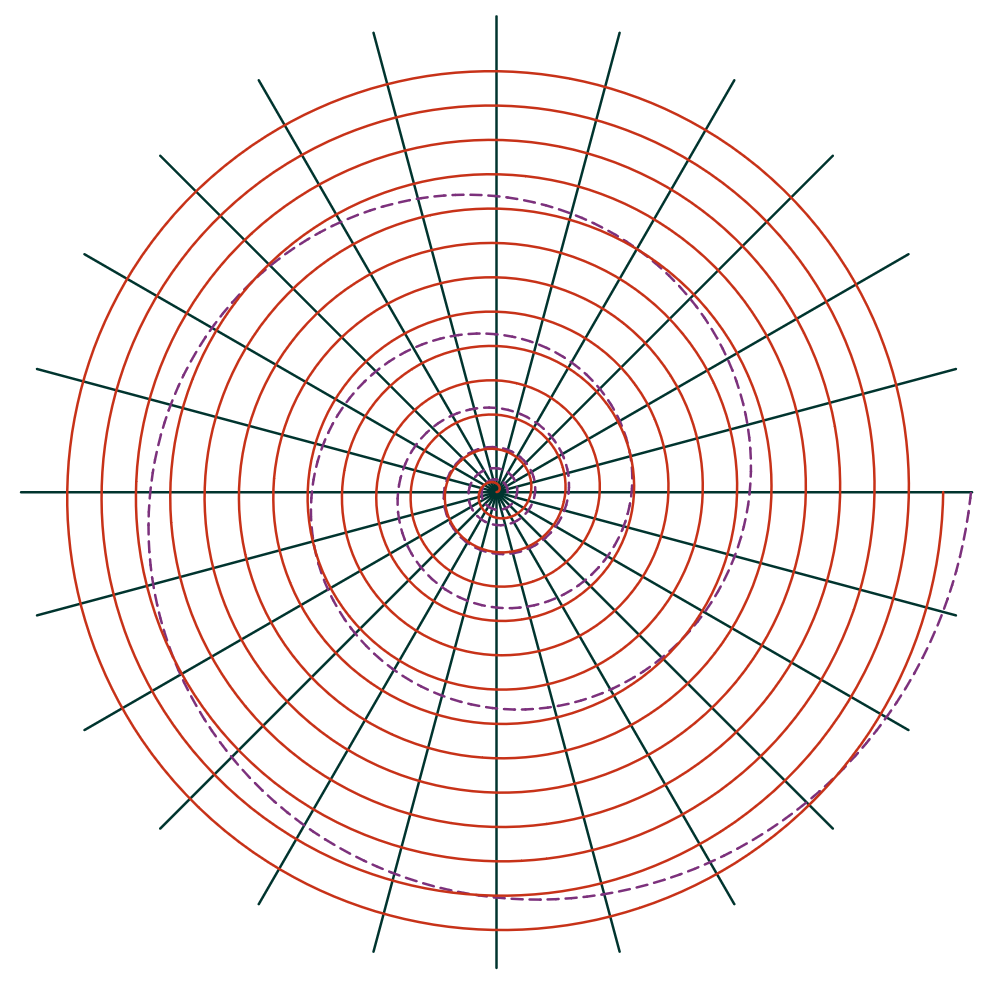
In a spider’s web, we can think of the center as the origin and the radial spokes as the coordinate rays for some set of angles. Here I chose to spread the rays apart by \(15^\circ\):
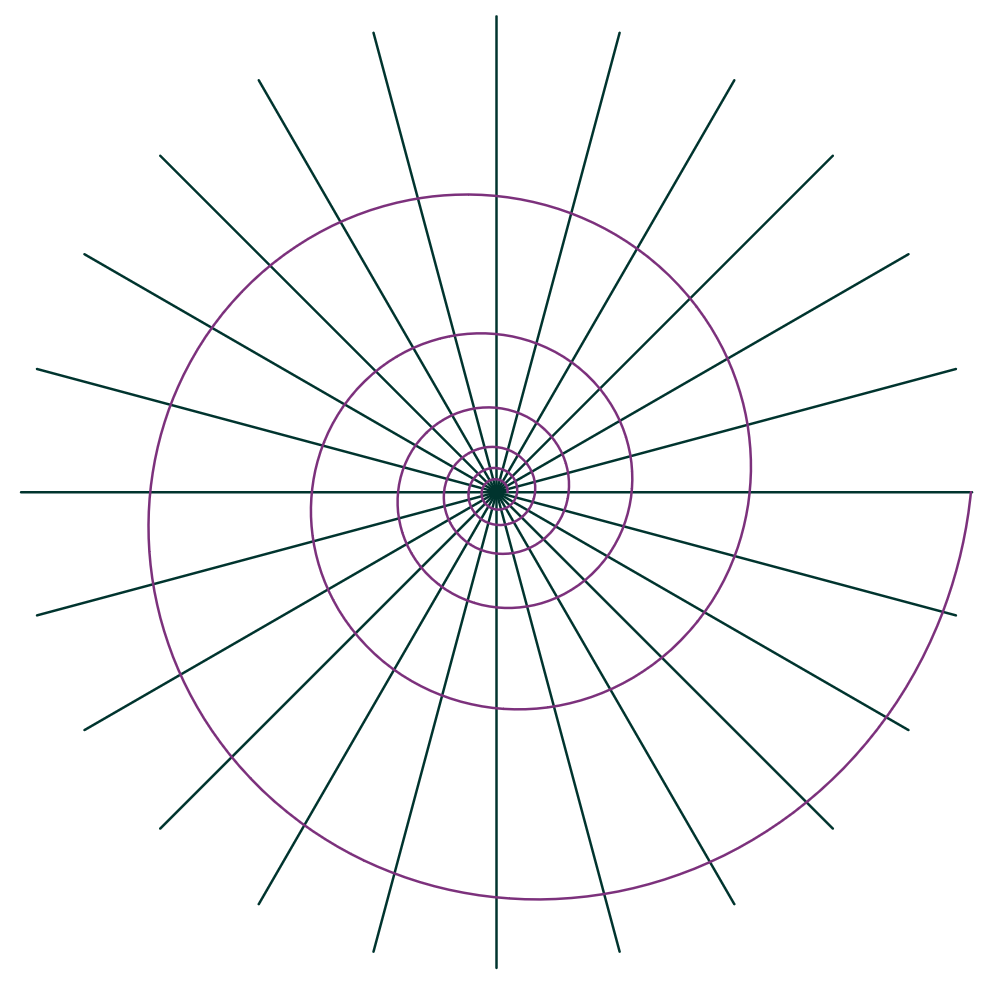
The auxiliary spiral is tough to judge, but I’ve seen a number of sources say it’s a logarithmic spiral. A logarithmic spiral is self-similar in the sense that incremental scalings will just give us the exact same spiral. If a spider tries to create the same angle between the auxiliary spiral and the radial spokes over and over, then the result would look like a logarithmic spiral. I don’t know if that’s what the spider is actually doing, but it seems like a reasonable enough theory. Here I used \(r = 2e^{\theta/10}\) for my logarithmic spiral:
The capture spiral is very well approximated by an arithmetic (or Archimedean) spiral. An arithmetic spiral has equation \(r = a+b\theta\), meaning when the spider does a lap around the center starting at \(\theta_1\) and ending at \(\theta_2 = \theta_1+2\pi\), its distance from the origin will have been \(r_1 = a+b\theta_1\) at the start of the lap and \(r_2 = a+b(\theta_1+2\pi)\) at the end. The net distance it has moved outward from the center of its web would then be
\[ r_2 - r_1 = (a+b(\theta_1+2\pi)) - (a+b\theta_1) = 2\pi b \]
Since this gives the same \(2\pi b\) value for any consecutive laps no matter where the spider is in making its spiral, we get uniform radial gaps throughout the entire web, which makes for a net insects are less likely to slip through. Here I used \(r = \theta\) for my arithmetic spiral:
Like anything we model in nature, it’s hard to tell if we are coming up with a nice mathematical approximation of a natural process or if nature has evolved creatures that have approximately mathematical behavior!
If you want to see this web-making strategy in action, check out this video from BBC Earth to watch a real-life spider weave its web!
What other creatures build things in mathy ways?

