
“Are there any mathematicians from Colombia?”
Thanks for your question, Elena! There are many mathematicians from Colombia. Let’s meet a couple.
Tatiana Toro
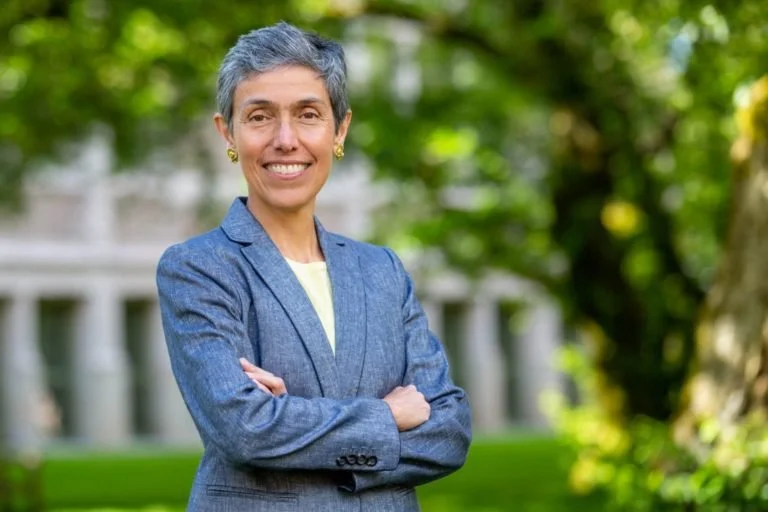
Tatiana Toro (Source: msri.org, via the Wayback Machine)
Tatiana Toro was born in Bogotá. After earning her bachelor’s degree at National University of Colombia, she came to the US and completed her PhD at Stanford. She’s currently serving as the director of the Simons Laufer Mathematical Sciences Institute (formerly MSRI), but her regular position is in the math department at UW Seattle!
Her areas of expertise are geometric measure theory, harmonic analysis and partial differential equations. A major theme in her work is a concept called harmonic measure. If you set a particle loose inside a region, moving randomly, how likely is it to first hit each part of the boundary? On a flat or smooth boundary, the hits are spread out in a regular, predictable way when you zoom in close. On a jagged boundary, spikes can shield the crevices between them, so some parts get hit much less often than others. Much of Dr. Toro’s work focuses on how well this intuition works in reverse: if the pattern of hits looks like what you’d expect from a flat or smooth surface, must the boundary itself be flat or smooth? It turns out that the answer is often yes for the right interpretation of “flatness” or “smoothness.”
You can learn more about Dr. Toro in her own words in her MAA Math Values testimonio.
Federico Ardila

Federico Ardila (Source: Jason Henry, via Quanta Magazine)
Also from Bogotá, Federico Ardila earned both his bachelor’s and doctoral degrees from MIT. When he’s not teaching and researching at Queen Mary University of London, he moonlights as a club DJ.
Dr. Ardila’s main mathematical focus is on the combinatorics of matroids, structures that generalize the notions of linear independence and dimension. His research explores connections between geometry and combinatorics, using geometry to better understand counting problems and combinatorics to better understand geometric problems. With Graham Denham and June Huh, he resolved conjectures from the 1980s about the behavior of h-vectors (certain number sequences that arise in the study of matroids), showing that the numbers increase and decrease smoothly, with a single peak. His work connects to other fields, from the geometry of evolutionary trees in biology to efficient ways to move robotic arms.
You can learn more about Dr. Ardila in this 2017 interview with Quanta Magazine.
Have you met any mathematicians from Colombia? Where else do mathematicians come from?

