
Snowboarding season is starting soon across the Pacific Northwest. If you’ve ever watched a snowboarding competition, you’ve likely seen a lot of different moves with a lot of different names! And some of the names get pretty goofy, like stalefish, air to fakie, or triple cork.
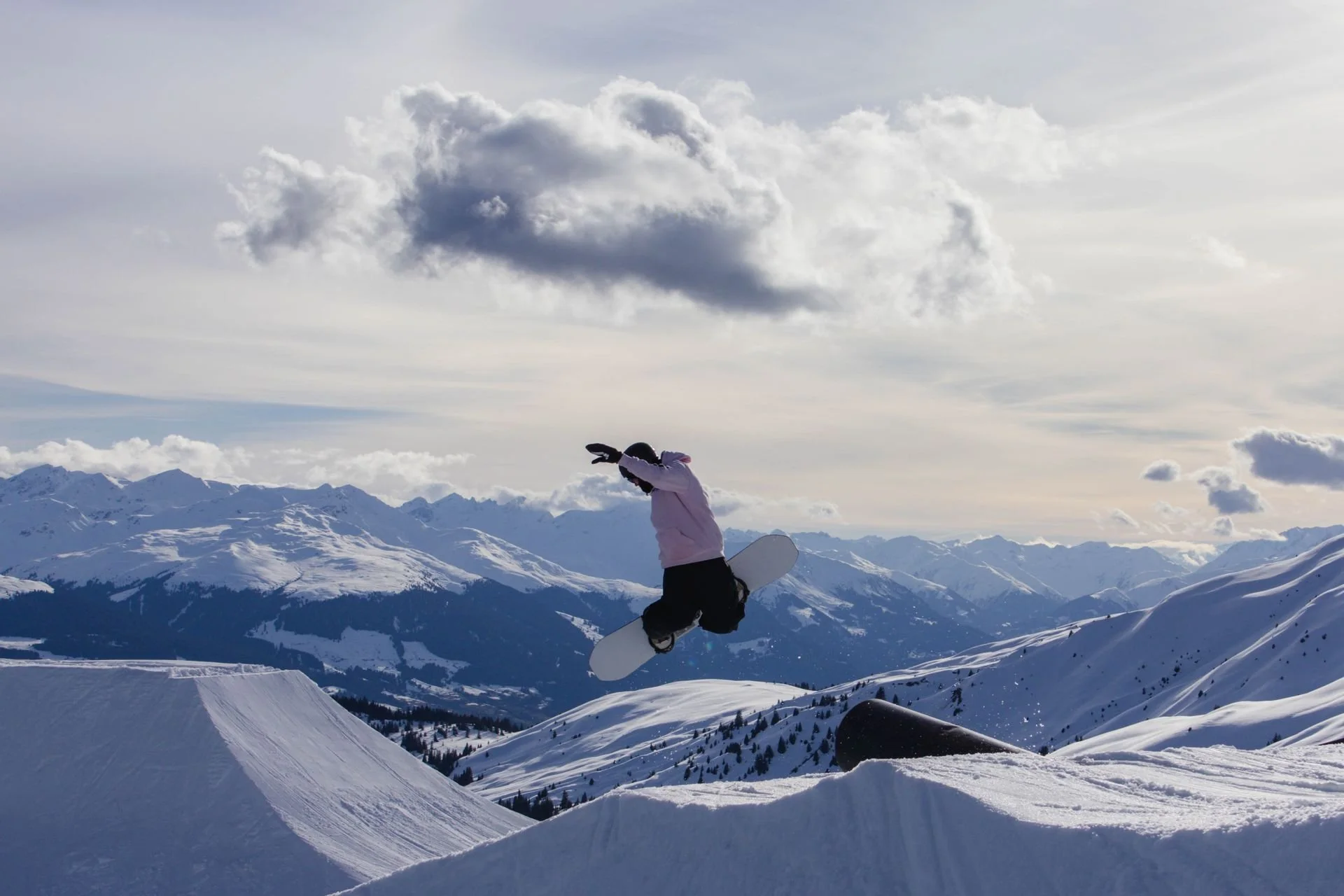
A snowboarder mid-air. (Image: Esther Höfling, via Pexels.)
While there are a lot of different elements to these tricks like grabs and stances, a lot of the tricks in Big Air events involve the rider rotating mid-air in a variety of ways.
If you’ve seen a number attached to a trick, like a backside 180 or a frontside misty 720, it refers to the angle the board rotates when viewed from above. That number will be a multiple of 180, since the rider will want to land with their board parallel to the direction of motion to continue riding smoothly. In particular, it will be some number of half-rotations, with a half-rotation corresponding to \(180^\circ\). To find the number of rotations, divide the number in the trick by 360, since \(360^\circ\) is one full rotation. For example, with the frontside misty 720 we get \(720/360 = 2\), so there are two full rotations with the board pointing the same direction at touchdown as it did at takeoff. For a backside cork 540, we find \(540/360 = 1.5\), so the board will turn one and a half times, pointing in the opposite direction after landing.
Frontside (FS) or backside (BS) tells you about which direction the rider is turning when rotating the board. If the rider spins in the direction that puts their face forward after rotating \(90^\circ\), it’s frontside. With a regular stance (left foot forward), frontside is a clockwise spin. With a goofy stance (right foot forward), frontside is a counterclockwise spin. Similarly, backside is when the player spins so their back points in the direction of motion \(90^\circ\) into the spin, and whether that’s clockwise or counterclockwise depends on the stance. A rider will tend to prefer one stance over another, which is their natural stance. The other stance for them will be switch or fakie.
Along with board spins, the rider can also invert, which is when their head dips below their center of mass. You’d likely recognize an inversions as the parts of a trick where the rider appears upside down or has their board above their head. One type of basic inversion is a cartwheel maneuver. When the cartwheel is done as a forward flip (board nose going down, tail coming up), it’s called a wildcat. When it is done as a backward flip, it’s called a tamedog. (A lot of snowboarding conventions follow this convention of opposite name for opposite side or direction!) Another type of basic inversion maneuver is when the rider somersaults perpendicular to the direction of motion. This is called a barrel roll and can be done as a frontflip or backflip.
In big air events, most tricks will involve a combination of rotations and inversions. The rotations will still be counted as though looking at the board from above and the inversions will be counted based on number of times the head dips below the center of mass. Most inversions have a “style,” like cork, misty, or rodeo. If you see a name like frontside rodeo 540, then it will have a single inversion with \(1.5\) board rotations. Adding double, triple, quad (for quadruple), and so on to the name tells you the number of inversions if it’s more than one. A backside double cork 1080 has three full spins and two inversions, for example.
It’s a lot easier to see these tricks than to read about them, so I vibe-coded an app you can use to experiment. There’s a little jank to it, but it should get the ideas across. Choose a trick or build your own and look at it from different vantage points by click-dragging in the viewport or selecting preset.
The side view should give you a sense for the inversions, along with the alert that appears in the upper left corner. The top view is good to look at when counting spins, as is the angle gauge in the upper right. If you switch to follow rider, you might get a better sense of what the board nose and rider’s head are doing around the rider’s center of mass. By default, I have idealized checked, which tweaks things so the board is horizontal at both takeoff and landing. (If you want it to be a little more realistic, uncheck that.) If the number of spins in a trick is an integer, then the board’s nose trace will form a closed loop in the idealized follow rider view. If it’s a half-integer, the loop won’t close, but the board’s tail will end where the nose began, which you’ll see by noting the board’s tail meets the start of the nose trace.
Something else to notice is that this model works by composing rotation matrices \(R_x\), \(R_y\), and \(R_z\), each corresponding to rotation by some input angle around the \(x-\), \(y-\), and \(z-\) axes, respectively. In terms of basic tricks, \(R_z\) corresponds to frontside and backside spins, \(R_y\) to wildcat and tamedog flips, and \(R_x\) to barrel rolls. You can see how they’re getting combined for each trick in the description sidebar.
Where else can you find math in winter sports?

