Is math a science?
“Is math a science?” — Shelley and Shaleena
That’s a thorny question! My short answer is “no,” and I think most mathematicians would agree, so let’s look at why.
What is a discipline?
Part of what makes this question thorny is that disciplines grow, evolve, and fracture into new disciplines.
In 1962, Purdue became the first university in America to form a dedicated computer science department. Before then, there were certainly things happening in math, physics, and electrical engineering departments across the country that we would recognize as “computer science.” The work Charles Babbage and Ada Lovelace did in the 1800s is something we also retroactively call “computer science.”
When was it, then, that computer science became a discipline? At some point there was a critical mass of ideas having enough in common with each other and enough in contrast with the disciplines they came from that it was worth clustering them together as “computer science.” That might seem a little arbitrary, since the disciplines like math, history, or music feel like they have always existed, but they’re really just ways that we’ve grouped similar-enough ideas, and we refine those groupings as we have more ideas. At some point, I suspect computer science will feel similarly “etched in stone.”
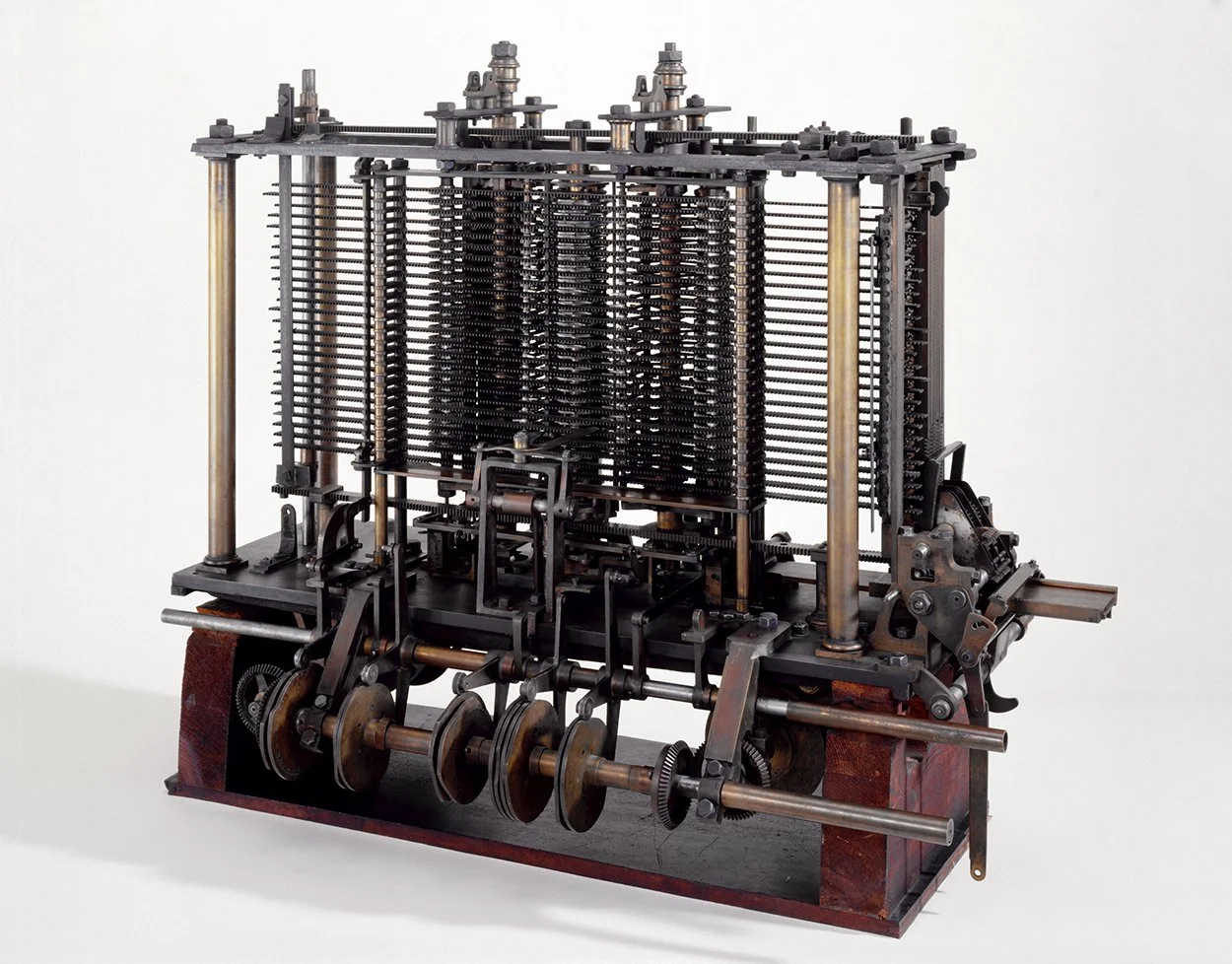
Charles Babbage’s Analytical Engine, conceived in 1834. (Image: John Cummings, via Wikimedia.)
When one discipline splits off from another, the borders we draw between them can remain pretty blurry. One of the Millennium Prize Problems (a list of open math problems each with an offered $1,000,000 prize for a solution) is to resolve whether problems whose solutions can be verified in polynomial time can actually also be solved in polynomial time. This is one of the most important problems one could ask about the nature of algorithms, so its resolution has huge implications for the field of computer science. However, its resolution requires mathematical rigor, so its place is on that blurry border between math and computer science we typically call theoretical computer science.
What is science?
People have been seeing patterns in how and seeking explanations for why things work the way they do for all of human history. A lot of understandings involved supernatural explanations for natural things. An early offshoot was the discipline of natural philosophy, which sought to provide natural explanations for natural phenomena. This distinction was articulated by the ancient Greek philosophers, but the idea of natural philosophy stuck around for a long time.
I think I first encountered the term when reading a biography of Isaac Newton, which called him a natural philosopher instead of a scientist. While most of us learn about Newton’s work on calculus, motion, gravity, and light, if you dig a little deeper, you’ll find that he wrote prolifically on alchemy and did not really seem to distinguish this from what we would now see as his more scientific endeavors.
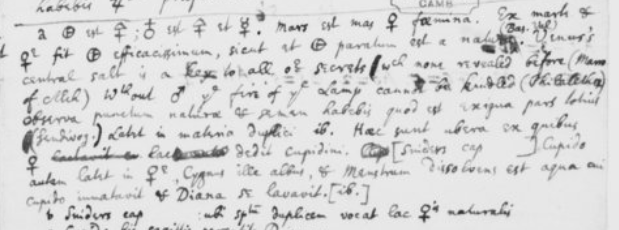
Some of Newton’s alchemical writings. (Source: Chymistry of Isaac Newton.)
To a modern eye, natural philosophy was a grab-bag discipline. Alchemy straddles the line between real chemistry and magical thinking. Claims like “heavy objects fall faster” or “the sun orbits the earth” could stand uncontested for millennia. But the field also made room for what we would now recognize as good scientific practice. Ibn al-Haytham’s Book of Optics, written in the early 11th century, was an example of a work in natural philosophy that founded its claims on evidence produced through careful experimentation. Like any discipline, natural philosophy just represented a useful grouping of ideas as people understood them in their time.
As with computer science, it’s hard to pin down exactly when science became a distinct discipline. For centuries, some ideas in natural philosophy continued to come purely from thought experiments and deduction while others came from testing nature and trying to match theories to empirical evidence, as in al-Haytham’s work. As people became more invested in measurement and using the language of mathematics to describe data from observation and experiment, the predictive power of natural philosophy grounded in both empirical evidence and reason started to outshine that of natural philosophy grounded only in reason. This shift in how people approached thinking about natural philosophy over the 16th and 17th centuries is what we now call the Scientific Revolution.
Francis Bacon articulated the importance of this interplay between experiment and reason:
“There remains simple experience which, if taken as it comes, is called accident; if sought for, experiment. But this kind of experience is no better than a broom without its band, as the saying is a mere groping, as of men in the dark, that feel all round them for the chance of finding their way, when they had much better wait for daylight, or light a candle, and then go. But the true method of experience, on the contrary, first lights the candle, and then by means of the candle shows the way; commencing as it does with experience duly ordered and digested, not bungling or erratic, and from it educing axioms, and from established axioms again new experiments; even as it was not without order and method that the divine word operated on the created mass. Let men therefore cease to wonder that the course of science is not yet wholly run, seeing that they have gone altogether astray, either leaving and abandoning experience entirely, or losing their way in it and wandering round and round as in a labyrinth. Whereas a method rightly ordered leads by an unbroken route through the woods of experience to the open ground of axioms.”
While the language is a little flowery, you might recognize this as a rough draft of the scientific method taught in schools:
Make an observation
Ask questions
Form a hypothesis
Conduct an experiment
Gather data
Develop a theory
Science evolved into a discipline whose claims must not only stand up to human reason, but must (perhaps more importantly) also stand the reality check of nature itself, broadly interpreted. While it’s not always as linear as the steps above, the goal is to get to the point where nature should tell you whether your idea is wrong. There is still a lot of deduction — it just needs to get tied back to nature at some point via experiment or existing work that is already tied to nature.
How is math not a science?
I think it’s probably easiest to answer this question by doing some mathematics. Let’s think about the odd numbers
1, 3, 5, 7, 9, 11, 13, 15, 17, 19, 21, 23, 25, …
What happens if we add them up? Well, there are infinitely many, but we can always stop somewhere:
1 + 3 = 4
1 + 3 + 5 = 9
1 + 3 + 5 + 7 = 16
1 + 3 + 5 + 7 + 9 = 25
Are you noticing what I’m noticing? Those sums are 4 = 2², 9 = 3², 16 = 4², and 25 = 5². Does that pattern continue? Let’s try some more:
1 + 3 + 5 + 7 + 9 + 11 = 36
1 + 3 + 5 + 7 + 9 + 11 + 13 = 49
1 + 3 + 5 + 7 + 9 + 11 + 13 + 15 = 64
1 + 3 + 5 + 7 + 9 + 11 + 13 + 15 + 17 = 81
So, what have we done so far? We noticed a pattern, asked if it continued, experimented, created more data, and saw that the pattern did indeed hold for more of our data. So far, we’ve done a pretty good job of adhering to the scientific method. Our theory seems to be that any time we sum all odd numbers from 1 to some point, we get a square number. We could refine that theory to say which square number results from stopping the sum at which odd number, since it looks like stopping at the nth odd number results in n². We could generate more examples and seeing the data align with our theory time and time again would make it more robust.
But is it a mathematical fact that the sum of the first n odd numbers is n²? I’m not yet satisfied that we have a mathematical fact on our hands, because I don’t yet know it’s always true. But here’s a way we can think about things. Even numbers are divisible by 2 and odd numbers are 1 more than an even number, so any odd number has the form 2k+1. Here is a visual representation of 1 through 15:

In each of these figures above, the 2 copies of k are the bright arms and 1 is a dark square. Here they are all equally bright:

And here they are nested together:
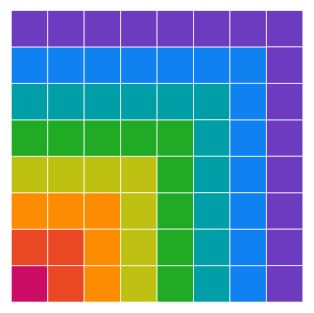
Can you see that each of our odd sums up through 1+3+5+7+9+11+13+15 is a square number? Can you see why 1+3+5+7+9+11+13+15+17 will also be?
We’re stumbling upon a logical maneuver called mathematical induction: if we know it is true that
1+3+5+…+(2n-1)=n²
then it will also be true that
1+3+5+…+(2n-1)+(2n+1)=(n+1)²
We can justify this visually:
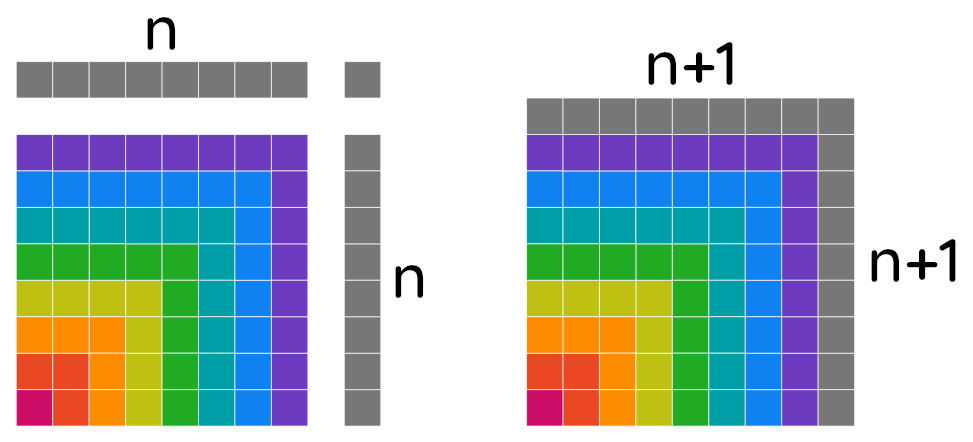
We can justify it algebraically:

Unlike with science, we’re not waiting to see if our theory stands up to scrutiny because we don’t need any further experimentation — we’ve proven beyond any shadow of a doubt that every such sum of odd numbers will produce precisely the square we predicted, since we’ve shown that if the pattern holds for some odd stopping point, it holds for the one after that, and then the one after that, and so on!
Solving a math problem comes with a level of certainty we never quite achieve in science. In science, we never really know anything absolutely — we end up with theories that nature hasn’t shown us to be false, despite our best attempts. Our scientific facts that have withstood sufficient scrutiny are true enough to be reliable for our purposes. If our understanding of currently settled science evolves, our current understanding will probably be a pretty decent approximation of whatever the new understanding turns out to be.
So, what is math?
When I was a grad student, I arrived to my assigned office to find a Trivial Pursuit card taped to the door. Paraphrasing, one of the questions on it was, “What modern discipline was invented when René Descartes connected the fields of algebra and geometry?” The answer on the back of the card was, “Mathematics.” I found it funny that a Trivial Pursuit writer felt math didn’t exist before 1637. What an oddly specific interpretation of what math is! Since this was a math department, I assumed someone else had also found it funny — enough so to tape it to a door. I don’t know if I find it funny because they chose that year, in particular, or because they thought it reasonable to choose any year.
I think there are a few principles that characterize mathematical thinking for me:
A language to describe the important objects (numbers, shapes, patterns, structures) and their relationships
A sense of abstraction that allows the objects to be untethered from the real world
A high standard of rigor for establishing truths via logical reasoning
Our exploration above dealt with odd numbers, square numbers, and sums, all standard objects in math. The problem didn’t even start with a real-world application, so it was itself a sort of abstraction, but we even further abstracted it into the frameworks of geometry and algebra, using each to supply a rigorous proof of a theorem.
When did my principles actually come together? I suspect early math had a very blurry border with early natural philosophy, whatever we might call those disciplines. The word geometry roughly translates to “earth measurement,” indicating why one might have been practicing it. It takes some nuance to see why statements like “that bird and that bird together are two birds” and “trees lose their leaves before winter” express different sorts of truths or to understand that the observation about birds reflects a more universal, abstract pattern: 1+1=2. I would guess objects and relationships were articulated first, which granted space for abstraction and rigor.
Euclid published his Elements around 300 BCE, which gave an abstract and rigorous treatment of geometry and basic number theory. Mathematicians have chased the standards he set ever since, so I’m comfortable saying that all three of my principles were there. We can definitely debate when math became abstract enough or rigorous enough or rich enough in language to be “modern” math, though. If pressed for an answer, I’d be very torn over whether that date should come much earlier or much later than 1637.
When answering “How does geometry work?” earlier this year, I looked at a sliver of the history of geometry, touching on some objects of study, abstraction, rigor, and real-world applications. I think that history serves as a decent microcosm of the history of math, more broadly. The language, abstraction, and rigor of a subfield of mathematics grow together and feed each other.
Unlike with science, I don’t think there have been any “mathematical revolutions” that have fundamentally shifted the way math is practiced by the community as a whole, but there have been shifts in attitudes about what is interesting or rigorous and trends sparked by unforeseen developments. Math results tend to stay math results unless we find an error in reasoning, so the body of knowledge has been growing since antiquity, with relatively few cuts and revisions.
So, what is math, if not a science? I’ve sometimes heard the name “formal sciences” applied to math, logic, and theoretical computer science, but the word “formal” is basically there to tip you off that these fields have a different standard in their search for truth than the scientific method. I’m fine with folks saying math is a formal science, and it makes sense that fields like math, logic, and theoretical computer science should wind up with their own category, but I really just think of them all as math!