
How does the Pythagorean theorem work?

“How does the Pythagorean theorem work?” — Samia
Great question! Let’s start with what it is and why it works.
The Pythagorean theorem and a proof
If we connect two rods of lengths a and b and flex them so they form an angle θ, then their free ends are some c distance apart. While we could measure c with a ruler, there should be a way to compute it from a, b, and θ.
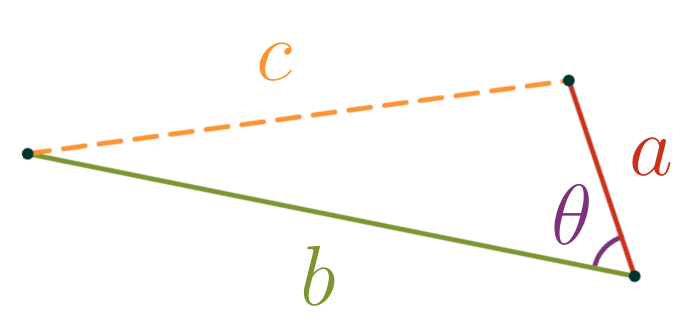
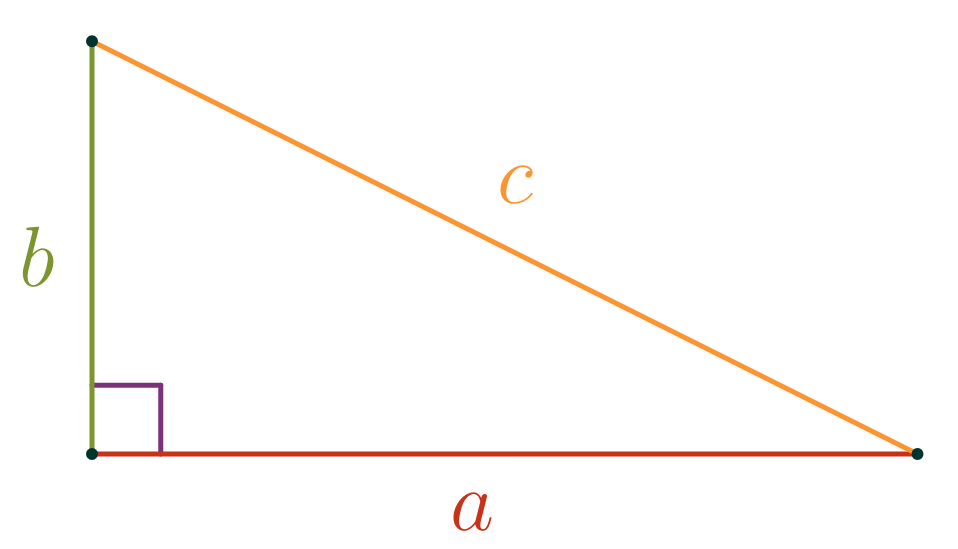
People first studied this via special cases, like when a = b or for particular angles θ. The most famous special case is the Pythagorean theorem, which answers this question when θ is a right angle:
Pythagorean theorem
If a right triangle (a triangle with a 90° angle) has side lengths a, b, and c, where c is the hypotenuse (the side opposite the 90° angle), then a² + b² = c².
There are many proofs of this theorem. My favorites are geometric rearrangements. For example, by arranging four triangles in a square as we have in the image below, we can see the white space on the left has area c² while the white space on the right has area a² + b²:
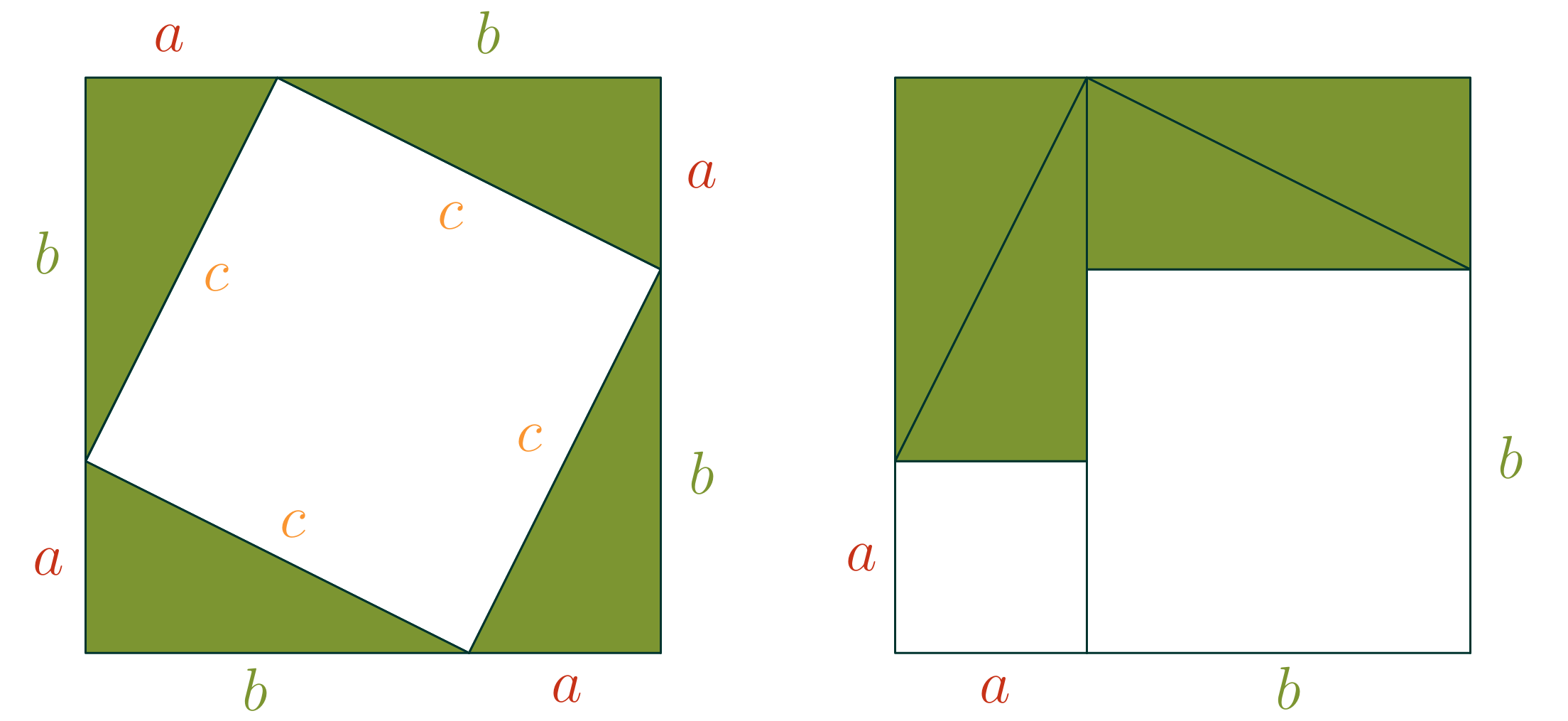
Since the white space has the same area in each, we have

To find c, we just have to take the square root of a² + b².
The distance formula
We’ll get back to non-right angles shortly, but I first want to look at the main way we use the Pythagorean theorem: computing lengths and distances.
As you study math, you’ll find that much of the work you do is in a Cartesian coordinate system. Each point has an x-coordinate and a y-coordinate that you can find in relation to an x-axis and y-axis. These axes meet at a right angle, so right angles come up frequently in the course of working with these coordinates.
If we have two points in the plane, we can find their distance apart as the length of the hypotenuse of a particular right triangle:
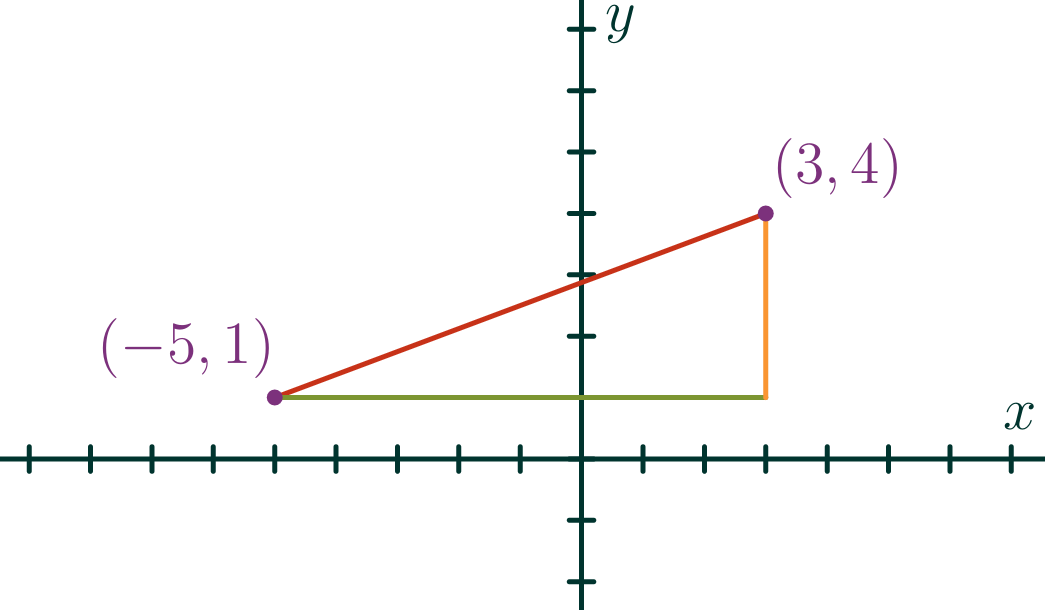
To find the distance from (-5,1) to (3,4), we want the length of the red line segment. The length of the green leg is the horizontal distance between our points:

Similarly, the length of the orange leg is the vertical distance:
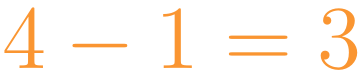
By the Pythagorean theorem, the length of the hypotenuse is then

It’s pretty common for algebra students to memorize a formula for the distance between two points in the plane:
Distance formula
The distance between the points (x₁,y₁) and (x₂,y₂) is

As we’ve seen, it’s just a special form of Pythagorean theorem, since | x₁ - x₂ | and | y₁ - y₂ | are just the lengths of our right triangle’s legs.
The neat part is that formulas like it also work in 3D. In 3-dimensional Euclidean space, the distance between two points is still the length of the line segment connecting them:
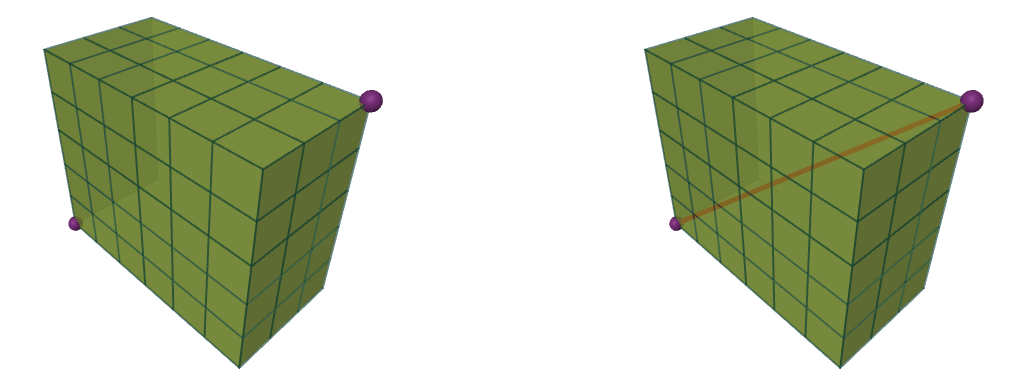
Since we’ve chosen to view these points within the grid of a Cartesian coordinate system, we can see three other lengths a, b, and c that play nicely with this grid, as labeled below:
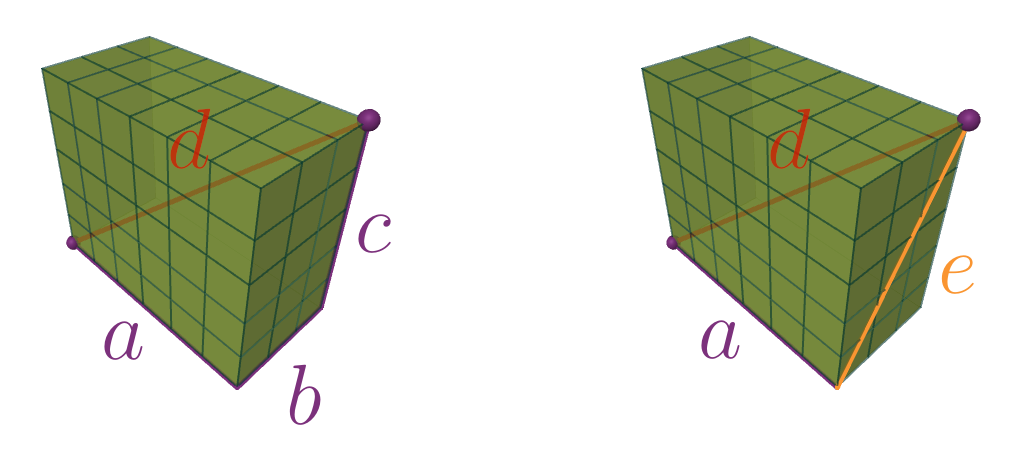
Since each face of the above rectangular prism is a rectangle, the Pythagorean theorem tells us that

It’s little tougher to make out, but that yellow diagonal actually also makes a right angle with the segment of length a, another application of the Pythagorean theorem tells us that

If we substitute b² + c² for e² in this equation, we get

a 3D version of the Pythagorean theorem. Turning this into a distance formula, the distance between (x₁,y₁,z₁) and (x₂,y₂,z₂) is

Just like applying the 2D Pythagorean theorem twice gets us a 3D distance formula, applying it three times will get us a 4D distance formula. (Good luck picturing that!) We can similarly extend the Pythagorean theorem to find distances in Euclidean spaces of any dimension.
Other angles and the law of cosines
So far we’ve focused on 90° angles. You’ve likely seen far more 90° angles in your life than any other angle, since people tend to build things boxy. If we were preoccupied with another angle (say, 60°), what would our theorem look like?
Here’s a geometric argument in the spirit of the 90° case. Below we have two arrangements of six triangles in a rhombus with 60° and 120° angles. (The yellow triangles have been flipped over while the others have only been rotated and translated.)
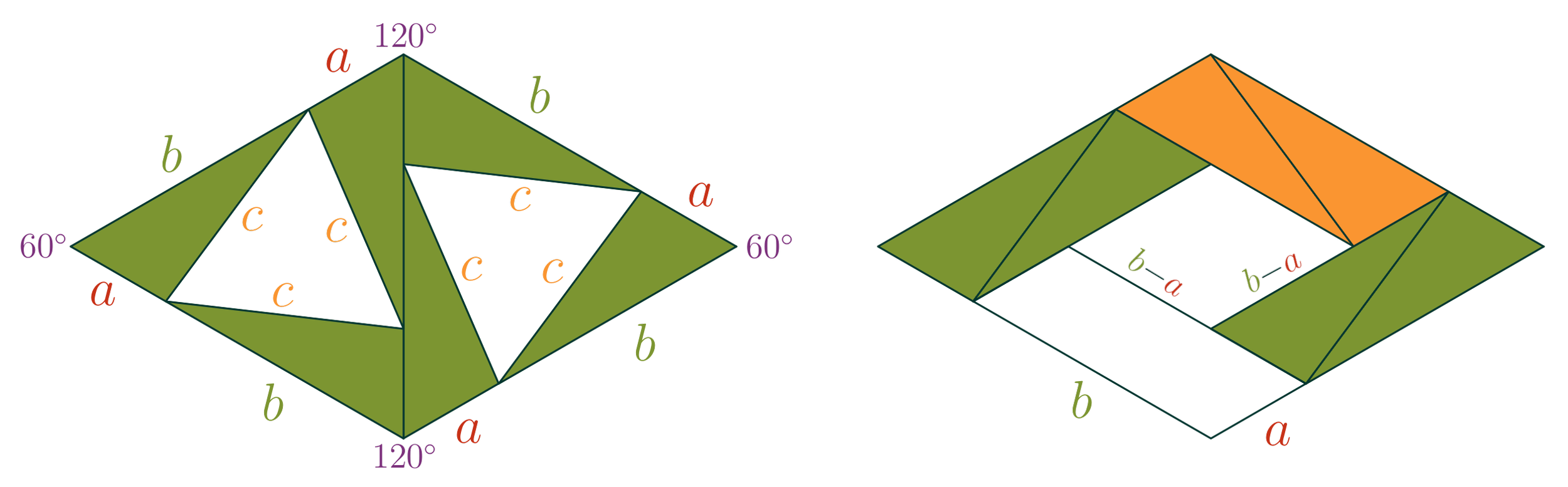
To compare the white space as before, it seems we need to find the areas. Or we could instead define the “parea” (a word I just made up, from parallelogram and area) of a 60°-120° parallelogram with side lengths a and b to be ab. While strange, parea satisfies many of the same rules area does. In fact, it’s related to area in a straightforward way:

However, parea is easier to compute than area for shapes like the ones above. It might even be the version of area we’d have settled on if we cared more about 60° angles than 90° angles! Let’s see it in action.
If we combine the two white space triangles on the left into a rhombus, it has parea c². The combined parea of the two parallelograms on the right is ab + (b-a)². Since the two pareas are the same, we have

which simplifies to

While it’s fun to think about how you might create diagrams and area variants to find Pythagorean-like theorems for other angles, with the right framing we can often answer an entire family of questions in one fell swoop. If you’re comfortable with trigonometry, you may recall the law of cosines:

If so, I’d recommend taking a look at a proof if you’re sketchy on the details of why it’s true. If not, it’s something to look forward to in your math journey. Since cos(90°) = 0, you can think of the cosine term as being a sort of amendment to the Pythagorean theorem to make it work for non-right angles. In the sense that it‘s the sweet spot where this error term zeroes out, the classic Pythagorean theorem is the simplest case, in retrospect.
As you learn more math and see more ways the Pythagorean theorem is generalized and applied, I think you’ll end up finding more ways to agree that basing the Pythagorean theorem and Cartesian coordinates on 90° angles was the right choice — pun intended!