
Explain the theory of relativity
We seem to have misplaced the slip, but this question comes to us from Carole: “Explain the theory of relativity.” Thank you for your question, Carole!
I’m assuming most people would take this to mean Einstein’s theory of relativity (\(E = mc^{2}\) and all that jazz), so we’ll look at some of his ideas, but we’ll need to look at what relativity meant before Einstein.
Uniformity of space
There are a handful of assumptions that physicists make about how the laws of the universe work. A couple big ones, together known as the cosmological principle, basically say that no matter where you are in space and whatever direction you might be headed, the laws of the universe you experience should be the same:
Homogeneity: Space is uniform at every point. Whether the earth is in our solar system or any other, we would expect to feel the same gravitational pull. The only differences should come from the other genuinely different objects in these solar systems, not from differences in the nature of space from point to point.
Isotropy: Space is uniform in every direction. We experience the “downward” pull of gravity on earth, but that directionality comes from the relationship between our mass and the earth’s mass and not because the universe inherently draws a distinction between “down” and any other direction.
In more mathematical language, we would say that the laws of the universe are translationally invariant and rotationally invariant.
These assumptions were made explicit by Isaac Newton in his Philosophiæ Naturalis Principia Mathematica.
Galilean relativity
Newton was building on the work of Galileo Galilei, who had articulated a way to think about frames of reference. I think Galileo’s problem is best illustrated by an example.
Suppose you are in a pink car driving 15 mph as you pass by a tree. A blue convertible passes you, driving 20 mph, while a purple truck drives in the opposite direction at 10 mph. Here is a picture of the world I’ve just described:
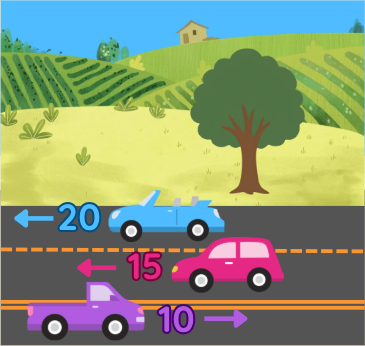
Velocities as seen by the tree.
On the other hand, from your perspective in the driver’s seat of the pink car:
You and your passenger seem to be at rest, traveling 15 mph - 15 mph = 0 mph.
The tree seems to be traveling in the opposite direction at 0 mph - 15 mph = -15 mph.
The blue convertible appears to be moving only 20 mph - 15 mph = 5 mph.
The purple truck looks like it’s whizzing by at -10mph - 15mph = -25 mph.
I’m using positive and negative signs to keep track of directions, where left is positive because our pink car’s “forward” is to the left. Based on those calculations, maybe this is also a picture of the world I’ve described:
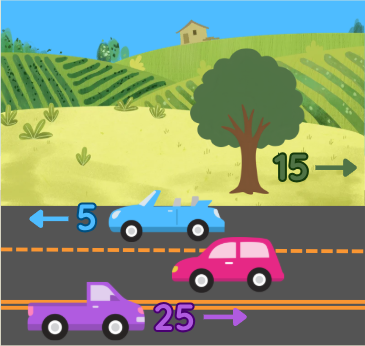
Velocities as seen from the pink car.
It seems a little silly to think of the tree as moving, but without the backdrop of the farm and country road, it would be really tough to tell who is actually moving, in which directions, and at what speeds! In some sense, every observer sees the world as though they’re center of the universe. If you are always at the center of the universe, then everything else must move relative to you.
We’re not in the blue convertible or purple truck, but by subtracting their (signed) velocities as they appear to us from all the velocities as we see them, we can figure out what they see when they measure the velocities of these same objects:
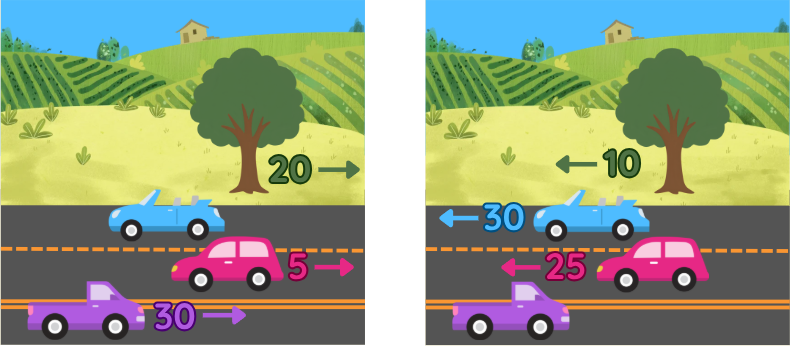
Velocities as seen from the blue convertible (left) and purple truck (right).
If you maintain a constant velocity, your frame of reference is inertial. Galileo assumed the laws of motion are the same in all inertial frames of reference, which means there is no absolute frame of reference we have to be working in when doing physics. It’s just as reasonable for us to observe, ponder, and calculate about the universe from our pink car as it would be for someone standing by the tree. And as the above example hints, there are calculations we can do in one inertial reference frame to see what people see in another.
The speed of light
When constructing his equations governing electromagnetism, James Clerk Maxwell predicted the speed of light: \( c = 299{,}792{,}458\) meters per second. By Galileo’s principle of relativity, if you run with a speed of \(3\) m/s towards someone shining a flashlight at you, then Galileo and Newton would have predicted that the light should appear to you to be moving at a speed of
\( 3 \,\, \textrm{m/s} + 299{,}792{,}458 \,\, \textrm{m/s} = 299{,}792{,}461 \,\, \textrm{m/s} \)
Sound waves can’t propagate through a vacuum and require a medium like air or water to travel. Since light behaves like a wave, it was assumed there had to be something it was traveling through in the “empty” space as it travels from the sun to the earth. Scientists called that something luminiferous aether and it was assumed that Maxwell’s speed of light was relative to the aether.
I’ll skip quite a bit of history for the sake of time, but whether light is itself matter or just a ripple in matter and whether or not aether was detectable or even existed are questions that shaped physics in the late 19th and early 20th centuries. If you want to read up on it, the Wikipedia article on luminiferous aether is a good place to start. It’s getting long in the tooth, but I think Edmund Whittaker’s A History of the Theories of Aether and Electricity is still the authoritative reference for a deeper dive.
For our purposed, we’ll jump to 1887, when the Michelson-Morley experiment attempted to measure how light’s speed changes when it travels in different directions with respect to the suspected “aether winds,” but no differences were found. This led to the gradual rejection of the idea that luminiferous aether even existed.
Without the aether, Maxwell’s predicted speed of light seemed to be the same \( c = 299{,}792{,}458\) m/s, regardless of the velocity of the observer. This meant that Galilean relativity could not apply to light. Scientists spent some time trying to resolve this in various ways, but Einstein’s 1905 special theory of relativity gave a resolution with predictions that have experimentally stood the test of time.
The spacetime interval
Let’s think about two points in space: \((x_1,y_1,z_1)\) and \((x_2,y_2,z_2)\). We’re going to want to talk about light traveling from \((x_1,y_1,z_1)\) to \((x_2,y_2,z_2)\), which will take some time to travel, so let’s add a temporal coordinate to help us talk about these points in space at a particular time: \((t_1,x_1,y_1,z_1)\) and \((t_2,x_2,y_2,z_2)\). This coordinate system combines time and space into a \(4\)-dimensional structure called spacetime.
Two events (points in spacetime) are light-connected if their spatial distance is exactly what light can cover over their temporal distance. Suppose that in our frame of reference we watch a light beam leave \(E_1 = (t_1,x_1,y_1,z_1)\) and enter \(E_2 = (t_2,x_2,y_2,z_2)\). By the usual distance formula, the distance in space that the light has traveled is
\[ d = \sqrt{(x_2-x_1)^{2}+(y_2-y_1)^{2}+(z_2-z_1)^{2}} \]
On the other hand, light moves with speed c in our (and any!) reference frame, so the distance is also the distance traveled by light in that time interval:
\[ d = c|t_2-t_1| \]
If we combine these and square both sides, we wind up with
\[ c^{2}(t_2-t_1)^{2} = (x_2-x_1)^{2}-(y_2-y_1)^{2}-(z_2-z_1)^{2} \]
We can define a function for any two events \(E_1 = (t_1,x_1,y_1,z_1)\) and \(E_2 = (t_2,x_2,y_2,z_2)\) in our inertial frame, light-connected or not, as
\[ s^{2}(E_1,E_2) = c^{2}(t_2-t_1)^{2} - (x_2-x_1)^{2}-(y_2-y_1)^{2}-(z_2-z_1)^{2} \]
This quantity \(s^{2}\) is called the spacetime interval between events \(E_1\) and \(E_2\). As defined, it is zero precisely for light-connected events.
What if someone in another inertial frame were to observe the same two events? They will still watch a beam of light go from some point to another, but they will have their own names and spacetime coordinates for each: \(E_1’ = (t_1’,x_1’,y_1’,z_1’)\) and \(E_2’ = (t_2’,x_2’,y_2’,z_2’)\). However, the speed of light is still c in their reference frame, so their spacetime coordinates for the two events satisfy
\[ c^{2}(t_2’-t_1’)^{2} = (x_2’-x_1’)^{2}-(y_2’-y_1’)^{2}-(z_2’-z_1’)^{2} \]
This shows that spacetime interval returns a value of \(0\) for pairs of light-connected events in either reference frame. It turns out that for any events \(E_1\) and \(E_2\) in our inertial frame, whether light-connected or not, corresponding to events \(E_1’\) and \(E_2’\) in a second observer’s inertial frame, also satisfy
\[ s^{2}(E_1,E_2) = s^{2}(E_1’,E_2’) \]
I don’t want to get too into the weeds here, so if you’re interested in the derivation of the above fact, the Wikipedia article on the derivation of the Lorentz transformations is pretty thorough. Otherwise, let it suffice to say that the cosmological principle, properties of inertial reference frames, and the speed of the light being \(c\) in any inertial reference frame are quite restrictive and force quite a bit of nice linear algebra to work out.
The weird stuff
Suppose someone is moving away from us purely in the \(x\)-direction. We can both start our clocks at time \(t=t’=0\) and identify some common point \((0,0,0)\) as the origin of space as we start our clocks. As they move away from us at velocity \(v\), our origin stays put at \((0,0,0)\) in our coordinate system. Their origin is also \((0,0,0)\) in their coordinate system, but to us that point looks like it’s at \((vt,0,0)\), since \(vt\) is the distance they have moved at time \(t\). In terms of spacetime events, their origin is \((t’,0,0,0)\) in their coordinate system at our time \(t\), when it is \((t,vt,0,0)\) in ours.
Here’s where it gets a little weird. If we agree that \( s^{2}(E_1,E_2) = s^{2}(E_1’,E_2’) \), then we have corresponding pairs of events in each reference frame to test: \(E_1 = (0,0,0,0)\) and \(E_2 = (t,vt,0,0)\) in our frame and \(E_1’ = (0,0,0,0)\) and \(E_2’ = (t’,0,0,0)\) in theirs. Plugging those in, we get
\begin{array}{lcl} s^{2}(E_1,E_2) & = & c^{2}(t-0)^{2} - (vt-0)^{2} - (0-0)^{2} - (0-0)^{2} \\ & = & c^{2}t^{2} - v^{2}t^{2} \end{array}
and
\begin{array}{lcl} s^{2}(E_1’,E_2’) & = & c^{2}(t’-0)^{2} - (0-0)^{2} - (0-0)^{2} - (0-0)^{2} \\ & = & c^{2}t’^{2} \end{array}
Setting these equal to each other, we have
\[ c^{2}t^{2} - v^{2}t^{2} = c^{2}t’^{2} \]
If we solve for \(t’^{2}\), we find
\begin{array}{lcl} t’^{2} & = & \frac{c^{2}t^{2} - v^{2}t^{2}}{c^{2}} \\ & = & \frac{c^{2} - v^{2}}{c^{2}} t^{2} \\ & = & \left(1-\left(\frac{v}{c}\right)^{2}\right) t^{2} \end{array}
and so
\[ t’ = \sqrt{1-\left(\frac{v}{c}\right)^{2}} \,\, t \]
What’s happening in this experiment experiment as our clock hits one minute?
If their velocity is \(0\), then \(t’ = \sqrt{1-(0/c)^{2}} \cdot 60 = 60\), so they have also seen \(60\) seconds pass. No surprises there!
If they are traveling 200 mph, a modest Formula 1 speed, then that’s about \(89.4\) m/s, so \[t’ = \sqrt{1-(89.4/299792458)^{2}} \cdot 60 = 59.99999999999733219…\] I’d have trouble telling that’s not also just \(60\) seconds!
If they are traveling half the speed of light, though, then \begin{array}{lcl} t’ & = & \sqrt{1-\left(\frac{c/2}{c}\right)^{2}} \cdot 60 \\ & = & \sqrt{1-\left(\frac{1}{2}\right)^{2}} \cdot 60 \\ & = & \frac{\sqrt{3}}{2} \cdot 60 \\ & = & 30\sqrt{3} \\ & = & 51.96… \end{array} When 60 seconds have passed for us, about 52 seconds seem to have passed for them!
What happens if the person traveling away from us does the same sort of calculations? They would consider us moving away from them with velocity \(-v\), since it’s in the other direction. Tracking our origin at their time \(0\) and time \(t’\), they would see our origin at \(E_1’ = (0,0,0,0)\) and \(E_2’ = (t’,-vt’,0,0)\) and find that corresponds to \(E_1 = (0,0,0,0)\) and \(E_2 = (t,0,0,0)\) in our coordinates. They would then see that
\begin{array}{lcl} c^{2}t^{2} & = & s^{2}(E_1,E_2) \\ & = & s^{2}(E_1’,E_2’) \\ & = & c^{2}t’^{2} - (-vt’)^{2} \\ & = & c^{2}t’^{2} - v^{2}t’^{2} \end{array}
Solving for \(t\) in \(c^{2}t^{2} =c^{2}t’^{2} - v^{2}t’^{2}\) gives
\[ t = \sqrt{1-\left(\frac{v}{c}\right)^{2}} \,\, t’ \]
So if they see us zipping away at half the speed of light, they would also conclude that when their clock reads \(60\) seconds, ours reads about \(52\) seconds. And this disparity between our clocks would grow as the velocity gets closer to the speed of light, \(c\).
So is their clock slow or is our clock slow? The uncomfortable position that special relativity has put us in is accepting there is no such thing as simultaneity, in an absolute sense. Even two clocks that are perfectly synchronized in our inertial reference frame can give two different times to someone whizzing by, and there is no absolute, privileged inertial frame of reference to tell us who is reading things right. Fortunately, humans don’t often find themselves in positions where we have to worry about this!
After seeing simultaneity go out the window, I don’t think anything else relativity claims can really shock me too much. It’s also the case that objects at rest in one inertial reference frame appear shorter along their axis of motion in other frames. We’ve seen the time dilation formula in the context of starting from \(t=t’=0\), but more generally,
\[ \Delta t’ = \sqrt{1-\left(\frac{v}{c}\right)^{2}} \,\, \Delta t \]
There is a corresponding length contraction formula:
\[ \Delta x’ = \sqrt{1-\left(\frac{v}{c}\right)^{2}} \,\, \Delta x \]
These ways that space and time get scaled lead to all kinds of interesting paradoxes to puzzle through, like how things can seem “too long” in one inertial frame of reference but not in another. My favorite was always the ladder paradox, which has a fun resolution that relies on the relativity of simultaneity.
Special relativity has plenty of other edits to make to classical mechanics, since any time a velocity can be measured, there are two inertial reference frames in play. Matt Parker recently put out a nice video looking at how special relativity impacts kinetic energy. You’ll see the Lorentz factor
\[ \gamma = \frac{1}{\sqrt{1-\left(\frac{v}{c}\right)^{2}}} \]
and even \(mc^{2}\) make an appearance there.
This post has already grown much longer than intended, so I won’t touch on general relativity, which reconciles special relativity with Newton’s law of gravity by allowing spacetime to be curved. Needless to say, that also requires a lot of updates to classical mechanics!