
Math in… Eyesight and Refraction

When drinking water through a straw, you might notice that the part of the straw sticking out of the water doesn’t quite line up with the part underwater.
When light travels from one medium to another—like from water to air, air to glass, or water to glass—it bends! This is called refraction.
Different colors of light have different wavelengths, which cause them to bend at different angles. This is why a prism can turn white light (a combination of colors) into a rainbow of colors, sorted into a spectrum from long wavelength (red) to short wavelength (violet).
Any single wavelength of light always bends the same way when going from air to water.

If the water meets the air in a plane, like the surface of still water in a glass, then you can measure the angles the light makes with a line perpendicular to that plane before and after it enters the water.
Taking the ratio of sines of these angles, you’ll get the same number no matter what angle the light enters the water at! For a standard reference yellow (589.29 nanometer wavelength), this number is

This number is a refractive index.
This rule, called Snell’s law, applies even when two media meet at a curved surface. Optometrists use this fact every day when they help people choose eyeglasses.
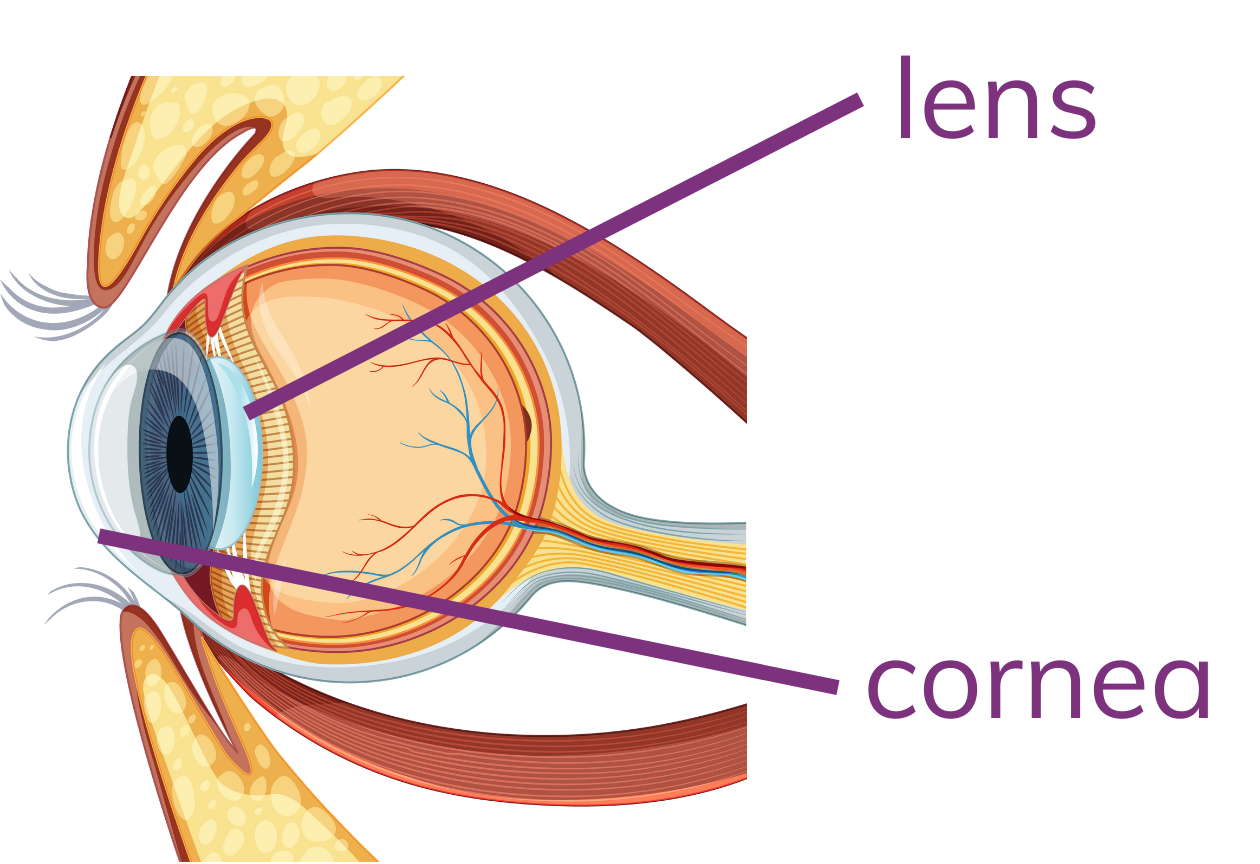
When you need glasses to correct blurry vision, it is because your eyes’ corneas and lenses are not refracting light correctly onto your retina.
An optometrist’s goal is to find you a pair of lenses that can assist your eyes in refracting. Eyeglasses refract light before it gets to your corneas so that your eyes can refract it again and get a sharp image.
Lenses come in many different shapes and use materials with a variety of different refractive indices. Let’s look at a couple examples with geometry based on CR-39, a plastic commonly used in eyeglass lenses with


Two spherical caps can be placed back-to-back to create a convex (or converging) lens. Light passing through it centrally converges near a single point called the focus.

Convergence gets worse farther from the center, an effect called spherical aberration. To counter this, many convex lenses are not made perfectly spherical.
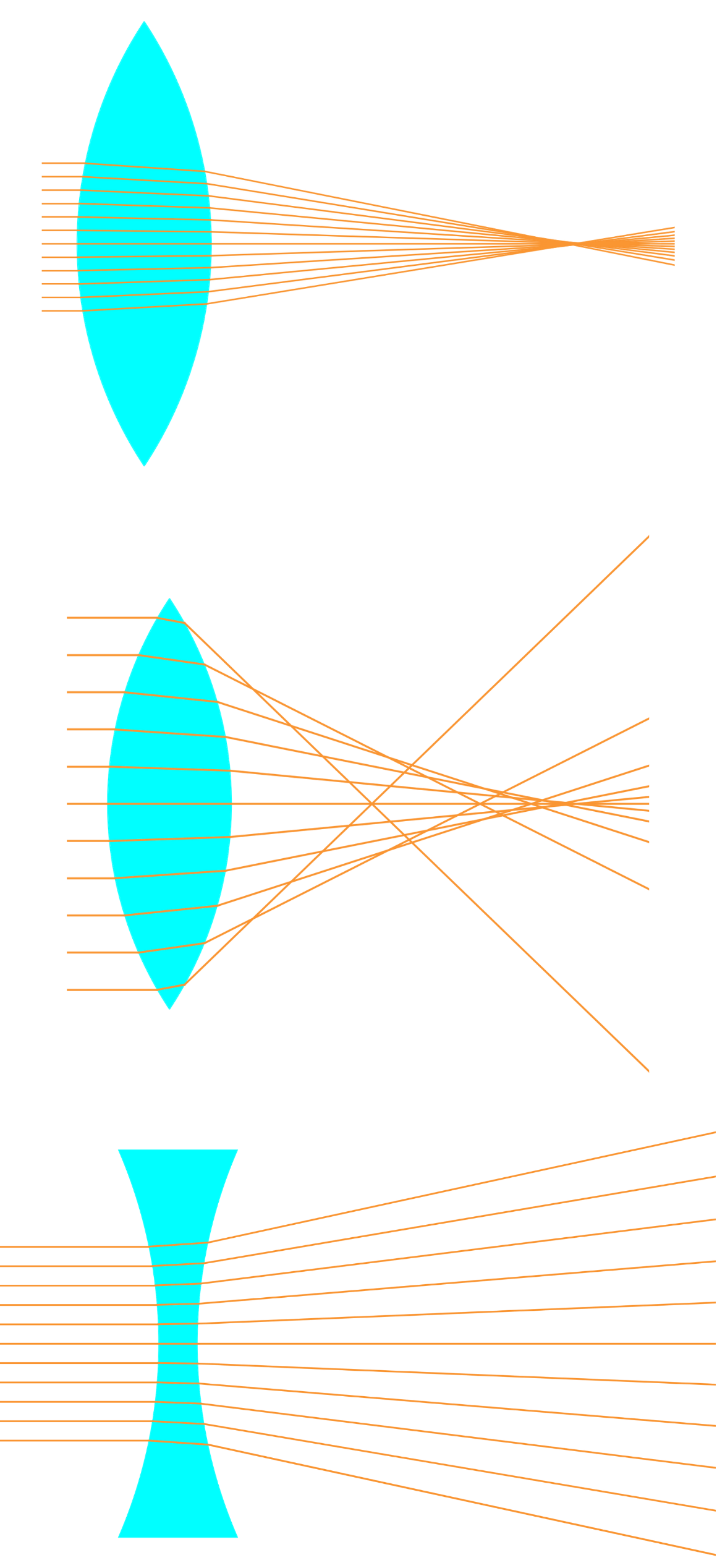
Two spherical caps can be carved from a cylinder to create a concave (or diverging) lens. Light passing through it fans out. Similarly, one might not make these perfectly spherical.
Eyeglass lenses typically have some combination of flat (plano), convex, or concave surfaces based on spheres and cylinders to approximate the help your eyes need bending light.
