
Math in… Ranked Choice Voting
In races with two candidates, you can learn about the candidates, decide which one makes sense for you and your community, and cast your vote. If they lose, it’s natural to feel disappointed, but you voted the best you could. In races with three or more candidates, decisions can get a little trickier!
Suppose you are in a class of students voting on a class pet: Hamster, Fish, Parakeet, Bunny, Tarantula, or Snake. You like Bunny because rabbits are your favorite animal, but Hamster still looks fun to cuddle. Reptiles and spiders scare you, though, so you’d rather not be in a room with one. How should you vote?

It really depends on how you think other people might vote! Suppose you think your classmates will vote roughly like this:

Sadly, Bunny likely isn’t going to win, no matter how you vote. If you vote for Hamster, though, you might nudge things so Hamster wins. That’s your second favorite outcome. Not bad!
Maybe you suspect your classmates will vote more like this, though:

Bunny isn’t too far behind Parakeet and Tarantula. If you vote for Bunny and Tarantula wins, you’re stuck in a room with a spider – yikes! Parakeet isn’t a favorite, but seems like the best shot to beat Tarantula. Maybe Parakeet is the right vote?
Your classmates might have similar dilemmas, but the numbers we’ve seen can’t tell that story because they only reflect first choices.
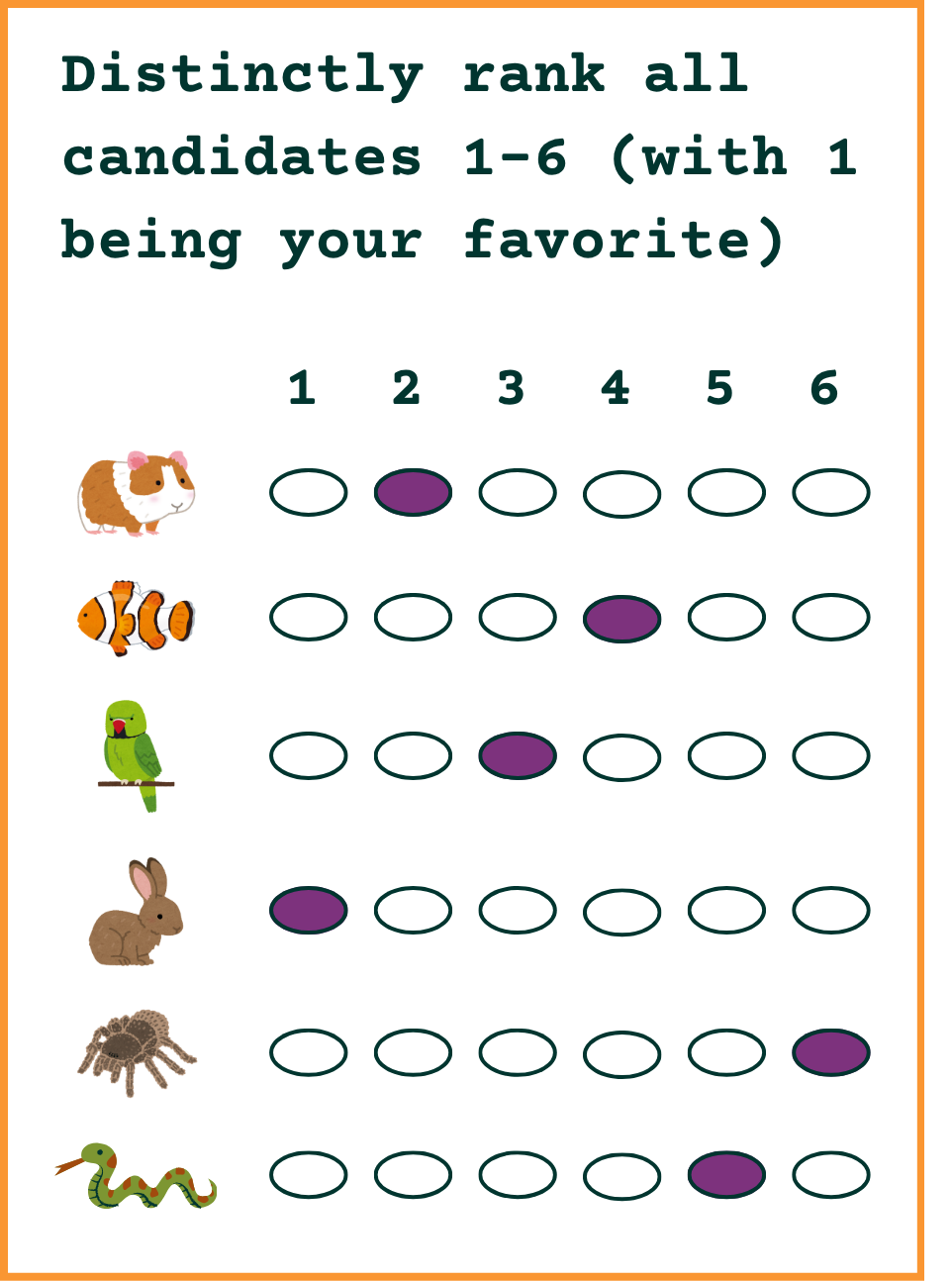
Ranked choice voting systems, on the other hand, take voters’ other choices into consideration. In these systems, voters submit rankings for the candidates instead of choosing just one. Your vote for class pet might look like the ballot to the right.
Some systems only have voters rank their top 3 or top 5 candidates instead of all of them. Other systems have voters assign points to the candidates so that point tallies act as weighted votes, reflecting voters’ preferences.
One common way to use rankings to choose a winner is instant-runoff voting. In that system, everyone submits a list of their rankings and then the votes for first choice are tallied. The candidate with the least first-choice votes is then eliminated. Anyone with that candidate as their first choice then has their second choice upgraded to first, and a new first-choice round starts. When only two candidates remain, there will (hopefully) be a winner with over 50% of the vote!
While Seattle doesn’t currently used ranked choice voting, its first ranked choice elections will happen in 2027.
What other ways could people vote in elections, and how could their votes to be counted?