

Education Zone
Pythagorean Puzzles
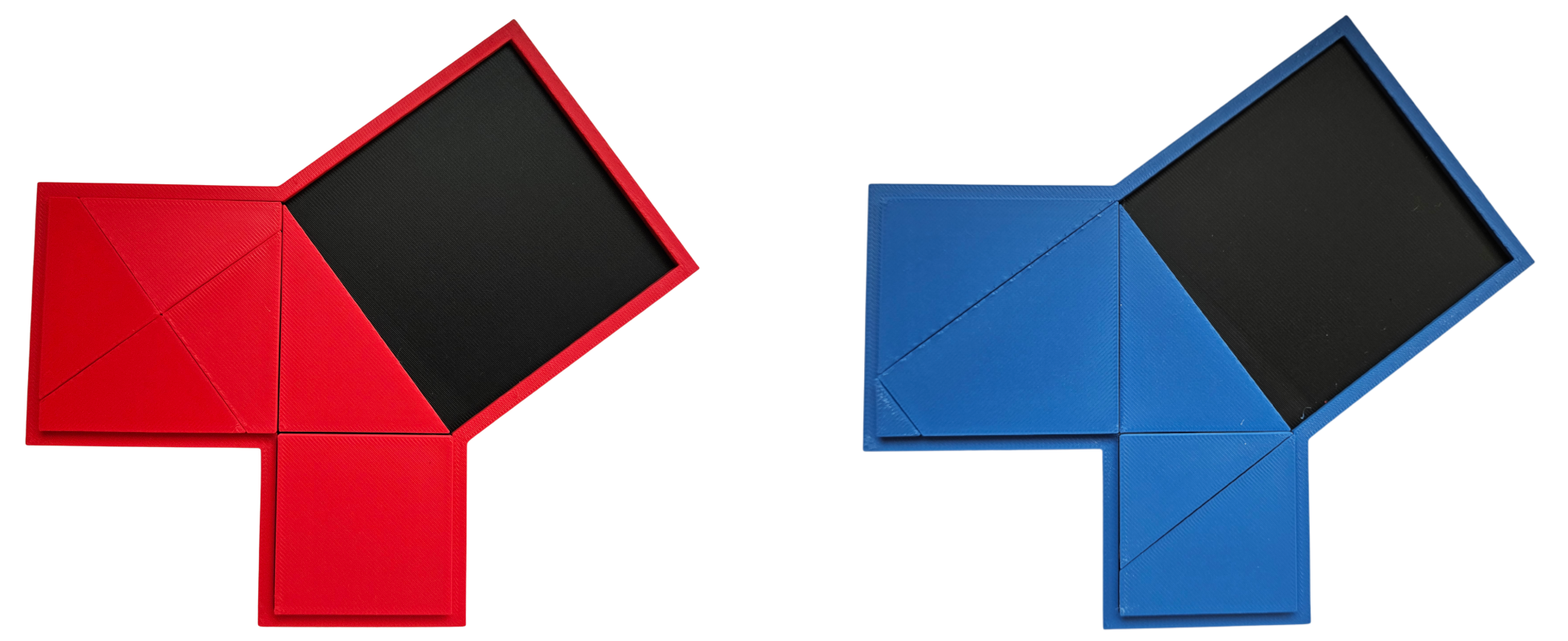
With SUMM’s big Pythagorean Palooza coming up, I’ve been working on a new set of dissection puzzles based on different proofs of the Pythagorean theorem.
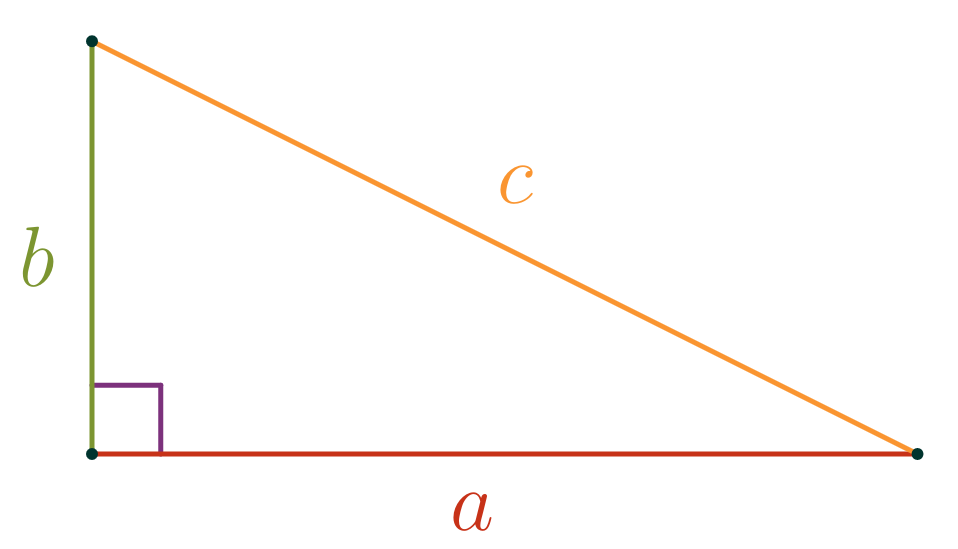
We looked at the Pythagorean theorem, one of its proofs, and some of its generalizations in an Ask a Mathematician post this June. Here’s a statement of the theorem:
Pythagorean theorem
For any right triangle, the sum of the squares of its two shortest sides’ lengths equals the square of its longest side’s length:
\[ \color{#c83219}{a}^{\color{#01352f}{2}} \color{#01352f}{+} \color{#7d9632}{b}^{\color{#01352f}{2}} \color{#01352f}{=} \color{#fa9632}{c}^{\color{#01352f}{2}} \]
I’ll make the puzzle files available for download once they’re done, if you would like to print them yourself. In the meantime, I’ve vibe-coded an app you can use to play with them. Click and drag pieces to move them. Many of the early puzzles will not require pieces to be rotated, but you can rotate a piece by holding right click and dragging. One puzzle will require flipping pieces over, so reflections can be done by holding shift while you right click.
Since \(10^{2}+24^{2}=26^{2}\) is the reason we’ll be celebrating at Kent Station on 10/24/26, all puzzles start with the \(a:b\) ratio set to \(5:12\). (Dividing each of \(10\), \(24\), and \(26\) by \(2\) gets us to the associated primitive Pythagorean triple \(5^{2} + 12^{2} = 13^{2}\).)
These proofs work for any right triangle, however, and you can drag the slider to see how the pieces must morph for different ratios \(a : b\). I’ve included the limiting behavior when you hit \(1:1\), which sometimes also results in fewer pieces. I’d recommend not solving puzzles while they’re set to \(1:1\), since it’s a little cheesy and you might end up with a solution that’s not actually part of the family. Puzzle 9 is a little eccentric in the sense that, as you change the ratio you’ll hit breakpoints where more or fewer pieces are required!
As you play with each dissection, think about how it might have been discovered. For example:
Which pieces (or combinations of pieces) have length \(c\)?
Do any pieces (or combinations of pieces) fit in the central right triangle?
Can you find pieces starting in the \(b \times b\) square that have an edge of length \(a\) or vice versa?
Do symmetries in the starting arrangement of the pieces lead to symmetries in the ending arrangement?
Could any of these puzzles where pieces don’t flip or rotate have come from tilings of the plane?
Do any of these puzzles seem related to one another? How?