
Intersections
A Public Art Exhibition

Yana Mohanty
Yana Mohanty’s career has spanned the fields of engineering, mathematics, education, business and art. She earned her B.S. and M.S. in Electrical Engineering and her Ph.D. in Mathematics, with focus on geometry. Yana is the founder of Imathgination LLC, a company whose flagship product Geometiles is an award-winning set of tiles now being used at many schools, universities and math festivals around the country and internationally.
Always searching for physical ways to communicate the beauty of mathematics, Yana has had her mathematical art displayed at the Mathematical Art Exhibit of the Joint Mathematics Meetings in 2019, 2020, and 2024. Her joint work with mathematician Bjoern Muetzel was displayed at the Illustrating Mathematics exhibit at Brown University in 2019.
Yana started making snapology origami objects out of used TetraPak containers during the Covid 19 pandemic as a way of coping with stress and uncertainty. The first product of this effort was her piece “Campanus 2000”, which was exhibited at the exhibit “Iyasi/Healing” at the Japanese Friendship Garden in San Diego in 2021. “Full Circles” is a follow up to “Campanus 2000”. Both pieces model figures from drawings by the Renaissance masters.
Artwork
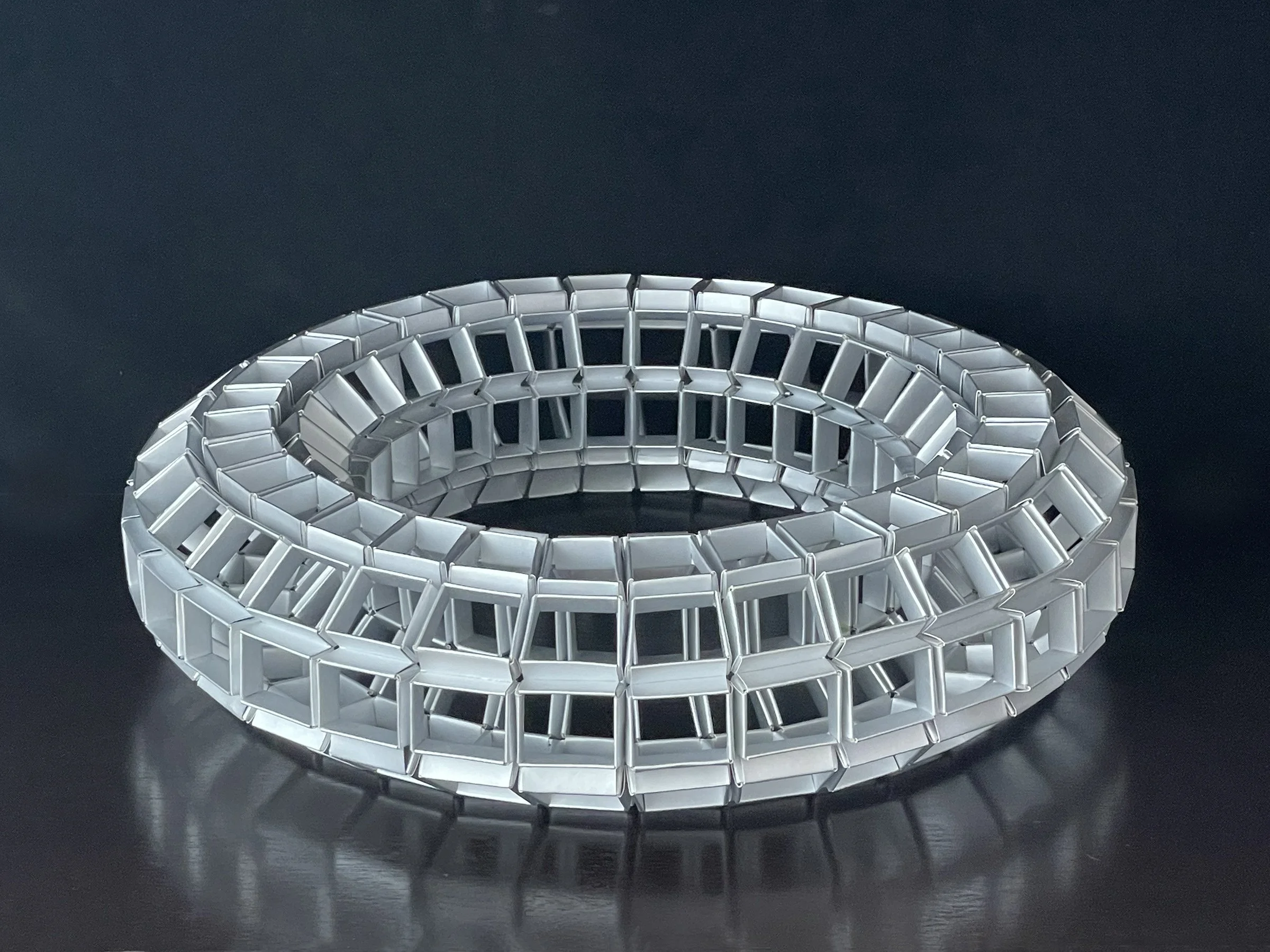
Full Circles
Strips of used TetraPak bottles
5” x 18” x 18”
The mazzocchio is a donut-shaped headdress worn by men in Italy in the 1400’s. It has been the subject of many Renaissance studies in perspective in various media. To mathematicians, the mazzocchio is a torus, a surface of genus 1 (meaning a one-holed donut) with areas of positive, negative, and zero curvature; it is an important shape in the study of topology, geometry, and even cosmology. It is safe to say that the torus, or mazzocchio, is very much in the middle of the interplay of math, art, and science.
This is a model of a discrete torus, known as the mazzocchio, famously depicted by Leonardo da Vinci in Codex Atlanticus (1478–1519). It is made with strips of Tetra Paks using the snapology origami technique by Heinz Strobl. This technique is based on hinged connections of polygons without the use of adhesives. Each hinge can orient in one of two possible directions, visually representing the concept of discrete Gaussian curvature. This curvature is defined as the product of principal curvatures, and its sign roughly describes the shape of the surface. The principal curvatures in “Full Circles” can be seen in the orientation of the hinges, so that the sign of the discrete Gaussian curvature can be practically read from the piece.
The name “Full Circles” has several references. It refers to the two topologically distinct and mutually perpendicular families of circles which comprise the piece—the large “circles” (32-gons), and the smaller “circles” (octagons). The name also hints at the fact that the Tetra Pak® containers have gone full circle from being a valuable container material to potential trash to being used again to make an object from Leonardo da Vinci’s canon.