Intersections
A Public Art Exhibition

Timea Tihanyi
Timea Tihanyi is a Hungarian born interdisciplinary visual artist and ceramicist living and working in Seattle, Washington. Tihanyi holds a Doctor of Medicine degree from Semmelweis University, Budapest, Hungary; a BFA in Ceramics from the Massachusetts College of Art in Boston; and an MFA in ceramics from the University of Washington. Tihanyi’s work has been exhibited in the United States, Brazil, Australia, Denmark, Spain, France, and the Netherlands. She has received many recognitions, including the 2018 Neddy Award in Open Media. In the Pacific Northwest, her work has been part of numerous solo and group exhibitions at Gallery 4Culture, CoCA, the Henry Art Gallery, Museum of Glass, the Seattle Art Museum Gallery, Greg Kucera Gallery, Bellevue Arts Museum, and the Museum of Northwest Art. Tihanyi is a Teaching Professor in the Interdisciplinary Visual Arts program at the University of Washington. She is the founder and director of Slip Rabbit, a unique mentoring space for experimentation and learning at the intersections of art, design, mathematics, architecture, computer science and engineering. Slip Rabbit is the first technoceramics studio in the Pacific Northwest.
Artwork
Matrix III
Porcelain
5.25” x 5” x 5”

Matrix IV
Porcelain
5” x 5” x 5”
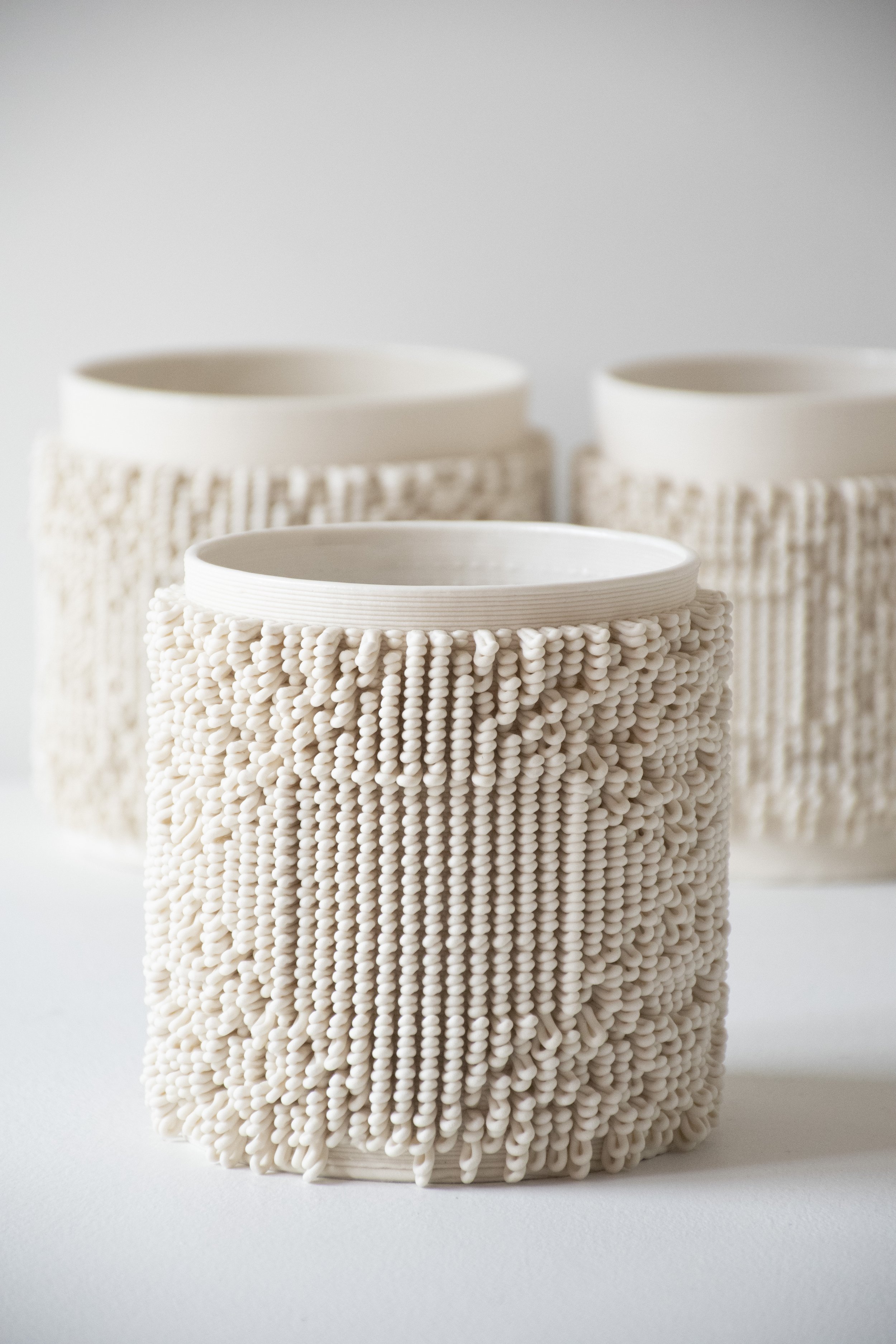
Matrix V
Porcelain
5.25” x 6” x 6”
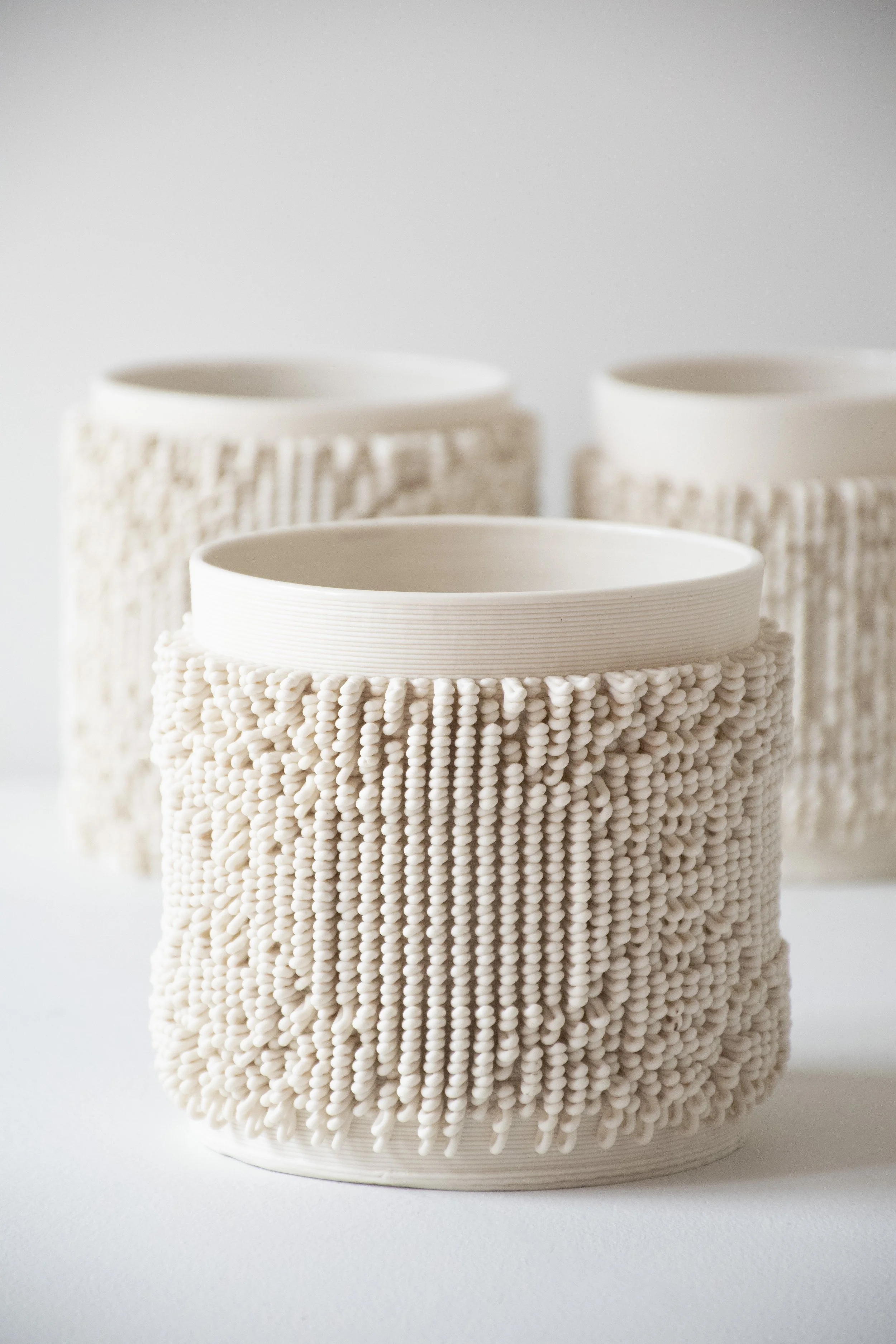
These pieces grew out of collaboration with mathematician Sara Billey. Our work explored Abelian sandpile models, which are models based on a specific case of cellular automata. These types of models are also called self-organized systems, due to the emerging unexpected patterns found in the final outcome. Sandpile models can also be understood as games with extremely simple rules that repeat leading to enormous complexities. As an artist working with digital technology and tangible materials, I was interested in finding out if there were mathematical descriptions (and models) of living systems. My work explores the connection between algorithmic predictability and unexpected occurrences in the natural world. My work seeks to build bridges between abstract math and tangible experience.