
Intersections
A Public Art Exhibition

Margaret Kepner
Margaret Kepner is an artist living in Washington, DC. As a child, she loved to make art. Her drawings often involved intricate geometric patterns, and her family predicted she would grow up to design wallpaper. Kepner attended Vassar College where she majored in Mathematics and minored in Physics and Art History. Throughout her college years, she took studio art, primarily painting. For her senior project, she created a series of works inspired by mathematics.
Following college, Kepner did research in Radio Astronomy in The Netherlands. She returned to the USA to pursue a Master’s Degree in Mathematics at NYU, and spent several years teaching high school math and physics. She worked as a programmer at the Federal Reserve Bank of NY before moving to Washington, DC. There she began a thirty-year career in Information Systems at the International Monetary Fund.
Since her retirement, Kepner has been able to concentrate on her longtime interest in finding connections between mathematics and art. She has participated in over 50 juried shows and has shown her prints in two solo exhibits. Her work was included in Mathematics + Art, A Cultural History by Lynn Gamwell.
Artwork
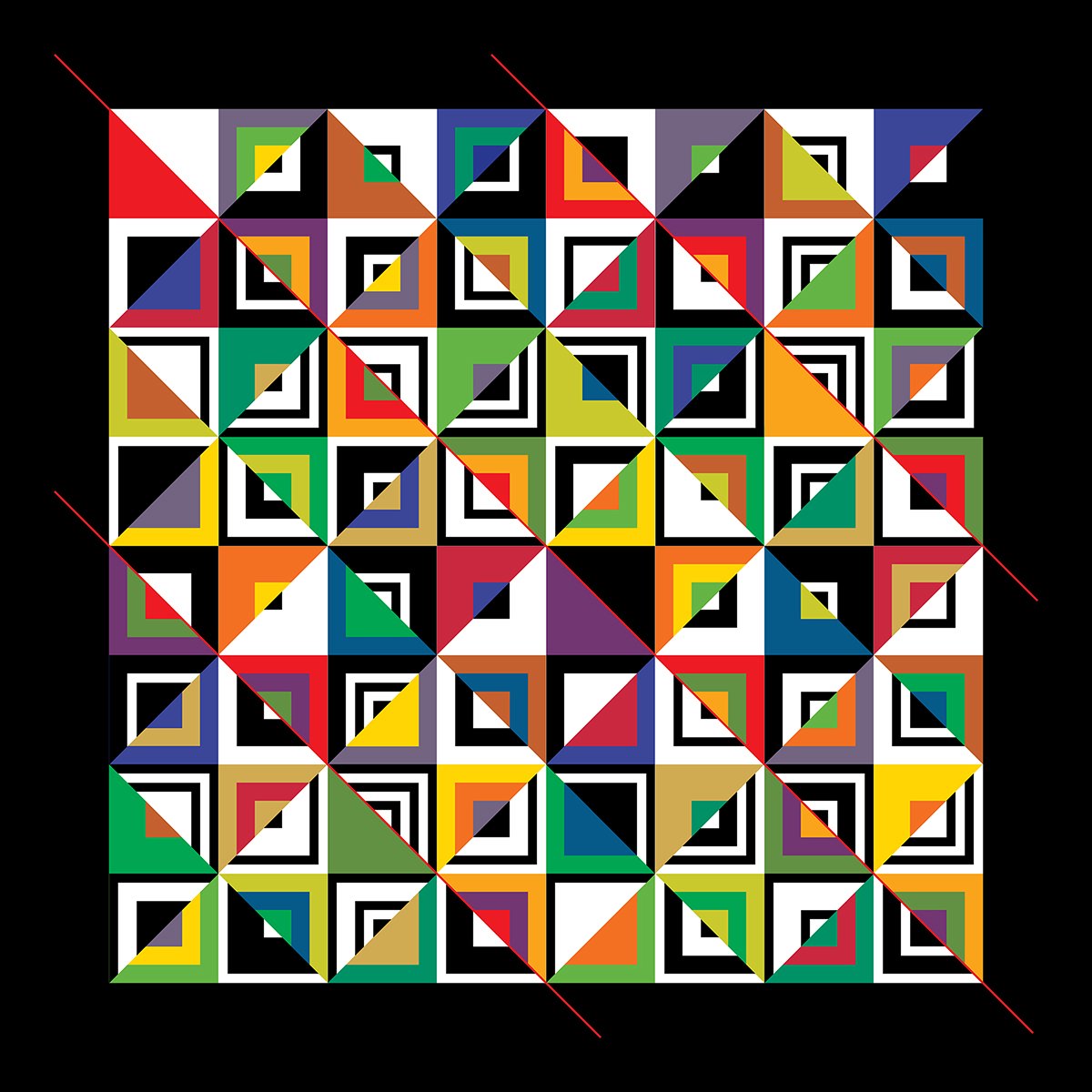
A Breeze Over Gwalior
Archival inkjet print, numbered and signed
24” x 24”
$400
The artwork 'Breeze over Gwalior' is based on a magic square of order 8, expressed in a visual format similar to a traditional quilt pattern. The magic square, known as the Gwalior Square, is an 8x8 array of numbers from 0 to 63, such that every row and column adds up to 252, the ‘magic constant.’ In addition, the two main diagonals, as well as every broken diagonal, sum to 252, making it pandiagonal. The numbers in the magic square are represented in two ways: base 2 and base 4. Concentric nested squares serve as the number places in the two base systems, and suggest the Log Cabin quilt structure. For each of the 64 squares, one half is shown in base 2 (black and white), and the other half in base 4 (red, yellow, green, and blue). Small color variations are used to emphasize the broken diagonals. The small squares are oriented by rotation to create a pinwheel effect. This pattern was chosen since it visually groups together 2x2 arrays of numbers, all of which sum to 126 (half the magic constant).
Magic squares have fascinated people and been part of human culture for thousands of years. In addition to their intriguing mathematical properties, they have been used in various civilizations in mystical ways. For example, in the Middle Ages there was a particular magic square associated with each known planet, and they played a role in casting horoscopes and other fortune telling. The Gwalior Square was discovered carved into the walls of Fort Gwalior in India by British soldiers in the 19th century. It was most likely made several centuries earlier, and may have been considered a propitious symbol to those who built the fort. The topic of magic squares remains a popular theme in recreational math today.
While the Gwalior magic square provides the math content for Breeze over Gwalior, the visual elements chosen are related to the Log Cabin quilt pattern. This pattern features concentric nested squares, two distinct colorways, and effects produced by rotation of the quilt blocks. In this case, the rotated blocks generate a pinwheel pattern. These visual properties all represent some aspect of the underlying math. Quilts and other decorative textiles have typically been created by the women of many cultures, often documenting migrations and linking generations. I felt the Log Cabin quilt pattern made an ideal visual ‘home’ for the Gwalior Magic Square.
The Gwalior Fort stands high on a hill in Madhya Pradesh, India, where, even in the heat, breezes can be felt. The pinwheel motif echoes the idea of wind. Therefore, I chose the title: A Breeze over Gwalior.