Intersections
A Public Art Exhibition

Alex Kreitzberg
Alex Kreitzberg is a math teacher living in Kirkland, Washington. He loved to make modifications to video games as a kid. He always found computers a bit magical, like little windows into other worlds. Adding art to video games exposed him to the world of art.
With an eye towards applying computers to other subjects, Alex went to the University of Oregon, getting a BS in Mathematics and Physics. After graduating, Alex moved to Seattle, where he began teaching mathematics, and participated in mathematics outreach at the science center.
Alex liked to play with various art programs, getting a sense for how these various programs encouraged different explorations of art. Eventually he got curious in what way digital tools related to traditional drawing, and whether traditional drawing was somehow more flexible or just different, so he started drawing traditionally. Now he likes to make scientific illustrations and art, sometimes blending ideas between the two.
Artwork
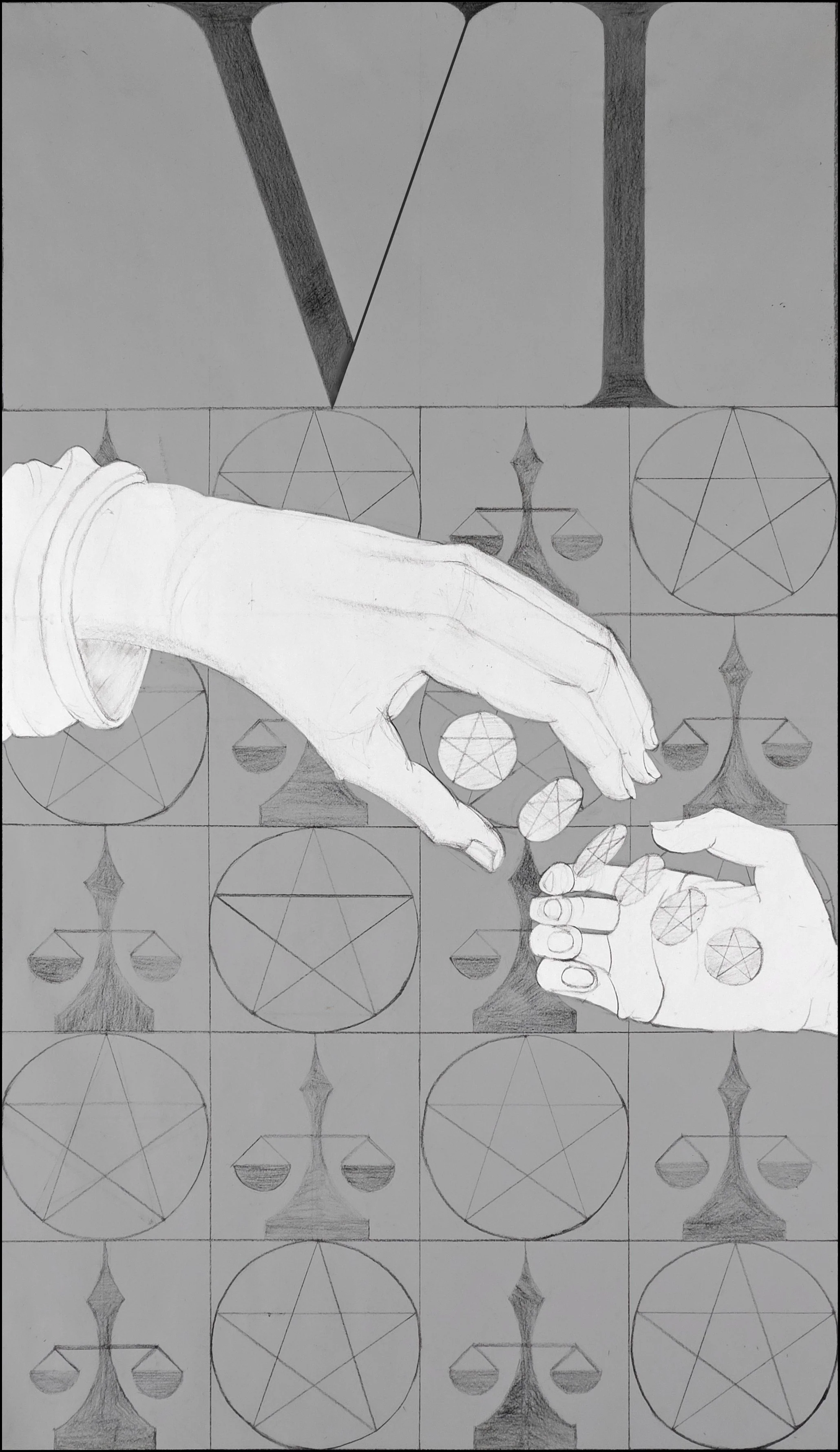
Six of Pentacles
Graphite with digital overlay
23.75” x 14.25”
$400
While I don't believe in Tarot, I'm impressed with how evocative to the imagination these cards can be. The cards typically align with major themes and ideas important to western culture.
The Six of Pentacles represents the idea that balance in a society is maintained when the wealthy give to those in need. The symbols either serve to convey this idea or indicate the suit of the card, or both.
In my work the image is geometrically constructed, except for the hands. Because it's a card, the number 6 (Roman numeral VI) needs to be easy to read. Generally the more symmetry a work has, the more spiritual it feels. It's also generally much easier to geometrically construct symmetrical objects. So regularly tiling circles, and bilateral scales is convenient. I also see the hands as conveying a more organic presentation of symmetry.