

Education Zone
Bilunabirotunda
Last month, the International Congress of Mathematicians was held in Philadelphia, marking the first time it was held in the US since 1986. To celebrate, the Simons Foundation sponsored a SUMM and Studio Infinity collaboration to help liven up the expo hall.
You might recall that SUMM and Studio Infinity previously collaborated on a build using truncated octahedra at the Joint Math Meetings in 2025, dubbed the Diamond Lattice Tower:
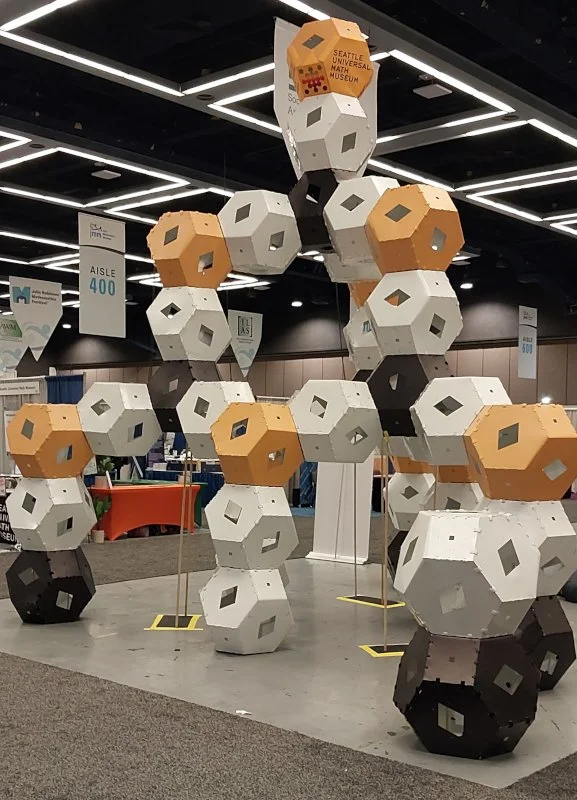
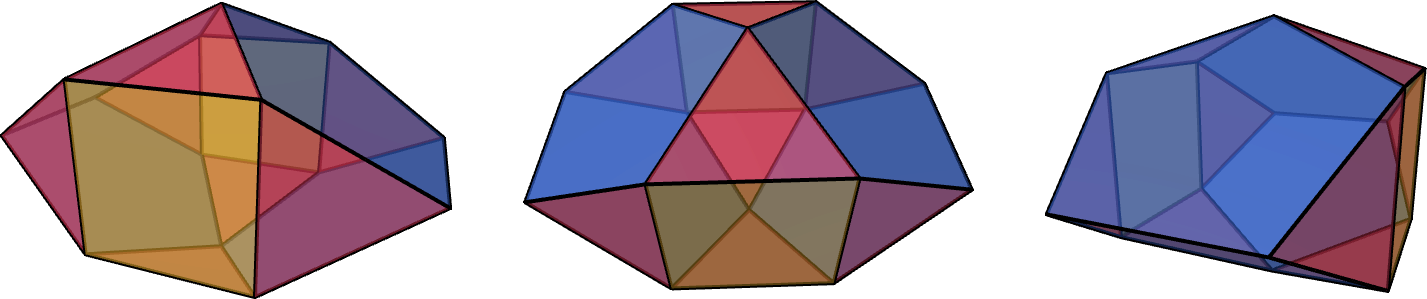
While we’ve now used these for a number of different builds, we wanted to try something new. Keeping with the idea of putting polyhedra together face-to-face in a way that lets people build nonrectilinearly, we chose the bilunabirotunda as our unit:
A few polyhedral families
Historically, mathematicians investigated polyhedra according to properties they satisfy. For example, a Platonic solid is a convex polyhedra with a single type of regular polygon for its faces so that every vertex “looks the same.” (More precisely, Platonic solids need to have vertex-transitivity: all vertices are equivalent under the symmetries of the figure.) It turns out there are exactly 5 Platonic solids:

If we relax these conditions to allow for more than one type of regular polygon to be used, keeping convexity and vertex-transitivity, the 5 Platonic solids are joined by infinite families of prisms and antiprisms (which the cube and octahedron are members of, respectively) and the 13 Archimedean solids (up to chirality):
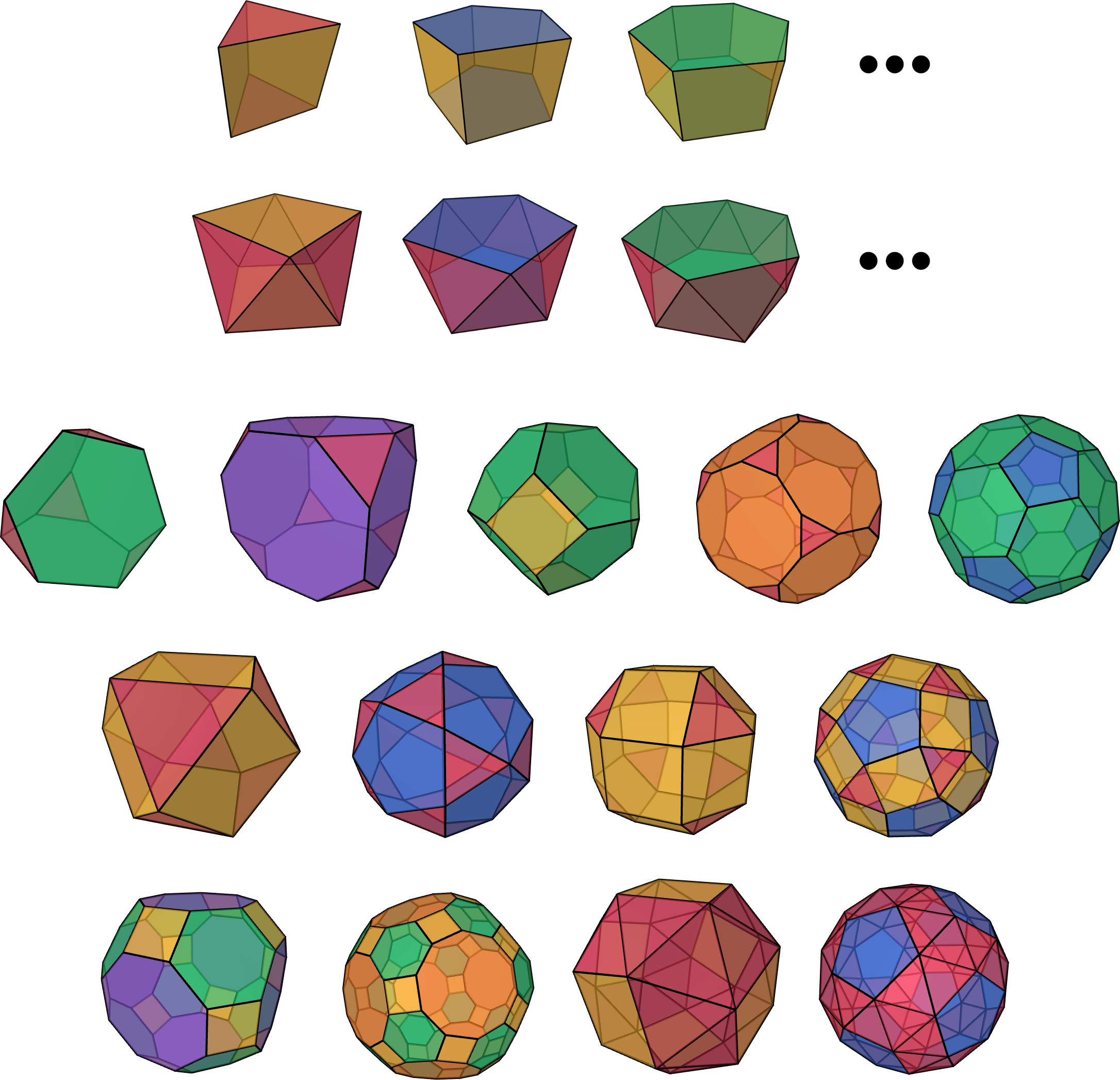
If we relax these conditions even further, only keeping convexity and that all faces must be regular polygons, we end up gaining 92 new shapes known as the Johnson solids. The bilunabirotunda is an example of a Johnson solid. The Johnson solids are a bit of a zoo, since they still have symmetries, but not the extreme regularity of the other families we mentioned.
Honeycomb tiling
While we previously used the truncated octahedron (middle shape in the middle row above) because of its notable ability to fill space, this time we were drawn to the bilunabirotunda for its ability to fill space — with the help of a couple friends!
You can stick bilunabirotunda together triangle-to-triangle, square-to-square, or pentagon-to-pentagon. Playing around with them, you might notice there is a way to stick three of them together like so:
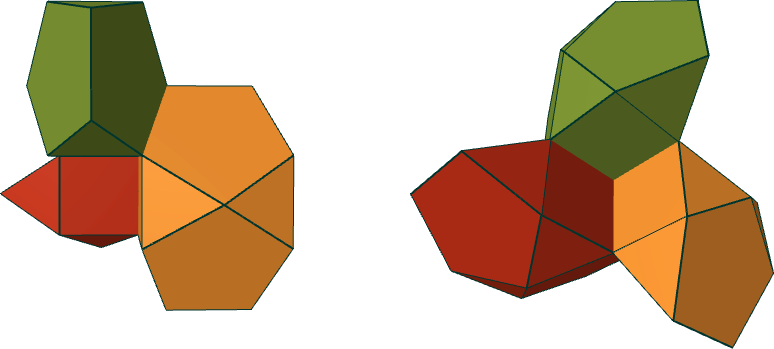
The three shapes create a little cube-shaped pocket. Perhaps not too surprising based on the symmetry of the arrangement! What I find wild about it is what you see when you flip it over:
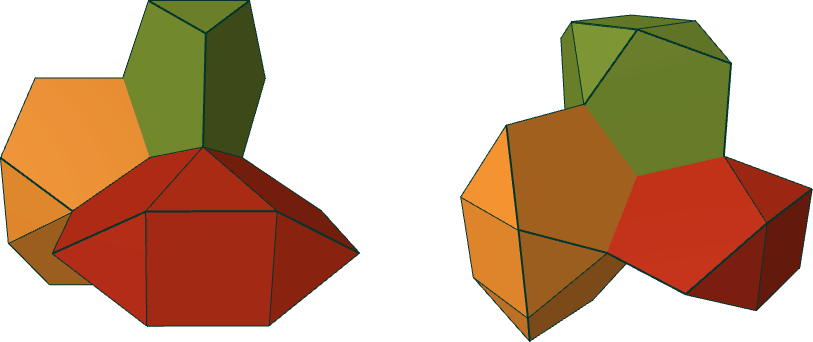
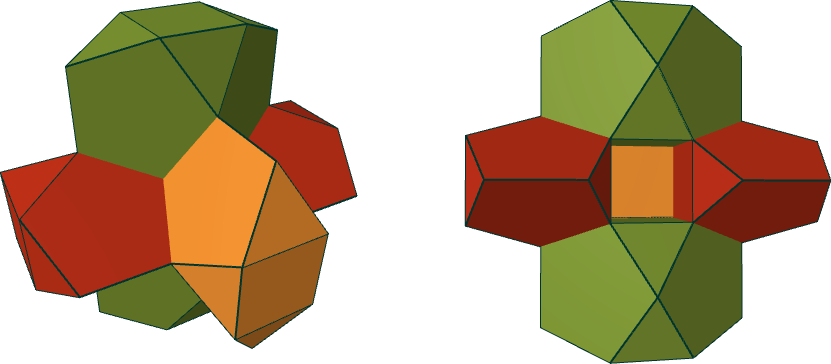
Those three pentagons come together just like three pentagonal faces of another platonic solid: the regular dodecahedron! We can actually finish off the faces of each of the cube and dodecahedron, leaving gaps of those exact shapes. Each cubic cavity shares a face with one of six distinct bilunabirotunda. Here’s a view of six around a cubic cavity, along with the view inside after removing one:
Similarly, each dodecahedral cavity shares a face with one of twelve distinct bilunabirotunda. Here’s a view of twelve around a cubic cavity, along with the view inside after removing one:
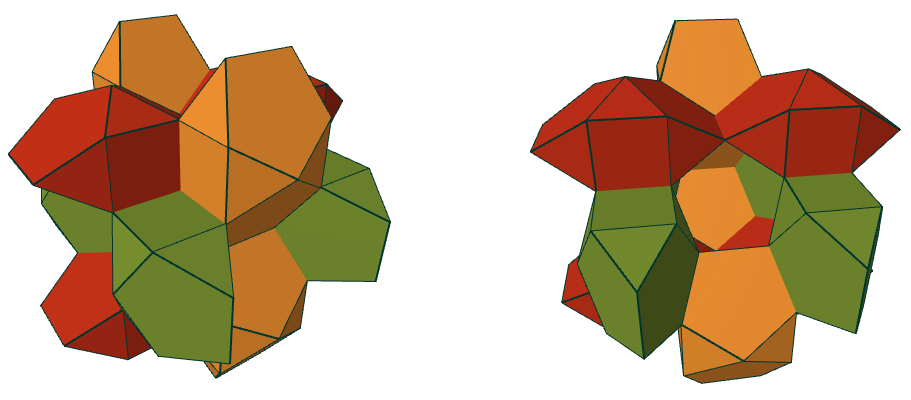
I’m suggestively using three colors to highlight three orientations that a bilunabirotunda can have in this structure. We can grow this structure as large as we want!
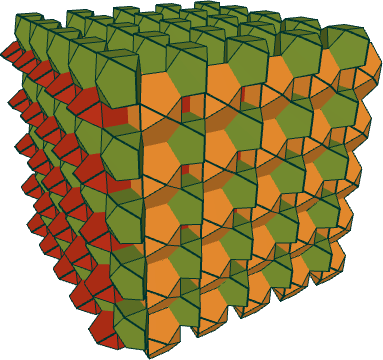
In this honeycombing scheme, every triangle will eventually abut a triangle of some other bilunabirotunda, so this arrangement fills space except for precisely those cubic and dodecahedral gaps.
When two bilunabirotundas meet at a triangle, the triangles are of two different types: one that is part of a pentagon-pentagon-triangle vertex and one that is part of a pentagon-triangle-pentagon-triangle vertex. The bilunabirotundas meet so that they end up oriented perpendicular to one another.
Birotundal Lunacy
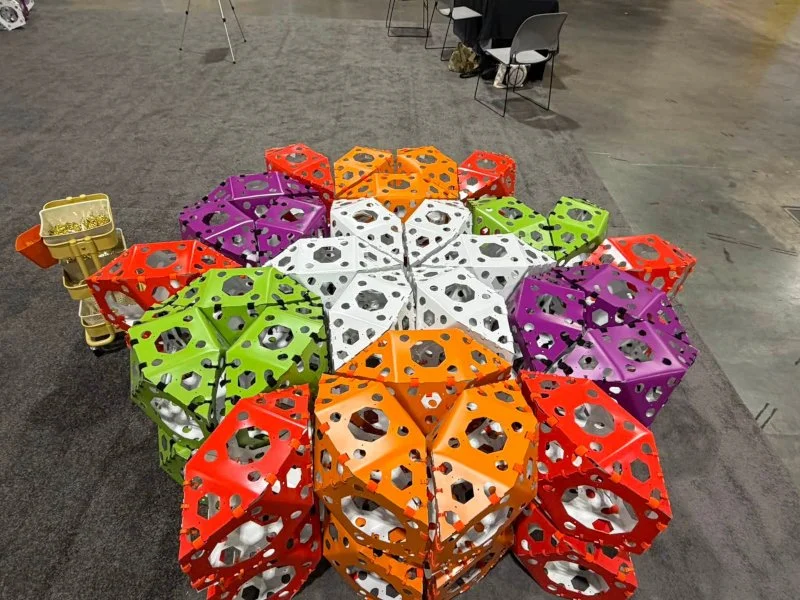
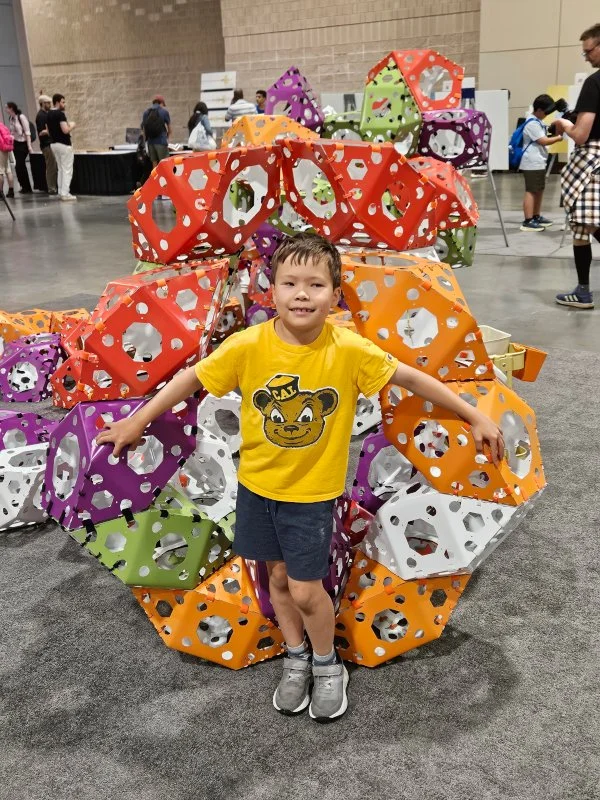
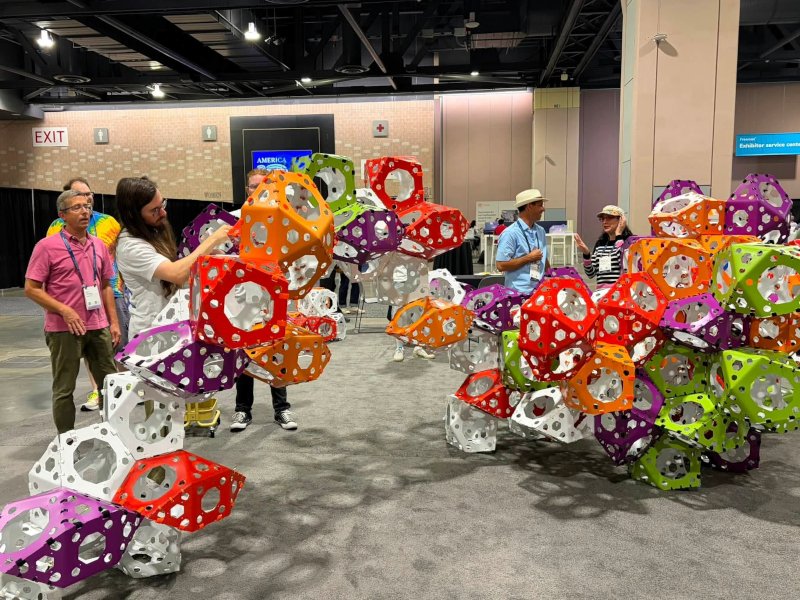
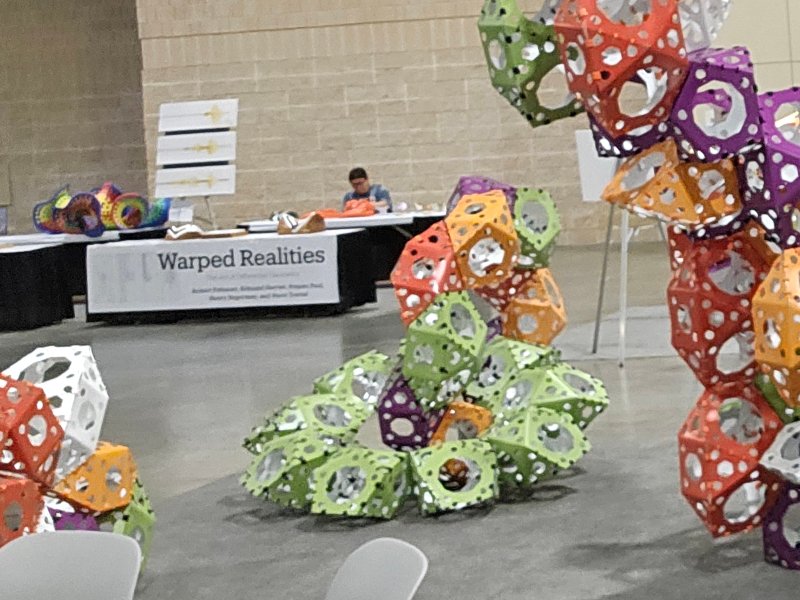
Instead of a set build, like the Diamond Lattice Tower, we instead hosted a free build at the ICM. People were encouraged to take blocks and attach them to one another. We had a number of smaller projects and then a larger project keeping within the structure of the honeycomb lattice above.
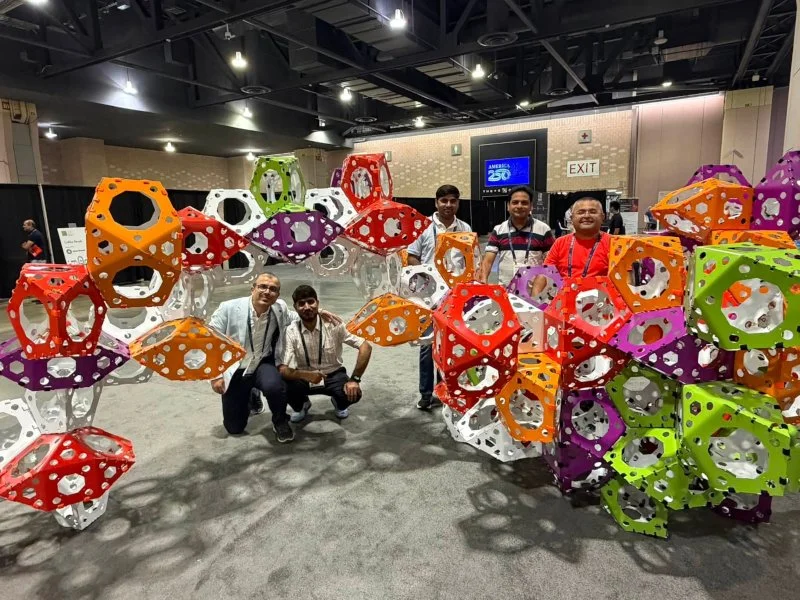
Bilunabirotundas at home or school
If you would like to try playing with bilunabirotundas on your own, I made a 3D-printable toy.
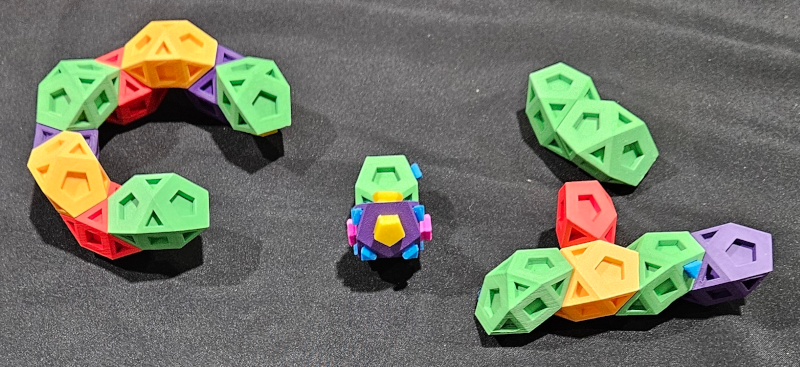
In order to make tighter fits, I used PLA to print the bilunabirotundas and TPU to print the slightly oversized pegs, so don’t attempt this as a purely PLA print. The STL files are here.
If you want a more old-school experience, you can print a paper net from this PDF. Here’s what the model looks like when assembled:
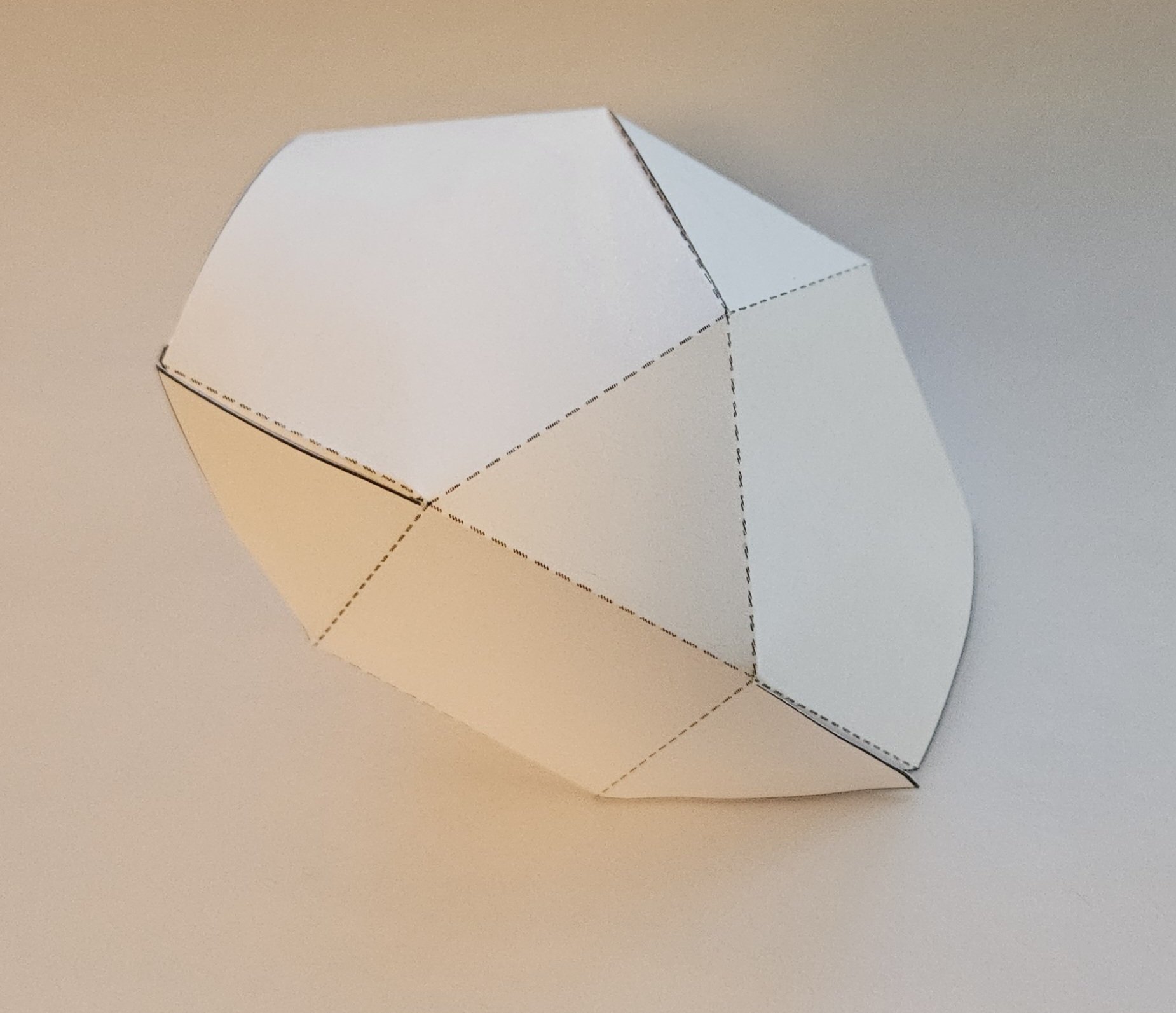
The tab work is a little finicky because of the narrow angles, so if you’re ok with tape on the outside, you can cut the tabs off and just tape faces together along the edges. You can fold the model inside out if you want to hide the dashed lines. For a sturdier model, I’d recommend printing on cardstock. As classroom project, students can each make one, color them with their own designs, and then tape or paste their bilunabirotundas face-to-face to make a larger structure.