
Are there any mathematicians from Texas?

“Are there any mathematicians from Texas?” — Anonymous
Absolutely, there are! Let’s meet a couple Texans who have recently retired after distinguished careers in mathematics.
Thomas Hales
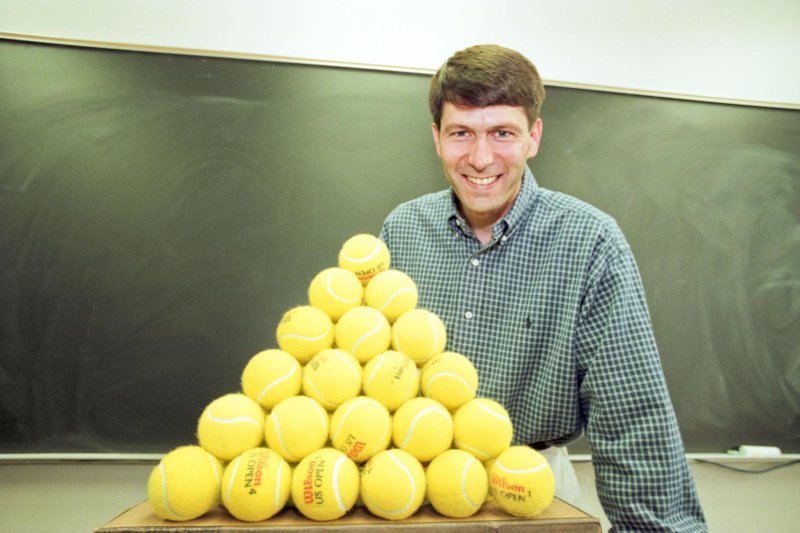
Thomas Hales (Source: University of Michigan Library Digital Collections)
Johannes Kepler wrote in 1611 that he suspected that stacking spheres as in the pyramid above was the most efficient at filling space. Other arrangements that did equally well had been found, but nobody had presented a way to fill more than the roughly 74% of space achieved with face-centered cubic and hexagonal close packing arrangements. The problem became known as the Kepler conjecture.
Kepler’s suspicions were finally confirmed in 1998 by Thomas Hales, a mathematician born in San Antonio. Hales also worked on other packing problems and made contributions to the Langlands program, a deep math research project attempting to pin down mysterious connections between number theory, algebraic geometry, and harmonic analysis. He retired from the University of Pittsburgh in 2025.
To read more on Thomas Hales’ work on packings:
Mary Wheeler
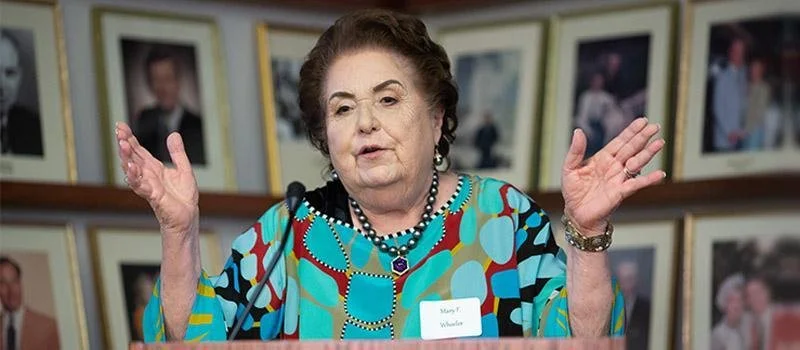
Mary Wheeler (Source: Oden Institute Center for Subsurface Modeling)
Mary Wheeler was born in Cuero, attended school at the University of Texas at Austin, and earned her PhD from Rice University in Houston before going on to hold professorships at both schools, so she’s about as Texan as they come! She also just so happens to be a pioneer in computational mathematics and the finite element method.
When solving real-world problems, we don’t need to be arbitrarily precise — how often have you worried whether the distance you’ve traveled was correct within an inch? When approximating things, the big question is, “How close is close enough?” Wheeler’s work involves finding approximate solutions to problems and justifying why those approximations are close enough to the actual solutions to be usable in real-world applications. The bulk of her 400+ papers focus on subsurface modeling, dealing with issues like ground water contamination, oil and gas extraction, blood vessel formation, cracks and fissures in the Earth’s surface, and more. She retired from UT Austin in 2024.
To read more about Mary Wheeler and her work:
Have you met any mathematicians from Texas? Where else do mathematicians come from?