

Education Zone
Rolling Cones
Suppose you drew a smiley face on the base of a cone and laid it on its side so the smiley face is right-side-up. What would happen if you gently rolled it on the tabletop?
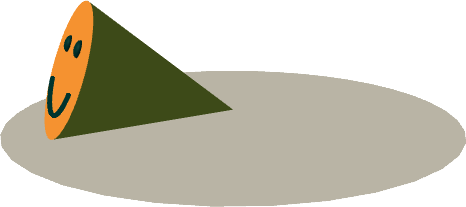
As the cone sweeps out a circle on the surface of the table, the smiley face would rotate like a wheel.
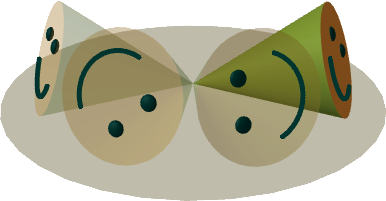
When would we next see the smiley face right-side-up? Would it be when the cone makes one full lap on the table? Before that? After that? Or does it perhaps depend on the cone?
If you want to experiment with this, you can try making a paper cone. The disk below is divided into 12 sectors.
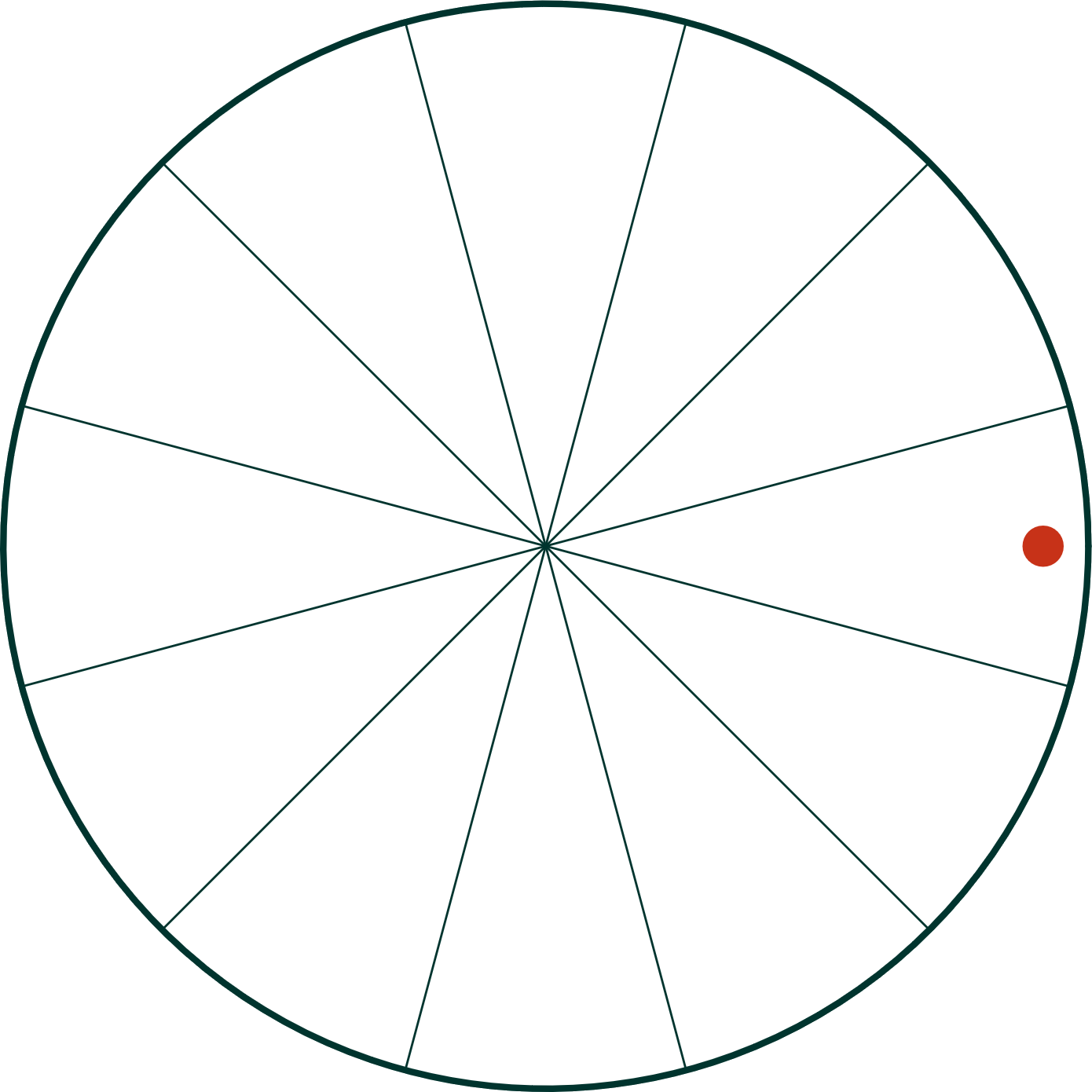
If you cut out the disk and remove a chunk of sectors, you can tape it together to make a cone with 1-11 sectors. For example, here’s how to make a 9-sector cone:
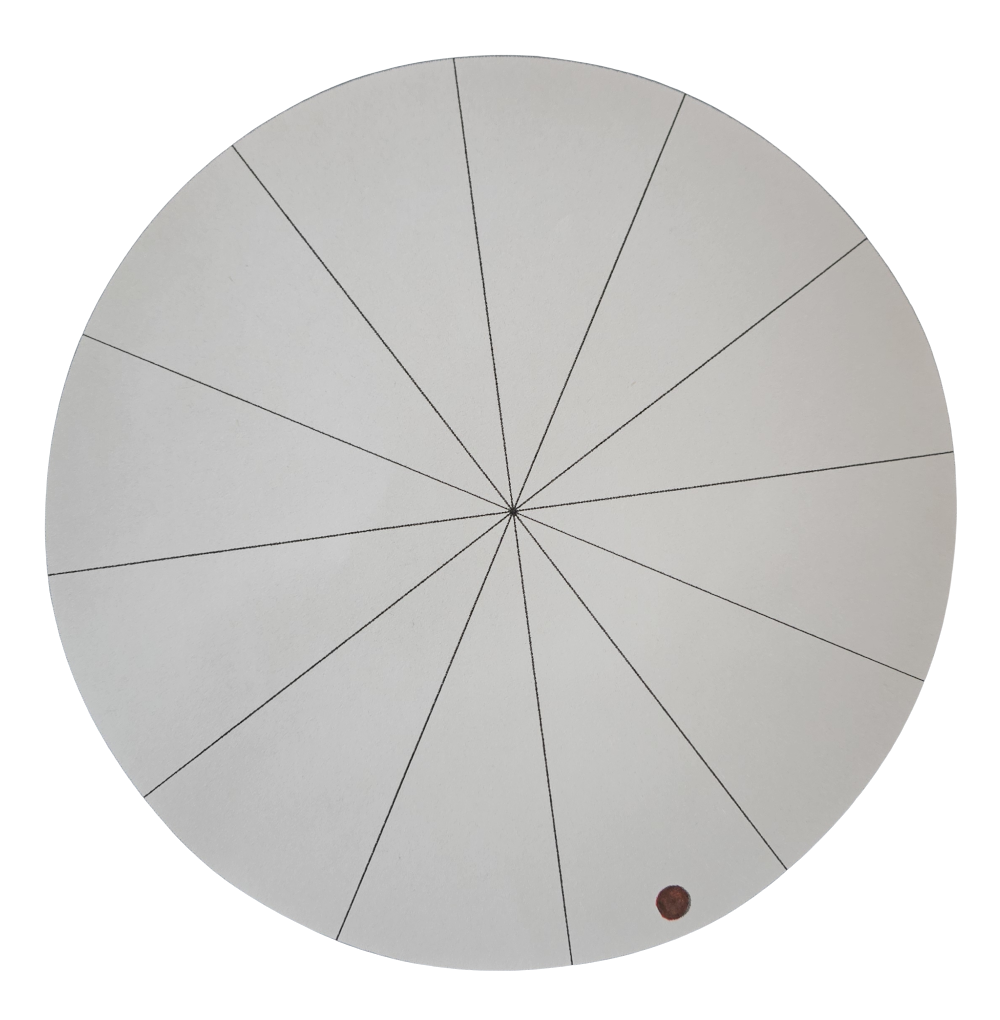
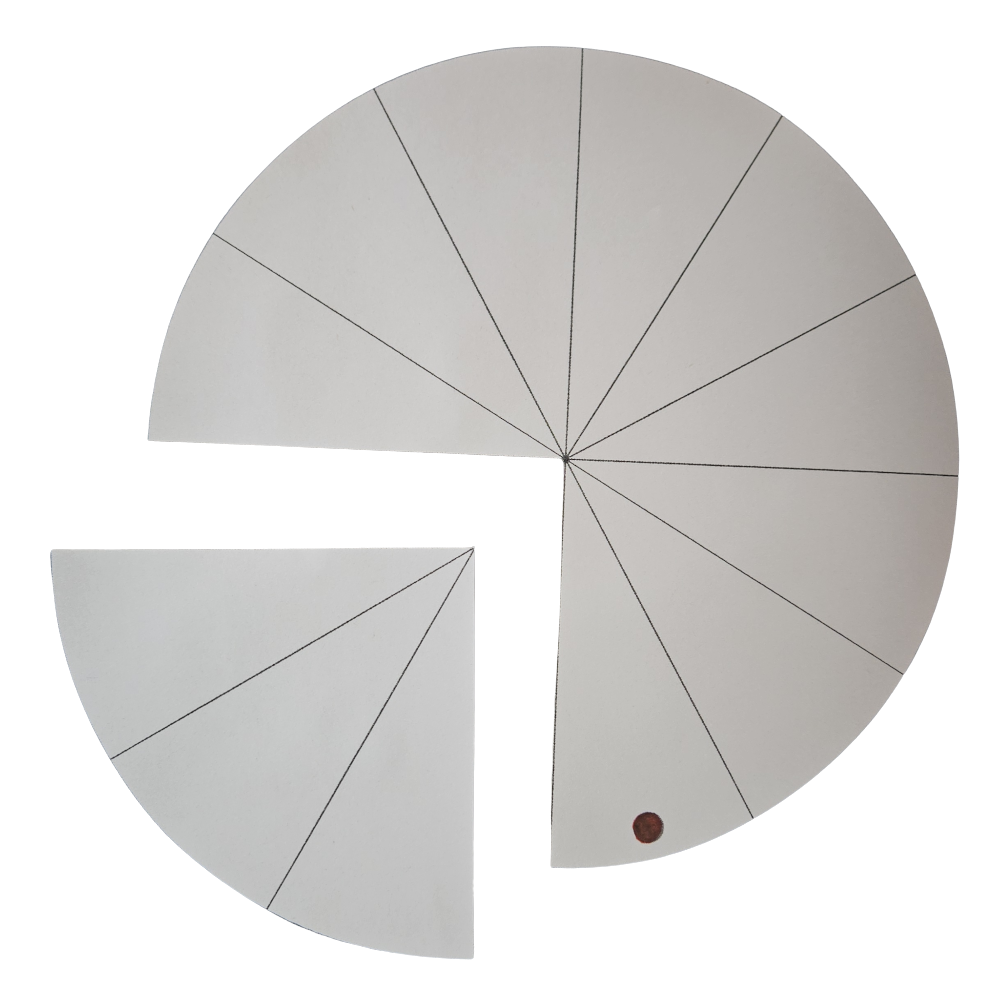
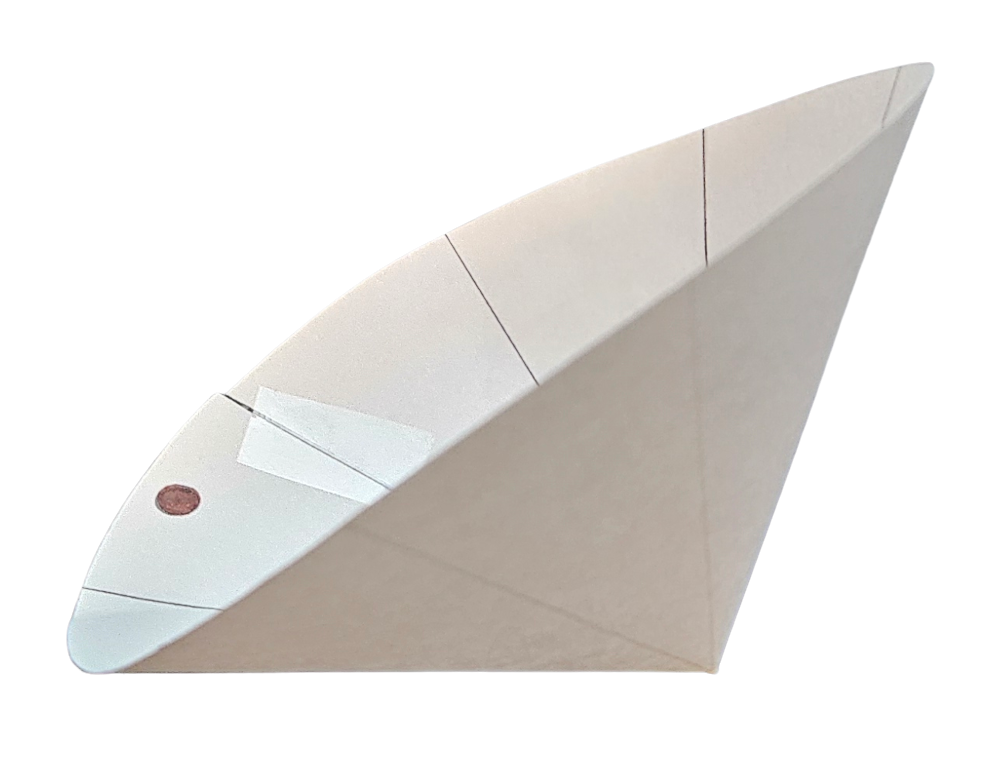
Using the dot touching the table as a proxy for the smiley face being right-side-up, you can test where along the cone’s laps the smiley face uprights itself. Heavier paper like cardstock can be helpful, but if your paper is too light and sensitive to roll, you can use two fingers to “roll” it: one holding down its current contact point with the table, and the second to flatten it out and choose the next contact point.
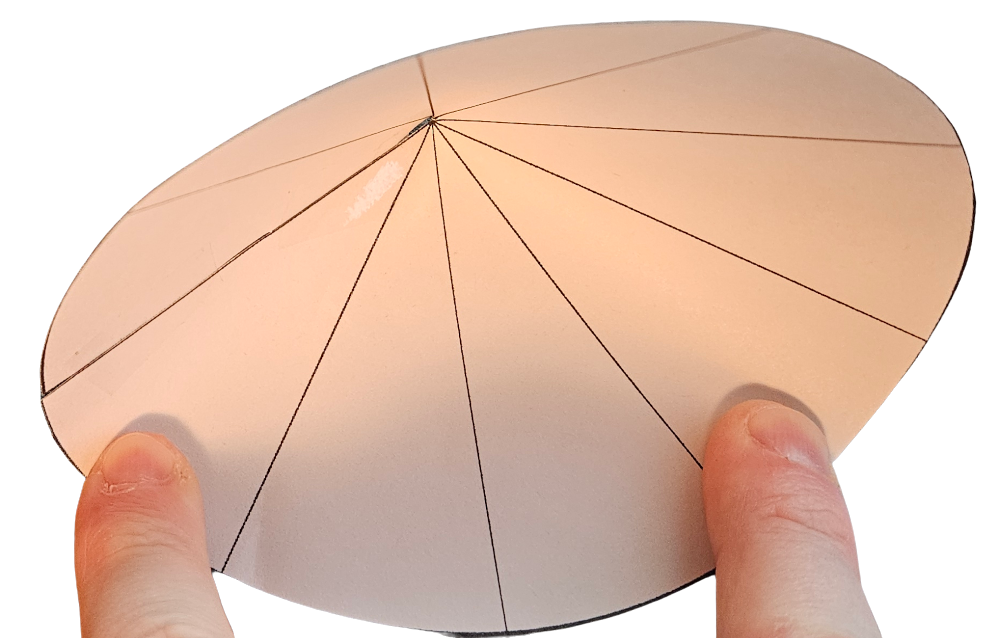
The sectors can be pretty helpful for visualizing what’s happening. For the 9-sector cone, we can think about it doing its laps on the full 12-sector disk. If the dot touches the table in sector 1, the next time we’ll see it touch the table is sector 10. The next time would be sector 10+9 = 19, which is actually sector 19-12 = 7. If we check which sectors the dot touches, we’ll see the repeating sequence
1, 10, 7, 4, 1, 10, 7, 4, …
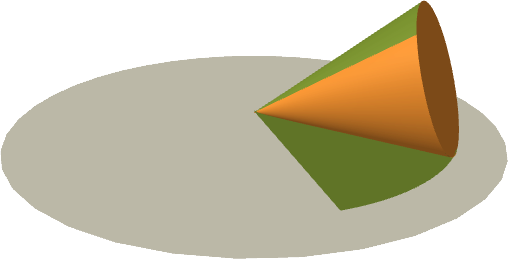
While it makes for nice visualization, choosing 12 sectors is a little arbitrary. As the cone rolls, you can think about the arbitrary sector of its surface that has made contact with the table so far, pictured as though the cone is peeling as it rolls.
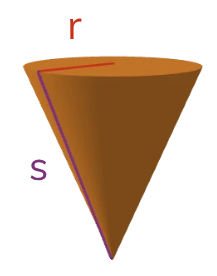
As the cone peels, the distance rolled by the circular wheel with radius r equals the distance it has covered on the circular track with radius s.
These distances are rα and sβ, where α is the angle the wheel has rotated and β is the angle of the sector the cone has covered on the table, both measured in radians.
There are two radii to track:
r, the radius of the circle forming the base of the cone
s, the radius of the circle being swept out on the table
We can find both of these lengths on the cone.
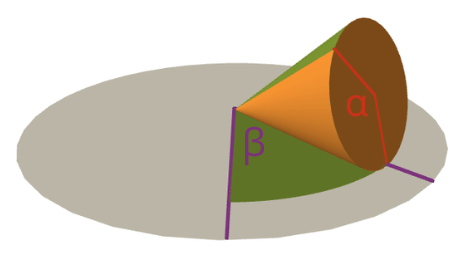
If tracking when the smiley face is right-side-up again for the first time, we’re interested in when α = 2π. If tracking when the cone has first completed a lap and come back to where it started, we’re interested in β = 2π.
Or, perhaps in honor of Tau Day, we’ll use τ = 2π.
Suppose we want to see the smiley face right-side-up for the first time 2/3 of the way through our cone’s first lap. Could we engineer a cone that does this? We would need α = τ when β = 2τ/3. Rearranging rα = sβ, we get
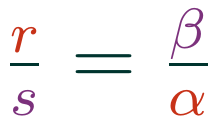
In our example, r/s = (2τ/3)/τ = 2/3, which tells us how to proportion a cone that does the trick! (In terms of our 12 sectors, we’d want to keep exactly 2/3 of them, so 8.)
Whenever α = τ, since division by α effectively strips the units of revolution from β, the ratio r/s conveniently tells us the smiley face will be right-side-up again r/s of the way into the cone’s first lap. So when we see the wheel’s first rotation depends in this way on the proportions of the cone.
Is it possible for the smiley face to be right-side-up for the first time after exactly one lap? That would mean α = τ when β = τ, giving r/s = 1. Since that would mean r = s, we’d need a right triangle with a leg equal to its hypotenuse to design the cone. (Can you see why?) But that’s impossible! What other feats are impossible for our rolling cones?
If you for some reason need mathematical justification for enjoying a Nestle Drumstick this summer:
Before ripping off the packaging, measure both r and s and then give it a roll. If you start with the base-side logo in readable orientation, you should find that the logo next displays upright r/s of the way into the Drumstick’s first lap!
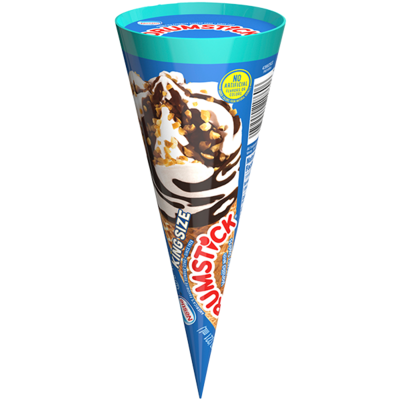
Image: caseys.com