

Education Zone
Bubble Tiles
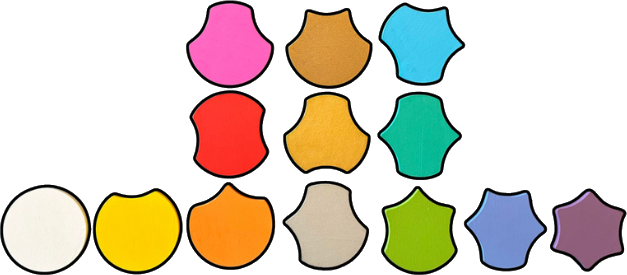
You may have seen them at our events, but our Kent Station location has recently been generously stocked with Bubble Tiles and frames from our friends at MathHappens. There are 13 Bubble Tiles, color-coded by type:
One question I've seen visitors exploring is which of the frames can be filled using only one type of tile. The frame below has been filled using three types of tiles but can also be filled entirely with just one type!
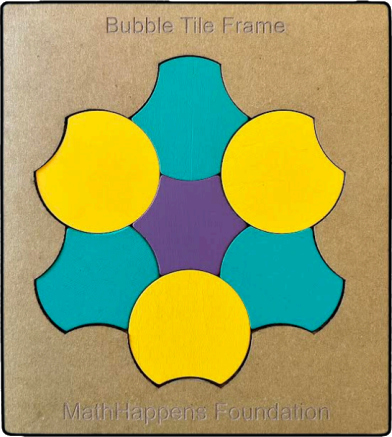
One way to think about a tile is as a circle that has been notched 0-6 times. If we count the notches in the tiles above, we'll find three 1-notchers, three 4-notchers, and one 6-notcher. What's the average number of notches per tile? Could that tell you anything about the number of notches per tile in a single-type tiling?
Though there are many ways to tile the above frame with Bubble Tiles, experimentation will teach you that you always need exactly seven tiles to tile it. This got me wondering: Can two tilings with different numbers of Bubble Tiles end up having the same area?
It turns out that the answer is no! To see why, we first actually need to compute some areas. If you want a challenge, see if you can work out how I've computed the areas below, starting with a circle of radius 1. There are a few ways to get there, but all you really need are the Pythagorean theorem, formulas for the areas of circles and triangles, and a little elbow grease. I'll let the shapes themselves moonlight as the symbols for their areas:
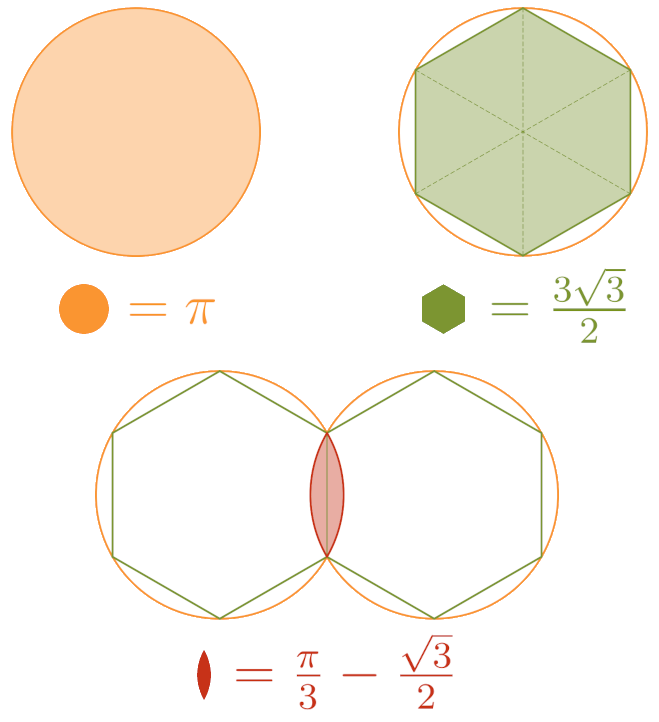
Here is my area question, expressed algebraically: Is it possible to choose positive integers A, B, C, and D with A and C distinct so that the equation below is true?

Each side of the equation represents the area of a tiling. A and C are the numbers of tiles while B and D are the total numbers of notches missing from those tiles.
While the area of our notch is a little strange, here's what stood out to me: √3 is algebraic while π is transcendental. A consequence of this is that π and √3 are not rational multiples of one another, so if we have integers M and N so that

then M = N = 0.
Now suppose we have integers A, B, C, and D satisfying our equation

Then we can rearrange it to get

They're messy, but 6A-6C+2D-2B and 3D-3B are both integers, so must both equal zero by the transcendence of π. From this we can see that B = D and A = C. Thus, having only assumed two Bubble Tilings have the same area, A = C shows they have the same number of tiles and B = D shows that the two tile sets have the same total number of missing notches.
A delightfully π-based proof in the week of Pi Day! Come visit us at Kent Station and experiment with MathHappens' Bubble Tiles. We'd love to hear what you wonder and what you discover!