
Intersections
A Public Art Exhibition

Juliet Fiss
Juliet Fiss is an abstract painter and computer scientist who lives and works in Kirkland, WA. She has a B.S. in Imaging Science from the Rochester Institute of Technology and a Ph.D. in Computer Science & Engineering from the University of Washington. She has worked at local tech companies, including Google and Microsoft Research, and is an NVIDIA Graduate Research Fellow.
Juliet’s paintings are colorful visualizations of mathematics and computer science algorithms, inspired by her interests in computer vision, signal processing, quantum computing, and the colorful patterns of birds and nature. Her work is included in the collections of Seattle University Sinegal Center for Science and Innovation and the Chester F. Carlson Center for Imaging Science at Rochester Institute of Technology.
Artwork
Sieve Ἐρατοσθένους 900
Acrylic on canvas
30” x 30”
$1,999
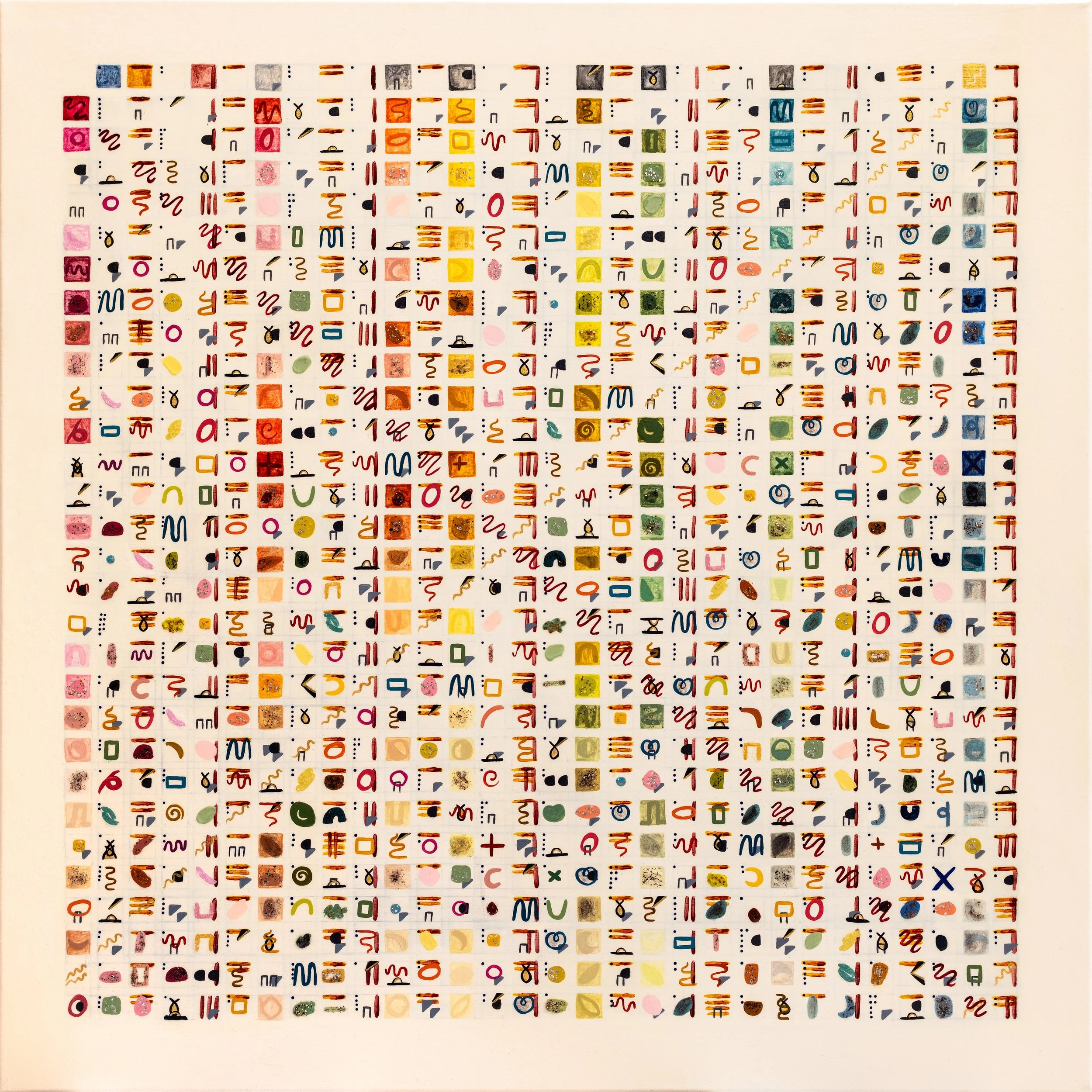
This painting is a mathematical visualization of the prime factorization of the integers in base 30.
Each square cell represents one number. The first row contains the numbers 1-30, the second row contains 31-60, and so on (900 numbers total). The filled-in squares are prime numbers, and their colors and symbols are used to represent that prime number where it appears as a prime factor.
Composite numbers are represented as combinations of colors and symbols of their prime factors. For example, 2 is a dark dot, 3 is a gold horizontal line, and 5 is a red vertical line. 30 (in the upper right corner) is 2 times 3 times 5, so those three symbols appear in the cell.
Patterns and symmetries in the prime numbers can be seen in the structure of the painting. All prime numbers greater than 5 appear in columns (numbers that are not multiples of 2, 3, or 5). Multiples of 29 (wavy gold line) and 31 (wavy red line) form strong diagonals. All prime factors appear at rhythmic intervals, and the entire painting is a polymeter of these rhythms that crisscross the grid.
(Note: Named for the “sieve of Eratosthenes,” an ancient algorithm for finding all prime numbers up to any given limit.)
“
„
Prime Factorization of the First 1200 Integers
Acrylic on canvas
40” x 30”
$2,477
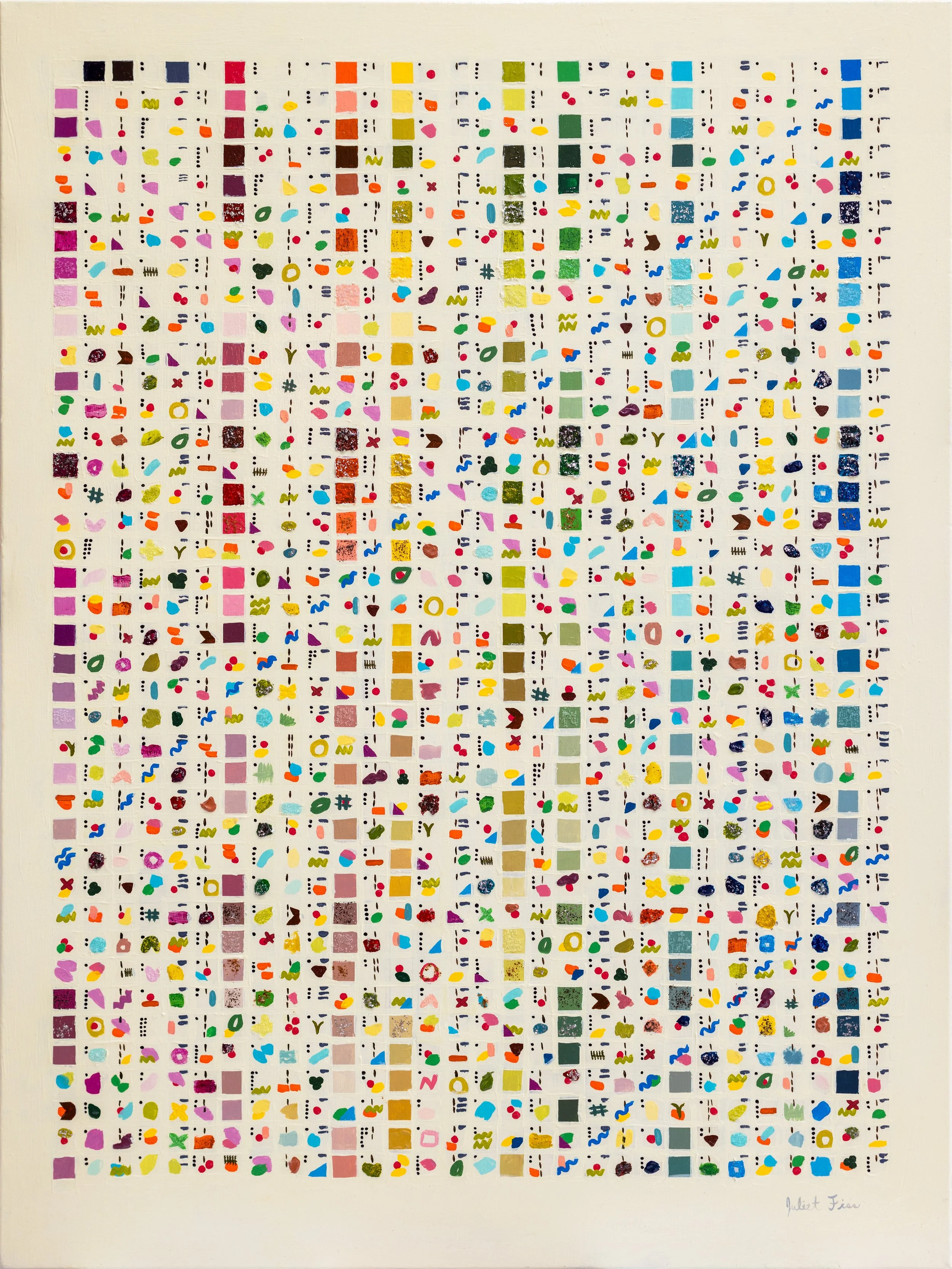
This work is a mathematical visualization of the prime factorization of the first 1200 integers.
The numbers are arranged in a grid that reads from left to right, top to bottom. The first row contains the numbers 1-30. The next row contains the numbers 31-60, and so on. Prime numbers are represented by solid squares, each filled with a unique combination of color and texture. Composite numbers are represented by a combination of colors and symbols of their prime factors.
The first prime number, 2, is represented by the color dark grey. Multiples of 2 contain a small dark grey dot. For example, the number 4 contains two small grey dots, because 4=2x2.
The next prime number, 3, is dark brown. Multiples of 3 contain a small dark brown vertical dash. For example, the number 6 contains both a dot and a vertical dash, because 6=2x3.
The next prime number, 5, is grey. The prime number 7 is red, 11 is orange, 13 is yellow, and so on.
Many patterns and symmetries can be discovered in this visualization. Multiples of 2, 3, and 5 are found along vertical lines. Prime numbers greater than 5 can be found along vertical lines that create a striking symmetry. Multiples of other prime numbers fall along diagonal lines. For example, multiples of 29 and multiples of 31 create a diamond pattern that criss-crosses the grid.
“
„
Paint with Prime Numbers 1-100
Acrylic on canvas
12" x 12”
$101
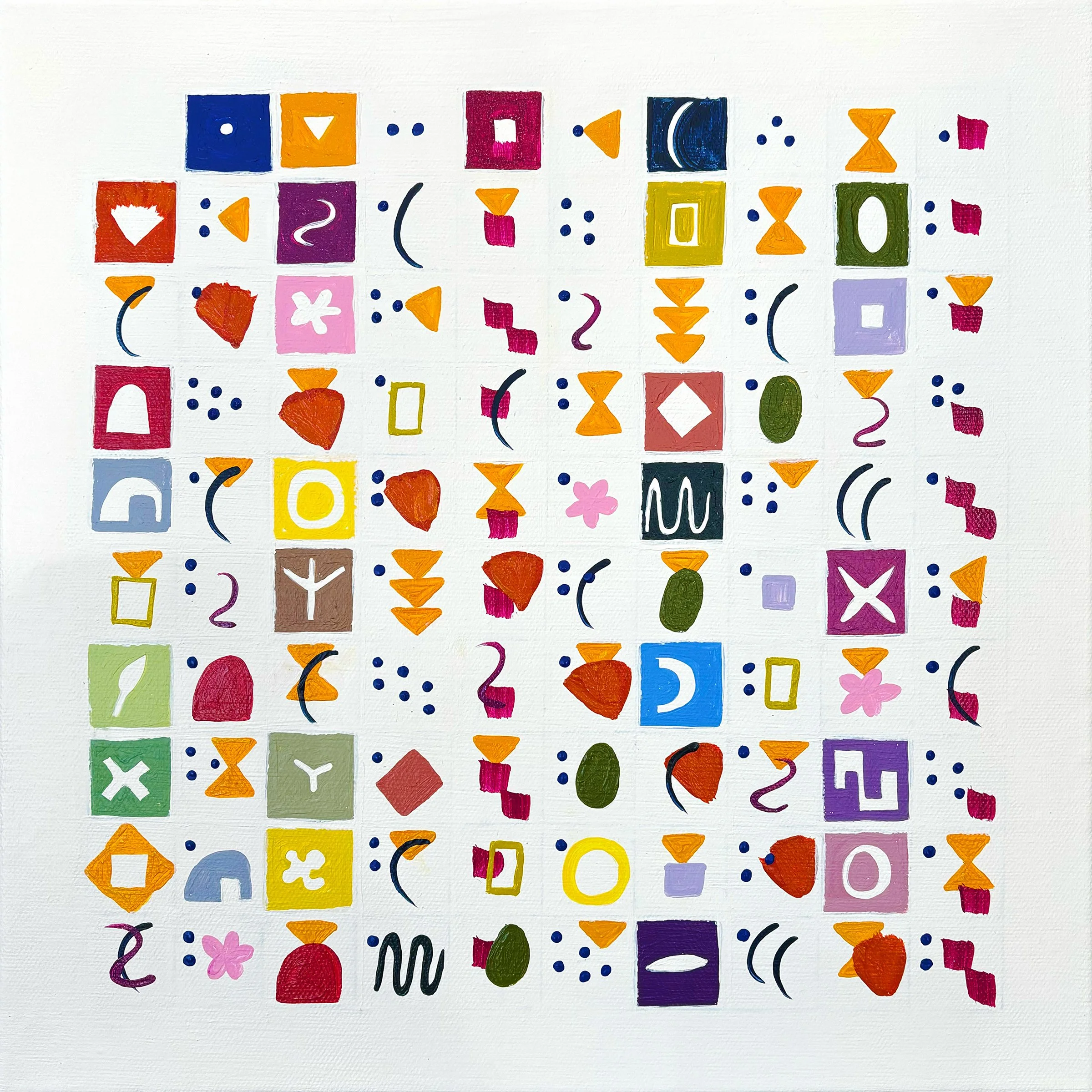
This painting is a visualization of the prime factorization of the integers from 1-100. The squares represent the numbers 1-100, with the first row being 1-10. Each symbol represents one prime number. For example, 2 is a blue dot, and 3 is a yellow triangle. Composite numbers are represented by a combination of symbols of their prime factors. For example, 4 is two blue dots. 6 is a blue dot and a yellow triangle. The painting can be used to visualize patterns, for example, all of the multiples of 11 falling along a diagonal. The painting was created for an educational video about how to create this type of artwork (see URL). 4th-6th graders in Rochester, MN, used this activity to create prime numbers artwork to hang in their school.
Please view this Demo Video URL where I demonstrate my painting process.