
Intersections
A Public Art Exhibition

Chi Essary
Chi Essary is an artist and independent arts curator dedicated to fostering dialogue between art, science, and modern spirituality. She studied printmaking and photography at the Pacific Northwest College of Art in Portland, Oregon, and began oil painting after moving to San Diego in 2001. Her current painting practice examines the tension between secular society and modern spiritual longing. Since 2017, she has curated numerous cross-disciplinary exhibitions, pairing authors and world-class scientists with artists to encourage cultural exchange.
A board member of Vanguard Culture for over 10 years, Essary has been an advocate for expanding the role of art in cultural discourse. She led the San Diego Art Prize for three years, streamlining its structure and bringing in jurors from major art hubs such as New York, and Mexico City.
Alongside her curatorial endeavors, Essary chronicles San Diego’s vibrant arts community through her blog Poetic License, where she provides a behind-the-scenes peek into artists' studios via thoughtful interviews and compelling studio portraits.
In her dual role as artist and curator, Essary explores the boundaries between the sacred and the profane, using creative practice as a means of deeper inquiry into modern meaning-making.
Satyan Devadoss
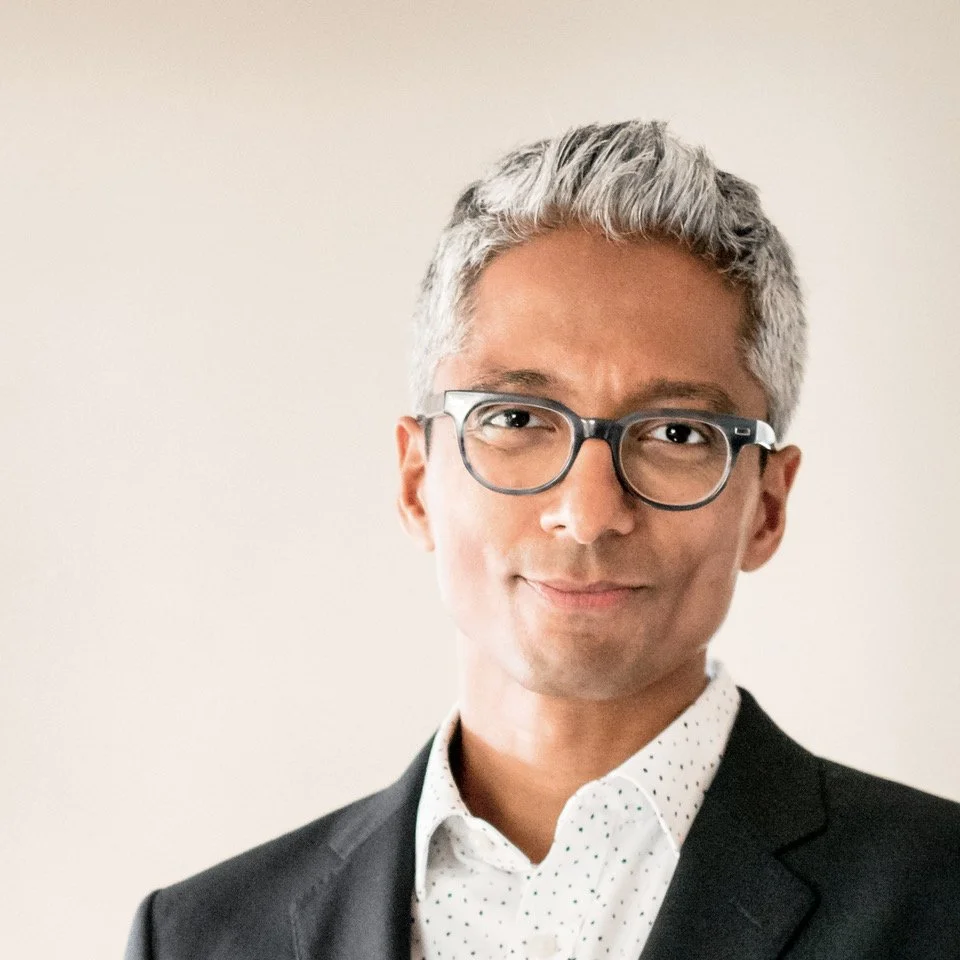
Satyan is currently the Fletcher Jones Professor of Applied Mathematics and Professor of Computer Science at the University of San Diego. Before coming to California, he was faculty at Williams for nearly 15 years, along with visiting positions at UC Berkeley, UC San Diego, Ohio State, Université Nice, Harvey Mudd, MSRI, and Stanford.
A fellow of the American Mathematical Society and recipient of two national teaching awards, his research focuses on shape and structure, including origami geometry, computational cartography, foldable architecture, sonnet linguistics, and beer genetics. Underneath this framework lies a strong desire for physical creations, for they point to the larger belief that mathematics should be made incarnate and tangible, for the physical world matters.
Satyan has recently joined SUMM’s Advisory Board.
Artwork
Boundary Line #5 (detail from Retable des Dominicains by Martin Schongauer c. 1480)
Oil paint on sewn linen, saw dust, second-hand serving platter
19.75” x 9.75” x 5”
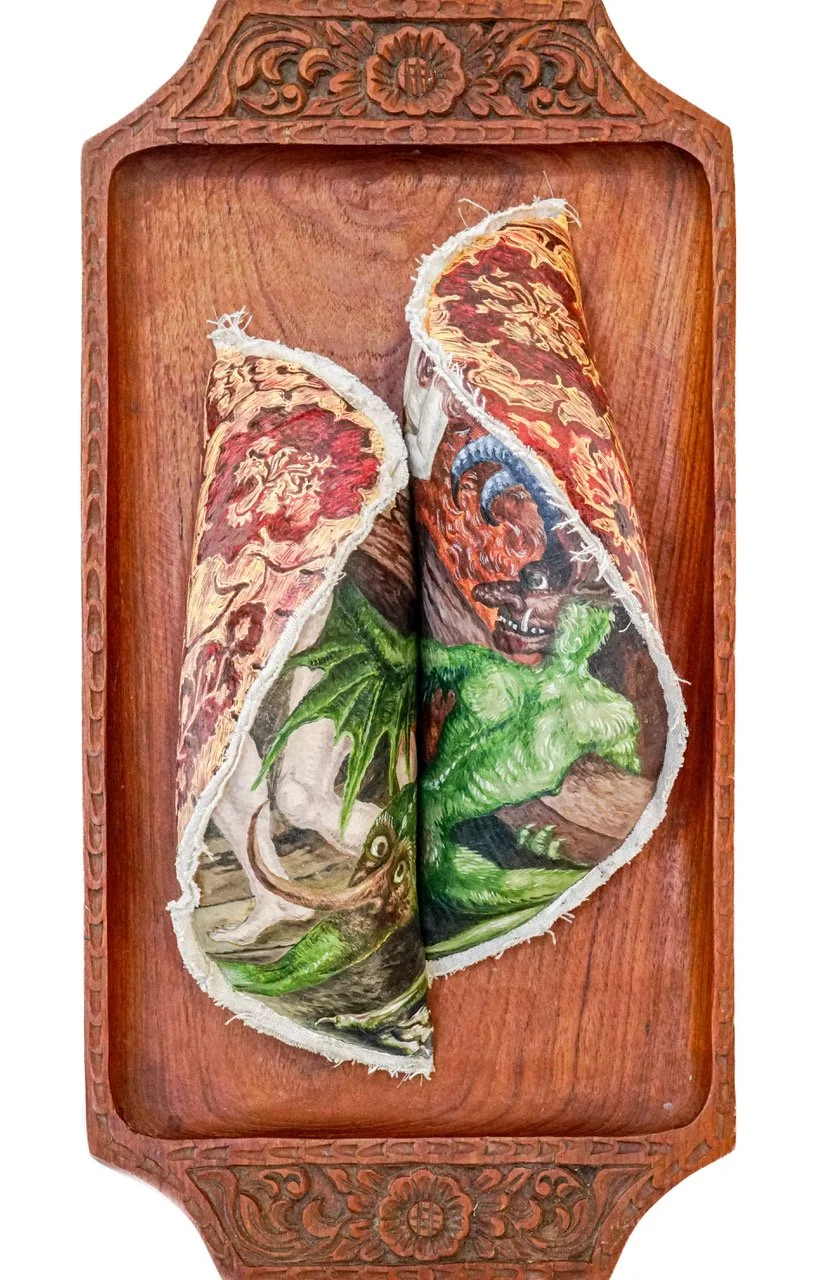
Inspired by the mystery of mathematics presented by Alexander Alexandrov (1950s) and his gluing theories, this work pulls together several echoes heard today: the malaise and disillusionment of modernity; the texture of fabric and thread in the resurgent women’s craft movement; and the deeper significance of secularity reflected by Julian Barnes: “I don’t believe in God, but I miss him.”
Alexandrov starts with a convex 2D region with boundary and then attaches two points on this boundary together. This forces one-half the boundary to glue to the other half, in essence halving the perimeter. He then proves that the resulting 3D convex shape is unique, based solely on original choice of the two attached points. The geometry of the space curve resulting from sewing the boundary remains unknown today.
This artwork uses Alexandrov’s methods to connect an oval in different points to produce the mirroring and mysterious seam curves seen in the piece. The material is analogous to the reconstruction of the fabric of our post-modern world, where the cultural norms that once held community together (from eating, to sewing, to attending houses of worship) have been refashioned with varying outcomes. The secularization of society is represented with details from a Renaissance religious painting with the icons and power structures avoided. Only the patterns from holy robes decorate the outer boundary, and a supporting character is the focus, leaving the moral and the meaning out of context. We are left to our own devices, a malady of the modern world.